QUEENS CHRONICLE, Thursday, November 16, 2017 Page 20
C M ANN page 20 Y K
IN THE ARENA
Queens’ rich collection of sports venues by Ryan Brady Citi Field. Arthur Ashe Stadium. The Kissena Park Velodrome. Throughout this borough are sports venues: arenas where some of the world’s best athletes face off, neighborhood spots where Little Leaguers compete and everything in between. Queens’ love of sports is a major part of its landscape. With a capacity of 41,800, Citi Field is far and away Queens’ largest stadium. Built in 2009, the venue has hosted three games of the 2015 World Series, including the final one in which the Kansas City Royals took the championship. One of its most notable features is the Jackie Robinson Rotunda, a double-stairway used to enter the venue that honors the first black MLB player. While the overall look of the stadium was praised, many considered its dimensions in the first few years to be problematic. The Amazin’s organization altered the outfield fences in 2011 and 2014 to make the stadium better for home runs. Professional soccer teams have also competed at the venue. The Mets preserved two important parts of Shea even after its demolition: in the Citi Field parking lot, one can see a sign in the pavement marking where Shea Stadium used to be. The old venue’s Home Run Apple can also be seen in the lot, as can a bronze marker showing where home plate used to be. Shea — which the Mets moved into in 1964, having played at the Polo Grounds in Manhattan during their first two years — also hosted the New York Jets during football season from 1964 to 1983. The Beatles also played a famous 1965 concert there. Before the Amazin’s set up shop at Shea, no other MLB team had called Queens home. “In terms of the Mets, we have a team to root for that’s based in [Queens],” Borough Historian Jack Eichenbaum told the Chronicle. The baseball team shares Flushing Meadows Corona Park with the United States Tennis Association. Since 1978, huge crowds have hit the Billie Jean King National Tennis Center each summer to see the most elite players in the world face off in the US Open. Before it was there, the West Side Tennis Club had hosted the tournament at Forest Hills Stadium, which today is a popular concert venue. The first year it did so was 1915. Six years later, the contest would move to Philadelphia, where it would stay until 1924; then, Forest Hills would host the competition until it moved to Flushing. Arthur Ashe Stadium, the largest tennisonly arena in the world, is the main venue. Last year, a new retractable roof was unveiled there.
Although it’s undergoing construction now, the other big arena at the National Tennis Center — the new Louis Armstrong Stadium — will be open in time for the US Open next year, a USTA spokesman told the Chronicle. The old one is a remodeled version of the Singer Bowl, which hosted trials for the 1964 Olympics in wrestling, judo and boxing according to The New York Times. Although they’re much more modest than either of the USTA venues, the tennis courts at the Douglaston Club are historically important. Two professional tennis stars — John McEnroe and Mary Carillo, who grew up in the neighborhood — used to play there. More stadiums may come to the Flushing area: Borough President Melinda Katz said earlier this year that she would like to one for soccer in Willets Point, along with a hockey arena. In terms of the sports that Flusing Meadows hosts, it doesn’t end at pro baseball and tennis. The green space is also the home of the New York Road Runners’ annual Queens 10K. The race runs around Meadow Lake and ends by the Fountain of the Planets. One of Queens’ most famous sports institutions is in its southern part. Having opened in 1894, Aqueduct Race Track in South Ozone Park is the only venue for its sport in New York City. (Belmont Park is just over the border in Nassau County.) In 1944, the first triple dead heat — a three-way tie — for a stakes game happened at Aqueduct during the Carter Handicap. The first two contests in famous horse Cigar’s 16-race winning streak also took place there. You can get a great look at Manhattan’s skyline at the Metropolitan Oval in Maspeth. A United States Soccer Federation youth academy plays at the field, which was founded by immigrants in the 1920s. Farther north in Queens sits another one of the borough’s most notable sports venues. Kids play baseball, roller hockey and soccer at the College Point Fields. And the Parks Department is expected to finish constructing a football field at the location next November. One of the best-known places for soccer in Queens is Belson Stadium at St. John’s University. The Red Storm women’s and men’s teams play there. It’s also the home field of the Euro Youth Football Association, a team in the Premier Development League. The school’s sprawling campus also has the borough’s largest indoor sports venue: Carnesecca Arena. Smaller only than Madison Square Garden and the Barclays Center, it’s the third biggest in the entire city. And it’s the main place where the school’s men’s and women’s basketball teams play. MSG hosts games between SJU and other Big
BORO OF
39TH ANNIVERSARY EDITION • 2017
SPORTS
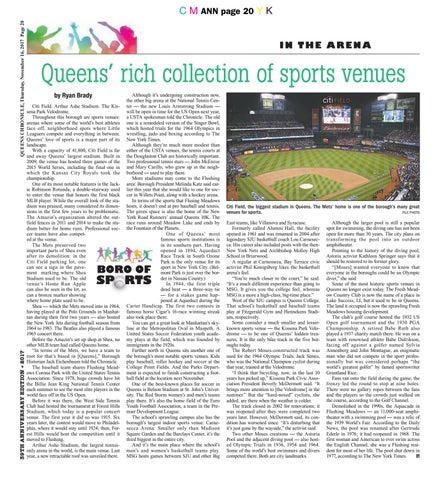
Citi Field, the biggest stadium in Queens. The Mets’ home is one of the borough’s many great FILE PHOTO venues for sports. East teams, like Villanova and Syracuse. Formerly called Alumni Hall, the facility opened in 1961 and was renamed in 2004 after legendary SJU basketball coach Lou Carnesecca. His career also included posts with the thenNew York Nets and Archbishop Molloy High School in Briarwood. A regular at Carnesseca, Bay Terrace civic activist Phil Konigsberg likes the basketball arena’s feel. “You’re much closer to the court,” he said. “It’s a much different experience than going to MSG. It gives you the college feel, whereas MSG is a more a high-class, big-time place.” West of the SJU campus is Queens College. That school’s basketball and baseball teams play at Fitzgerald Gym and Hennekens Stadium, respectively. Some consider a much smaller and lesserknown sports venue — the Kissena Park Velodrome — to be one of Queens’ hidden treasures. It is the only bike track in the five boroughs today. The Robert Moses-constructed track was used for the 1964 Olympic Trials. Jack Simes, who was the National Champion cyclist during that year, trained at the Velodrome. “I think that bicycling, now, in the last 10 years has picked up,” Kissena Park Civic Association President Beverly McDermott said. “It brings more attention to [the Velodrome] in the summer.” But the “hard-nosed” cyclists, she added, are there when the weather is colder. The track closed in 2002 for renovations; it was reopened after they were completed two years later. However, McDermott said, its condition has worsened since. “It’s disturbing that it’s just gone by the wayside,” the activist said. Two other Moses creations — the Astoria Pool and the adjacent diving pool — also hosted Olympic Trials in 1936, 1954 and 1964. Some of the world’s best swimmers and divers competed there. Both are city landmarks.
Although the larger pool is still a popular spot for swimming, the diving one has not been open for more than 30 years. The city plans on transforming the pool into an outdoor amphitheater. Pointing to the history of the diving pool, Astoria activist Kathleen Springer says that it should be restored to its former glory. “[Moses] wanted everyone to know that everyone in the boroughs could be an Olympic diver,” she said. Some of the most historic sports venues in Queens no longer exist today. The Fresh Meadow Country Club is now the name of a place in Lake Success, LI, but it used to be in Queens. The land it occupied is now the sprawling Fresh Meadows housing development. The club’s golf course hosted the 1932 US Open golf tournament and the 1930 PGA Championship. A retired Babe Ruth also played a 1937 charity match there. He was on a team with renowned athlete Babe Didrikson, facing off against a golfer named Sylvia Annenberg and John Montague, an enigmatic man who did not compete in the sport professionally but was considered perhaps “the world’s greatest golfer” by famed sportswriter Grantland Rice. Fans ran onto the field during the game; the frenzy led the round to stop at nine holes. There were no gallery ropes between the fans and the players so the crowds just walked on the course, according to the Golf Channel. Demolished in the 1990s, the Aquacade in Flushing Meadows — an 11,000-seat amphitheater with a swimming pool — was a relic of the 1939 World’s Fair. According to the Daily News, the pool was renamed after Gertrude Ederle in 1976; it had reopened in 1968. The first woman and American to ever swim across the English Channel, she was a Flushing resident for most of her life. The pool shut down in Q 1977, according to The New York Times.