FOTO: COLECCIÓN J. MEDINA
campana de ORO
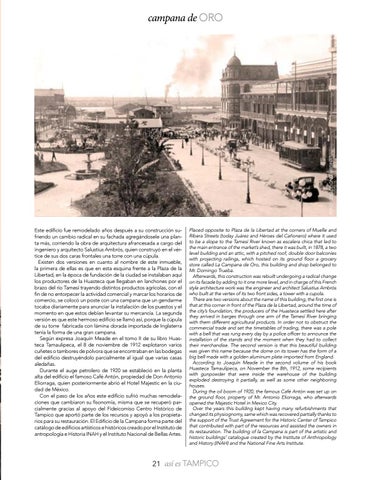
Este edificio fue remodelado años después a su construcción sufriendo un cambio radical en su fachada agregándosele una planta más, corriendo la obra de arquitectura afrancesada a cargo del ingeniero y arquitecto Salustius Ambrós, quien construyó en el vértice de sus dos caras frontales una torre con una cúpula. Existen dos versiones en cuanto al nombre de este inmueble, la primera de ellas es que en esta esquina frente a la Plaza de la Libertad, en la época de fundación de la ciudad se instalaban aquí los productores de la Huasteca que llegaban en lanchones por el brazo del río Tamesí trayendo distintos productos agrícolas, con el fin de no entorpecer la actividad comercial y marcar los horarios de comercio, se colocó un poste con una campana que un gendarme tocaba diariamente para anunciar la instalación de los puestos y el momento en que estos debían levantar su mercancía. La segunda versión es que este hermoso edificio se llamó así, porque la cúpula de su torre fabricada con lámina dorada importada de Inglaterra tenía la forma de una gran campana. Según expresa Joaquín Meade en el tomo II de su libro Huasteca Tamaulipeca, el 8 de noviembre de 1912 explotaron varios cuñetes o tambores de pólvora que se encontraban en las bodegas del edificio destruyéndolo parcialmente al igual que varias casas aledañas. Durante el auge petrolero de 1920 se estableció en la planta alta del edificio el famoso Café Antón, propiedad de Don Antonio Eliorraga, quien posteriormente abrió el Hotel Majestic en la ciudad de México. Con el paso de los años este edificio sufrió muchas remodelaciones que cambiaron su fisonomía, misma que se recuperó parcialmente gracias al apoyo del Fideicomiso Centro Histórico de Tampico que aportó parte de los recursos y apoyó a los propietarios para su restauración. El Edificio de la Campana forma parte del catálogo de edificios artísticos e históricos creado por el Instituto de antropología e Historia INAH y el Instituto Nacional de Bellas Artes.
Placed opposite to Plaza de la Libertad at the corners of Muelle and Ribera Streets (today Juárez and Héroes del Cañonero) where it used to be a slope to the Tamesí River known as escalera chica that led to the main entrance of the market’s shed, there it was built, in 1878, a two level building and an attic, with a pitched roof, double door balconies with projecting railings, which hosted on its ground floor a grocery store called La Campana de Oro, this building and shop belonged to Mr. Domingo Trueba. Afterwards, this construction was rebuilt undergoing a radical change on its facade by adding to it one more level, and in charge of this French style architecture work was the engineer and architect Salustius Ambrós who built at the vertex of its two front sides, a tower with a cupola. There are two versions about the name of this building, the first one is that at this corner in front of the Plaza de la Libertad, around the time of the city’s foundation, the producers of the Huasteca settled here after they arrived in barges through one arm of the Tamesí River bringing with them different agricultural products. In order not to obstruct the commercial trade and set the timetables of trading, there was a pole with a bell that was rung every day by a police officer to announce the installation of the stands and the moment when they had to collect their merchandise. The second version is that this beautiful building was given this name because the dome on its tower has the form of a big bell made with a golden aluminum plate imported from England. According to Joaquín Meade in the second volume of his book Huasteca Tamaulipeca, on November the 8th, 1912, some recipients with gunpowder that were inside the warehouse of the building exploded destroying it partially, as well as some other neighboring houses. During the oil boom of 1920, the famous Café Antón was set up on the ground floor, property of Mr. Antonio Eliorraga, who afterwards opened the Majestic Hotel in Mexico City. Over the years this building kept having many refurbishments that changed its physiognomy, same which was recovered partially thanks to the support of the Trust Agreement for the Historic Center of Tampico that contributed with part of the resources and assisted the owners in its restauration. The building of la Campana is part of the artistic and historic buildings’ catalogue created by the Institute of Anthropology and History (INAH) and the National Fine Arts Institute.
21 así es tampico