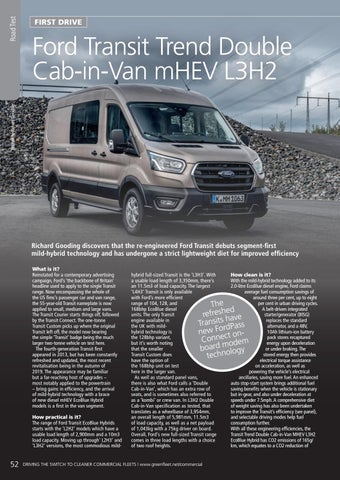
Ford Transit Trend Double Cab-in-Van mHEV L3H2
Written by Richard Gooding
Road Test
FIRST DRIVE
Richard Gooding discovers that the re-engineered Ford Transit debuts segment-first mild-hybrid technology and has undergone a strict lightweight diet for improved efficiency What is it? Reinstated for a contemporary advertising campaign, Ford’s ‘the backbone of Britain’ headline used to apply to the single Transit range. Now encompassing the whole of the US fims’s passenger car and van range, the 55-year-old Transit nameplate is now applied to small, medium and large vans. The Transit Courier starts things off, followed by the Transit Connect. The one-tonne Transit Custom picks up where the original Transit left off, the model now bearing the simple ‘Transit’ badge being the much larger two-tonne vehicle on test here. The fourth-generation Transit first appeared in 2013, but has been constantly refreshed and updated, the most recent revitalisation being in the autumn of 2019. The appearance may be familiar but a far-reaching host of upgrades – most notably applied to the powertrain – bring gains in efficiency, and the arrival of mild-hybrid technology with a brace of new diesel mHEV EcoBlue Hybrid models is a first in the van segment. How practical is it? The range of Ford Transit EcoBlue Hybrids starts with the ‘L2H2’ models which have a usable load length of 2,900mm and a 10m3 load capacity. Moving up through’ L2H3’ and ‘L3H2’ versions, the most commodious mild-
52
hybrid full-sized Transit is the ‘L3H3’. With a usable load length of 3,350mm, there’s an 11.5m3 of load capacity. The largest ‘L4H3’ Transit is only available with Ford’s more efficient range of 104, 128, and 168bhp EcoBlue diesel units. The only Transit engine available in the UK with mildhybrid technology is the 128bhp variant, but it’s worth noting that the smaller Transit Custom does have the option of the 168bhp unit on test here in the larger van. As well as standard panel vans, there is also what Ford calls a ‘Double Cab-in-Van’, which has an extra row of seats, and is sometimes also referred to as a ‘kombi’ or crew van. In L3H2 Double Cab-in-Van specification as tested, that translates as a wheelbase of 3,954mm, an overall length of 5,981mm, 11.5m3 of load capacity, as well as a net payload of 1,043kg with a 75kg driver on board. Overall, Ford’s new full-sized Transit range comes in three load lengths with a choice of two roof heights.
How clean is it? With the mild-hybrid technology added to its 2.0-litre EcoBlue diesel engine, Ford claims average fuel consumption savings of around three per cent, up to eight per cent in urban driving cycles. A belt-driven integrated starter/generator (BISG) replaces the standard alternator, and a 48V, 10Ah lithium-ion battery pack stores recaptured energy upon deceleration or under braking. The stored energy then provides electrical torque assistance on acceleration, as well as powering the vehicle’s electrical ancillaries, saving more fuel. An enhanced auto stop-start system brings additional fuel saving benefits when the vehicle is stationary but in-gear, and also under deceleration at speeds under 7.5mph. A comprehensive diet of weight saving has also been undertaken to improve the Transit’s efficiency (see panel), and selectable driving modes help fuel consumption further. With all these engineering efficiencies, the Transit Trend Double Cab-in-Van MHEV L3H2 EcoBlue Hybrid has CO2 emissions of 165g/ km, which equates to a CO2 reduction of
The d refresheave h TransitsrdPass new Fo ct onConne odem board mology techn
DRIVING THE SWITCH TO CLEANER COMMERCIAL FLEETS | www.greenfleet.net/commercial