COUNCIL TAX
One per cent in council tax will not stop pressure The County Councils Network (CCN) has warned that new freedoms to raise an additional one per cent in council tax will only raise one tenth of the amount being cut from their budgets. Councils will be able to add a further one per cent to council tax to offset continuing reductions in core government funding. However, county leaders say that this will raise just £105 million compared to the £1 billion reduction in budgets by 2020 for the 37 county councils in the country – threatening local services and leading county leaders to make ‘unpalatable’ decisions. While the majority of county councils are likely to add on the extra one per cent, they are reluctant to do so and argue it will further entrench funding and council tax inequalities across rural shire counties. Instead, they suggest that there should be an extension of ‘transitional funding’ for the next two years to help prevent the widespread closure of frontline services and non-statutory services. Paul Carter, chairman of the CCN, said: “Residents in rural counties will be asking why they are paying so much more in council tax
than anyone else but receiving so much less. Two years ago we faced a similar situation, and the government listened to our concerns and introduced transitional grants. I hope ministers in Whitehall see sense and provide Sajid Javid with the resources he needs to extend this help and prevent unfair cuts and council tax rises in our county heartlands.” Meanwhile, the District Councils’ Network (DCN) has urged for changes to the ‘unfair’ system governing council tax increases which are curbing their key role in operating prevention services.
Government ‘shifting the burden’ of cuts to struggling families The Labour party has accused the government of ‘attempting to shift the burden’ of local government cuts onto struggling families. Responding to warnings of council tax rises, Andrew Gwynne, Shadow Secretary of State for Communities and Local Government, said that council finances were at breaking point and would not be stabilised by the minimal settlements and policy tools currently being offered by the Ministry of Housing, Communities and Local Government. Gwynne said: “Almost eight years of cuts have devastated our local government services, and instead of providing new money, central government is attempting to shift the burden onto struggling families. The government must provide genuinely new money to fund our public services. Labour in power will always stand up for working people. That’s why we need to see as many Labour councillors as possible elected to stand up for our local communities next May.” READ MORE:
READ MORE:
tinyurl.com/y8fslay4
tinyurl.com/y7kncyf9
ELECTIONS
ROAD MAINTENANCE
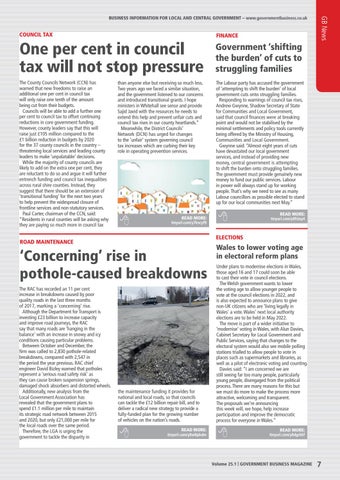
‘Concerning’ rise in pothole-caused breakdowns The RAC has recorded an 11 per cent increase in breakdowns caused by poor quality roads in the last three months of 2017, marking a ‘concerning’ rise. Although the Department for Transport is investing £23 billion to increase capacity and improve road journeys, the RAC say that many roads are ‘hanging in the balance’ with an increase in snowy and icy conditions causing particular problems. Between October and December, the firm was called to 2,830 pothole-related breakdowns, compared with 2,547 in the period the year previous. RAC chief engineer David Bizley warned that potholes represent a ‘serious road safety risk’ as they can cause broken suspension springs, damaged shock absorbers and distorted wheels. Additionally, new analysis from the Local Government Association has revealed that the government plans to spend £1.1 million per mile to maintain its strategic road network between 2015 and 2020, but only £21,000 per mile for the local roads over the same period. Therefore, the LGA is urging the government to tackle the disparity in
FINANCE
GB News
BUSINESS INFORMATION FOR LOCAL AND CENTRAL GOVERNMENT – www.governmentbusiness.co.uk
the maintenance funding it provides for national and local roads, so that councils can tackle the £12 billion repair bill, and to deliver a radical new strategy to provide a fully-funded plan for the growing number of vehicles on the nation’s roads. READ MORE:
tinyurl.com/y8w8pbdm
Wales to lower voting age in electoral reform plans Under plans to modernise elections in Wales, those aged 16 and 17 could soon be able to cast their vote in council elections. The Welsh government wants to lower the voting age to allow younger people to vote at the council elections in 2022, and is also expected to announce plans to give non-UK citizens who are ‘living legally in Wales’ a vote. Wales’ next local authority elections are to be held in May 2022. The move is part of a wider initiative to ‘modernise’ voting in Wales, with Alun Davies, Cabinet Secretary for Local Government and Public Services, saying that changes to the electoral system would also see mobile polling stations trialled to allow people to vote in places such as supermarkets and libraries, as well as a pilot of electronic voting and counting. Davies said: “I am concerned we are still seeing far too many people, particularly young people, disengaged from the political process. There are many reasons for this but we must do more to make the process more attractive, welcoming and transparent. The proposals we’re announcing this week will, we hope, help increase participation and improve the democratic process for everyone in Wales.” READ MORE:
tinyurl.com/y8dgrkkf
Volume 25.1 | GOVERNMENT BUSINESS MAGAZINE
7