AIR POLLUTION
EMPLOYEE SATISFACTION
Councils must implement redesigned speed bumps to cut pollution
Public sector job satisfaction reaches four-year high According to a survey by the Chartered Institute of Personnel and Development (CIPD) and Halogen Employee Outlook, two-thirds of public sector employees were satisfied with their jobs, the highest level since Autumn 2012. However, despite this being higher than the average employee satisfaction rate which was 63 per cent, 43 per cent of pubic sector workers said they were under excessive pressure at work at least once a week, compared to 38 per cent of all employees. The report also identified evidence of post‑referendum optimism with 57 per cent of employees confirming they believed it was unlikely they would lose their current main job, and just 12 per cent saying they think it is likely. Claire McCartney, associate research adviser at the CIPD, said: “There was a great deal of uncertainty before the referendum, so people might be feeling more settled, and many will be happy with the outcome based on their voting decision. “Another reason for the increase could be that some of the new messages we’re hearing on fairness and equality from government may be resonating with public sector workers.”
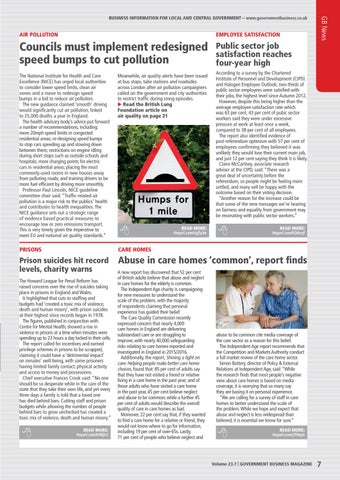
The National Institute for Health and Care Excellence (NICE) has urged local authorities to consider lower speed limits, clean air zones and a move to redesign speed bumps in a bid to reduce air pollution. The new guidance claimed ‘smooth’ driving would significantly cut air pollution, linked to 25,000 deaths a year in England. The health advisory body’s advice put forward a number of recommendations, including: more 20mph speed limits in congested residential areas; re-designing speed bumps to stop cars speeding up and slowing down between them; restrictions on engine idling during short stops such as outside schools and hospitals; more charging points for electric cars in residential areas; placing the most commonly-used rooms in new houses away from polluting roads; and training drivers to be more fuel efficient by driving more smoothly. Professor Paul Lincoln, NICE guideline committee chair said: “Traffic-related air pollution is a major risk to the publics’ health and contributes to health inequalities. The NICE guidance sets out a strategic range of evidence based practical measures to encourage low or zero emissions transport. This is very timely given the imperative to meet EU and national air quality standards.”
Meanwhile, air quality alerts have been issued at bus stops, tube stations and roadsides across London after air pollution campaigners called on the government and city authorities to restrict traffic during smog episodes. E Read the British Lung Foundation article on air quality on page 21
PRISONS
CARE HOMES
Prison suicides hit record levels, charity warns
Abuse in care homes ‘common’, report finds
The Howard League for Penal Reform has raised concerns over the rise of suicides taking place in prisons in England and Wales. It highlighted that cuts to staffing and budgets had ‘created a toxic mix of violence, death and human misery’, with prison suicides at their highest since records began in 1978. The figures, published in conjunction with Centre for Mental Health, showed a rise in violence in prisons at a time when inmates were spending up to 23 hours a day locked in their cells. The report called for incentives and earned privilege schemes in prisons to be scrapped, claiming it could have a ‘detrimental impact’ on inmates’ well-being, with some prisoners having limited family contact, physical activity and access to money and possessions. Chief executive Frances Crook said: “No one should be so desperate while in the care of the state that they take their own life, and yet every three days a family is told that a loved one has died behind bars. Cutting staff and prison budgets while allowing the number of people behind bars to grow unchecked has created a toxic mix of violence, death and human misery.” READ MORE:
tinyurl.com/h98jlr2
READ MORE:
tinyurl.com/zyj5y4n
A new report has discovered that 52 per cent of British adults believe that abuse and neglect in care homes for the elderly is common. The Independent Age charity is campaigning for new measures to understand the scale of the problem, with the majority of respondents claiming that personal experience has guided their belief. The Care Quality Commission recently expressed concern that nearly 4,000 care homes in England are delivering substandard care or are struggling to improve, with nearly 40,000 safeguarding risks relating to care homes reported and investigated in England in 2015/2016. Additionally, the report, Shining a light on care: Helping people make better care home choices, found that: 85 per cent of adults say that they have not visited a friend or relative living in a care home in the past year; and of those adults who have visited a care home in the past year, 45 per cent believe neglect and abuse to be common; while a further 45 per cent of adults would describe the overall quality of care in care homes as bad. Moreover, 22 per cent say that, if they wanted to find a care home for a relative or friend, they would not know where to go for information, including 19 per cent of over-65s. Lastly, 71 per cent of people who believe neglect and
GB News
BUSINESS INFORMATION FOR LOCAL AND CENTRAL GOVERNMENT – www.governmentbusiness.co.uk
READ MORE:
tinyurl.com/h3drryf
abuse to be common cite media coverage of the care sector as a reason for this belief. The Independent Age report recommends that the Competition and Markets Authority conduct a full market review of the care home sector. Simon Bottery, director of Policy & External Relations at Independent Age, said: “While the research finds that most people’s negative view about care homes is based on media coverage, it is worrying that so many say they are basing it on personal experience. “We are calling for a survey of staff in care homes to better understand the scale of the problem. While we hope and expect that abuse and neglect is less widespread than believed, it is essential we know for sure.” READ MORE:
tinyurl.com/j7l9qot
Volume 23.7 | GOVERNMENT BUSINESS MAGAZINE
7