Historic Gordon building faces uncertain future Southard: A ‘tragedy’ if it is torn down by KEVIN SPRADLIN SUMMERFIELD – Linda Southard, a lifetime Summerfield resident, cannot bear the thought of a treasured historical building in Summerfield becoming no more than a series of memories and lasting impressions captured by artists on canvas and tapestry. That, she said, simply will not do.
By consensus, this past January Mayor Gail Dunham and all five members of the Summerfield Town Council rejected a $3.7 million proposal from CUBE, an architectural firm out of Chapel Hill, to renovate the historic R.C. Gordon Hardware building located on the southeast corner of the intersection of N.C. 150 and Summerfield Road. The two-story brick structure dates back to approximately 1877, when it was known as the Ogburn-Gordon Store and owned by George J. Smith. The building is a key component of the Summerfield Historic District, an area of mostly residential buildings with a few commercial ones, and it is recognized by the North Carolina State Historic Preservation Office.
The town purchased the Gordon property, including the Gordon Hardware building which rests on a .35-acre lot and a separate 13.39-acre tract bordering U.S. 220, for $399,000 in 2014. The previous town council had long stated plans to turn the building into a public meeting facility with potential for additional town staff office space, but until January there were no initial cost estimates for bringing those plans to reality. CUBE’s $3.7 million proposal includes $750,000 to stabilize the building, and another $850,000 to ready the building for a certificate of occupancy in order to be open for public use. The remaining $2.1 million would have been used for an addition at the southern end of the building, plus code-required stairs, an elevator, heating, air conditioning, plumbing, electrical and technology upgrades, and landscaping. “I want to see it restored,” said Southard, who was raised in the Wilson house only a few doors down Oak Ridge Road and recalls the R.C. Gordon Hardware building as a community gathering place. “I do not really want to see add-ons because it takes away from the historical significance. It
14
Spring 2018
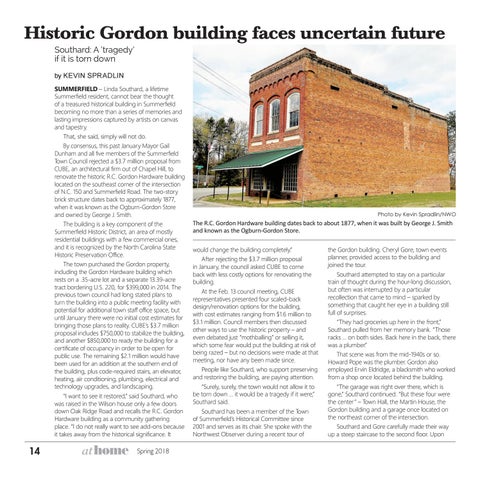
Photo by Kevin Spradlin/NWO
The R.C. Gordon Hardware building dates back to about 1877, when it was built by George J. Smith and known as the Ogburn-Gordon Store. would change the building completely.”
After rejecting the $3.7 million proposal in January, the council asked CUBE to come back with less costly options for renovating the building.
At the Feb. 13 council meeting, CUBE representatives presented four scaled-back design/renovation options for the building, with cost estimates ranging from $1.6 million to $3.1 million. Council members then discussed other ways to use the historic property – and even debated just “mothballing” or selling it, which some fear would put the building at risk of being razed – but no decisions were made at that meeting, nor have any been made since.
the Gordon building. Cheryl Gore, town events planner, provided access to the building and joined the tour.
Southard attempted to stay on a particular train of thought during the hour-long discussion, but often was interrupted by a particular recollection that came to mind – sparked by something that caught her eye in a building still full of surprises.
“They had groceries up here in the front,” Southard pulled from her memory bank. “Those racks … on both sides. Back here in the back, there was a plumber.”
People like Southard, who support preserving and restoring the building, are paying attention.
That scene was from the mid-1940s or so. Howard Pope was the plumber. Gordon also employed Ervin Eldridge, a blacksmith who worked from a shop once located behind the building.
Southard has been a member of the Town of Summerfield’s Historical Committee since 2001 and serves as its chair. She spoke with the Northwest Observer during a recent tour of
Southard and Gore carefully made their way up a steep staircase to the second floor. Upon
“Surely, surely, the town would not allow it to be torn down … it would be a tragedy if it were,” Southard said.
“The garage was right over there, which is gone,” Southard continued. “But these four were the center” – Town Hall, the Martin House, the Gordon building and a garage once located on the northeast corner of the intersection.