Proctase as a bentonite alternative – what’s the latest? AWRI researchers have discovered information about the mechanisms of wine protein haze formation and have identified Proctase – with its ability to break down haze-forming grape proteins – as a potential alternative to bentonite. Ella Robinson, Neil Scrimgeour, Matteo Marangon, Richard Muhlack, Paul Smith and Peter Godden
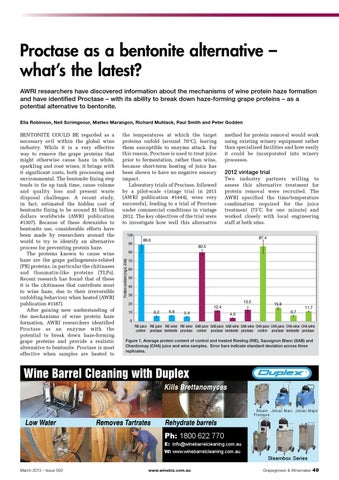
the temperatures at which the target proteins unfold (around 70°C), leaving them susceptible to enzyme attack. For this reason, Proctase is used to treat juice prior to fermentation, rather than wine, because short-term heating of juice has been shown to have no negative sensory impact. Laboratory trials of Proctase, followed by a pilot-scale vintage trial in 2011 (AWRI publication #1444), were very successful, leading to a trial of Proctase under commercial conditions in vintage 2012. The key objectives of the trial were to investigate how well this alternative
method for protein removal would work using existing winery equipment rather than specialised facilities and how easily it could be incorporated into winery processes.
2012 vintage trial Two industry partners willing to assess this alternative treatment for protein removal were recruited. The AWRI specified the time/temperature combination required for the juice treatment (75˚C for one minute) and worked closely with local engineering staff at both sites.
100 90
87.4
89.6 80.5
80 Protien content (mg/L OVA)
BENTONITE COULD BE regarded as a necessary evil within the global wine industry. While it is a very effective way to remove the grape proteins that might otherwise cause haze in white, sparkling and rosé wines, it brings with it significant costs, both processing and environmental. The bentonite fining step tends to tie up tank time, cause volume and quality loss and present waste disposal challenges. A recent study, in fact, estimated the hidden cost of bentonite fining to be around $1 billion dollars worldwide (AWRI publication #1307). Because of these downsides to bentonite use, considerable efforts have been made by researchers around the world to try to identify an alternative process for preventing protein haze. The proteins known to cause wine haze are the grape pathogenesis-related (PR) proteins, in particular the chitinases and thaumatin-like proteins (TLPs). Recent research has found that of these it is the chitinases that contribute most to wine haze, due to their irreversible unfolding behaviour when heated (AWRI publication #1187). After gaining new understanding of the mechanisms of wine protein haze formation, AWRI researchers identified Proctase as an enzyme with the potential to break down haze-forming grape proteins and provide a realistic alternative to bentonite. Proctase is most effective when samples are heated to
70 60 50 40 30 13.5
20 10
12.4 6.2
6.8
5.4
15.8 6.7
4.0
11.7
0 RIE juice RIE juice RIE wine RIE wine SAB juice SAB juice SAB wine SAB wine CHA juice CHA juice CHA wine CHA wine control proctase bentonite proctase control proctase bentonite proctase control proctase bentonite proctase Figure 1. Average protein content of control and treated Riesling (RIE), Sauvignon Blanc (SAB) and Chardonnay (CHA) juice and wine samples. Error bars indicate standard deviation across three replicates.
Steam Jetvac Maxi Jetvac Major Pressure
Ph: 1800 622 770
Restore to brand new quality
E: info@winebarrelcleaning.com.au W: www.winebarrelcleaning.com.au
Steambox Series March 2013 – Issue 590
www.winebiz.com.au
Grapegrower & Winemaker
49