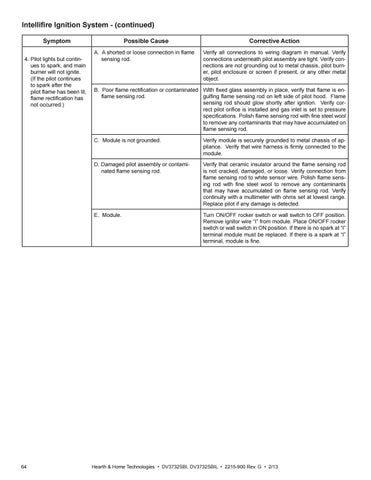
Intellifire Ignition System - (continued) Symptom 4. Pilot lights but continues to spark, and main burner will not ignite. (If the pilot continues to spark after the pilot flame has been lit, flame rectification has not occurred.)
64
Possible Cause A. A shorted or loose connection in flame sensing rod.
Corrective Action Verify all connections to wiring diagram in manual. Verify connections underneath pilot assembly are tight. Verify connections are not grounding out to metal chassis, pilot burner, pilot enclosure or screen if present, or any other metal object.
B. Poor flame rectification or contaminated With fixed glass assembly in place, verify that flame is enflame sensing rod. gulfing flame sensing rod on left side of pilot hood. Flame sensing rod should glow shortly after ignition. Verify correct pilot orifice is installed and gas inlet is set to pressure specifications. Polish flame sensing rod with fine steel wool to remove any contaminants that may have accumulated on flame sensing rod. C. Module is not grounded.
Verify module is securely grounded to metal chassis of appliance. Verify that wire harness is firmly connected to the module.
D. Damaged pilot assembly or contaminated flame sensing rod.
Verify that ceramic insulator around the flame sensing rod is not cracked, damaged, or loose. Verify connection from flame sensing rod to white sensor wire. Polish flame sensing rod with fine steel wool to remove any contaminants that may have accumulated on flame sensing rod. Verify continuity with a multimeter with ohms set at lowest range. Replace pilot if any damage is detected.
E. Module.
Turn ON/OFF rocker switch or wall switch to OFF position. Remove ignitor wire “I” from module. Place ON/OFF rocker switch or wall switch in ON position. If there is no spark at “I” terminal module must be replaced. If there is a spark at “I” terminal, module is fine.
Hearth & Home Technologies • DV3732SBI, DV3732SBIL • 2215-900 Rev. G • 2/13