Appendix
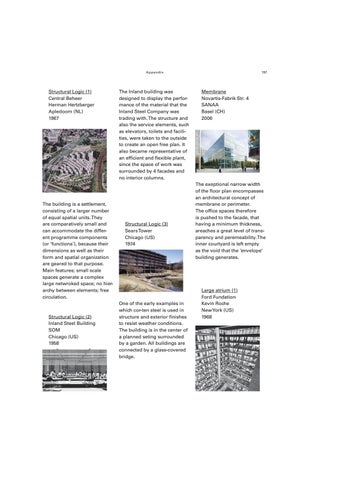
Structural Logic (1) Central Beheer Herman Hertzberger Apledoom (NL) 1967
The building is a settlement, consisting of a larger number of equal spatial units. They are comparatively small and can accommodate the different programme components (or ‘functions’), because their dimensions as well as their form and spatial organization are geared to that purpose. Main features; small scale spaces generate a complex large netwroked space; no hierarchy between elements; free circulation.
Structural Logic (2) Inland Steel Building SOM Chicago (US) 1958
The Inland building was designed to display the performance of the material that the Inland Steel Company was trading with. The structure and also the service elements, such as elevators, toilets and facilities, were taken to the outside to create an open free plan. It also became representative of an efficient and flexible plant, since the space of work was surrounded by 4 facades and no interior columns.
Structural Logic (3) Sears Tower Chicago (US) 1974
One of the early examples in which cor-ten steel is used in structure and exterior finishes to resist weather conditions. The building is in the center of a planned seting surrounded by a garden. All buildings are connected by a glass-covered bridge.
157
Membrane Novartis-Fabrik Str. 4 SANAA Basel (CH) 2006
The exeptional narrow width of the floor plan encompasses an architectural concept of membrane or perimeter. The office spaces therefore is pushed to the facade, that having a minimum thickness, areaches a great level of transparency and peremeability. The inner courtyard is left empty as the void that the ‘envelope’ building generates.
Large atrium (1) Ford Fundation Kevin Roche New York (US) 1968