domestic ideals of the time. The Kanzler Bungalow in Bonn – the former German Presidential Residence (1964-1999) - serves as an insightful example of how modern domestic styles and settings were used to identify with the new democratic society of post war Germany: The dining room served for conferences, the living room as reception for events and for briefings or casual meetings.
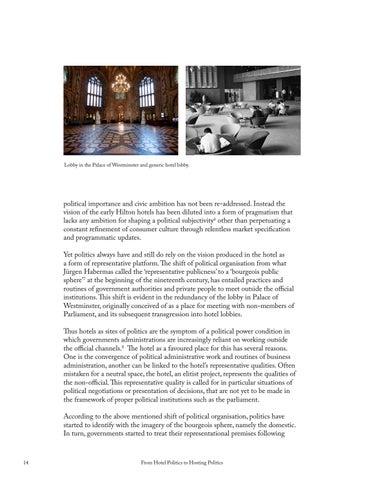
Lobby in the Palace of Westminster and generic hotel lobby.
political importance and civic ambition has not been re-addressed. Instead the vision of the early Hilton hotels has been diluted into a form of pragmatism that lacks any ambition for shaping a political subjectivity6 other than perpetuating a constant refinement of consumer culture through relentless market specification and programmatic updates.
While politics increasingly use domestic settings for their daily routines, the hotels response to these changes is only limited. The modern hotel, a typology characterised by its functional zoning and respective separation of public services such as conference rooms from its private guest-rooms, has been hindered from catering to a more cohesive relation between domestic settings and political protocols. Instead the demands were addressed within the given boundaries of the architectural diagram. This has produced a twofold situation: First, the ever increasing specialisation of hotels in subgenres like spa-hotels, boutique hotels or conference hotels. And second, the almost unlimited growth (mutation) of the base of the hotel containing its services, responding to the market demands by purely adding program to it. While the former comes at the cost of disregarding an holistic and civic approach to the hotel, by isolating it from its urban context into specialised zones that only supply the hotel with the necessary minimal infrastructure, the latter prevents the hotel from actually producing a more meaningful relation between its spaces and forms of usage (protocols). Instead larger conferences are met by moving out of the city (Schloss Elmenau) or by temporarily transforming the hotel space before going back to business as usual.
Yet politics always have and still do rely on the vision produced in the hotel as a form of representative platform. The shift of political organisation from what Jürgen Habermas called the ‘representative publicness’ to a ‘bourgeois public sphere’7 at the beginning of the nineteenth century, has entailed practices and routines of government authorities and private people to meet outside the official institutions. This shift is evident in the redundancy of the lobby in Palace of Westminster, originally conceived of as a place for meeting with non-members of Parliament, and its subsequent transgression into hotel lobbies. Thus hotels as sites of politics are the symptom of a political power condition in which governments administrations are increasingly reliant on working outside the official channels.8 The hotel as a favoured place for this has several reasons. One is the convergence of political administrative work and routines of business administration, another can be linked to the hotel’s representative qualities. Often mistaken for a neutral space, the hotel, an elitist project, represents the qualities of the non-official. This representative quality is called for in particular situations of political negotiations or presentation of decisions, that are not yet to be made in the framework of proper political institutions such as the parliament. According to the above mentioned shift of political organisation, politics have started to identify with the imagery of the bourgeois sphere, namely the domestic. In turn, governments started to treat their representational premises following
14
From Hotel Politics to Hosting Politics
Typological problem of separation: While the flexible base of the hotel consumes all program, the top remains static. 15