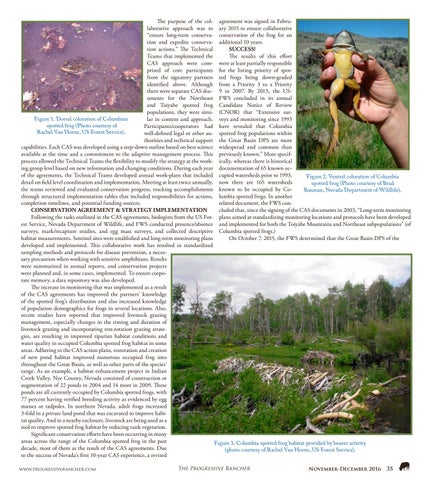
The purpose of the col- agreement was signed in Februlaborative approach was to ary 2015 to ensure collaborative “ensure long-term conserva- conservation of the frog for an tion and expedite conserva- additional 10 years. tion actions.” The Technical SUCCESS! Teams that implemented the The results of this effort CAS approach were com- were at least partially responsible prised of core participants for the listing priority of spotfrom the signatory partners ted frogs being down-graded identified above. Although from a Priority 3 to a Priority there were separate CAS doc- 9 in 2007. By 2013, the USuments for the Northeast FWS concluded in its annual and Toiyabe spotted frog Candidate Notice of Review populations, they were simi- (CNOR) that “Extensive surFigure 1. Dorsal coloration of Columbian lar in content and approach. veys and monitoring since 1993 spotted frog (Photo courtesy of Participants/cooperators had have revealed that Columbia Rachel Van Horne, US Forest Service). well-defined legal or other au- spotted frog populations within thorities and technical support the Great Basin DPS are more capabilities. Each CAS was developed using a step-down outline based on best science widespread and common than available at the time and a commitment to the adaptive management process. This previously known.” More specifprocess allowed the Technical Teams the flexibility to modify the strategy at the work- ically, whereas there is historical ing group level based on new information and changing conditions. During each year documentation of 65 known ocof the agreements, the Technical Teams developed annual work-plans that included cupied watersheds prior to 1993, Figure 2. Ventral coloration of Columbia detail on field level coordination and implementation. Meeting at least twice annually, now there are 165 watersheds spotted frog (Photo courtesy of Brad the teams reviewed and evaluated conservation progress, tracking accomplishments known to be occupied by CoBauman, Nevada Department of Wildlife). through structured implementation tables that included responsibilities for actions, lumbia spotted frogs. In another completion timelines, and potential funding sources. related document, the FWS conCONSERVATION AGREEMENT & STRATEGY IMPLEMENTATION cluded that, since the signing of the CAS documents in 2003, “Long-term monitoring Following the tasks outlined in the CAS agreements, biologists from the US For- plans aimed at standardizing monitoring locations and protocols have been developed est Service, Nevada Department of Wildlife, and FWS conducted presence/absence and implemented for both the Toiyabe Mountains and Northeast subpopulations” (of surveys, mark/recapture studies, and egg mass surveys, and collected descriptive Columbia spotted frogs.) habitat measurements. Sentinel sites were established and long-term monitoring plans On October 7, 2015, the FWS determined that the Great Basin DPS of the developed and implemented. This collaborative work has resulted in standardized sampling methods and protocols for disease prevention, a necessary precaution when working with sensitive amphibians. Results were summarized in annual reports, and conservation projects were planned and, in some cases, implemented. To ensure corporate memory, a data repository was also developed. The increase in monitoring that was implemented as a result of the CAS agreements has improved the partners’ knowledge of the spotted frog’s distribution and also increased knowledge of population demographics for frogs in several locations. Also, recent studies have reported that improved livestock grazing management, especially changes in the timing and duration of livestock grazing and incorporating rest-rotation grazing strategies, are resulting in improved riparian habitat conditions and water quality in occupied Columbia spotted frog habitat in some areas. Adhering to the CAS action plans, restoration and creation of new pond habitat improved numerous occupied frog sites throughout the Great Basin, as well as other parts of the species’ range. As an example, a habitat enhancement project in Indian Creek Valley, Nye County, Nevada consisted of construction or augmentation of 22 ponds in 2004 and 14 more in 2009. These ponds are all currently occupied by Columbia spotted frogs, with 77 percent having verified breeding activity as evidenced by egg masses or tadpoles. In northern Nevada, adult frogs increased 3-fold in a private land pond that was excavated to improve habitat quality. And in a nearby exclosure, livestock are being used as a tool to improve spotted frog habitat by reducing rank vegetation. Significant conservation efforts have been occurring in many areas across the range of the Columbia spotted frog in the past Figure 3. Columbia spotted frog habitat provided by beaver activity decade, most of them as the result of the CAS agreements. Due (photo courtesy of Rachel Van Horne, US Forest Service). to the success of Nevada’s first 10-year CAS experience, a revised www.progressiverancher.com
The Progressive Rancher
November-December 2016 35