




Cover photo: istockphoto.com/Phongsak Sangkhamanee
PSC STAFF
James Carroll CEO carroll@pscouncil.org
Stephanie S. Kostro President kostro@pscouncil.org
Tim Brennan Vice President, Technology Policy and Government Relations brennan@pscouncil.org
Matthew Busby Vice President, Membership busby@pscouncil.org
Paul Foldi Vice President, International Development foldi@pscouncil.org
Steve Harris Vice President, Defense and Intelligence harris@pscouncil.org
Cassie Katz Vice President, Marketing and Communications katz@pscouncil.org
Andrea Ostrander Vice President, Events ostrander@pscouncil.org
Krista Sweet Vice President, Civilian Agencies ksweet@pscouncil.org
Donald Baumgart Director, Vision Federal Market Forecast baumgart@pscouncil.org
Sebastian Herrick Director, Procurement Policy herrick@pscouncil.org
Melissa Phillips, CMP Director, Operations phillips@pscouncil.org
Tomeka B. Scales, Ph.D. Director, Media Engagement & Communications scales@pscouncil.org
Jean Tarascio Director, Member Relations tarascio@pscouncil.org
Janet Jackson Executive Assistant jackson@pscouncil.org
Christian Larsen Director, Emerging Technologies larsen@pscouncil.org
Cierra “Cici” Earl Program Associate, Research Operations earl@pscouncil.org
Alex Fish Sponsorship Associate fish@pscouncil.org
Laila Hammonds Membership Associate lhammonds@pscouncil.org
Gisell Lopez Event Marketing Associate lopez@pscouncil.org
Taryn Phillips Marketing and Communications Associate tphillips@pscouncil.org
Marin Selig Senior Associate, Events selig@pscouncil.org
Luke Shannon Research & Analysis Associate shannon@pscouncil.org
Naomi Coleman Marketing Intern coleman@pscouncil.org

ince joining PSC, I’ve been deeply engaged with our team and members to drive results. I’m proud to report that our momentum is strong. Since the last issue of this publication, six new companies have joined our growing community.
I’d like to personally welcome some of the new members, who are spotlighted on page 7. Members can connect via our PSC Member Directory—a powerful tool for searching a company’s government customers, business classifications, and more to facilitate new connections and one-on-one interactions.
Our advocacy efforts are also accelerating. PSC has remained active during the recent government shutdown. Our action items include:
PSC Member Communications
• Maintaining a Government Shutdown & Resource Center with information on recommended member actions, key agency updates, and additional resources.
• Hosting multiple member briefing webinars throughout the shutdown to provide updates and address questions.
The Hill
• Sending a letter to Congress in advance of the shutdown to highlight the negative implications not only for contractors, but also for the broader economy and national security.
• Holding regular meetings with Hill staff to advocate on behalf of our members and receive updates.
Media and Comms
• Developing a shutdown fact sheet to educate key stakeholders on past shutdowns and what they should be doing during, and after the shutdown.
• Issuing two press releases to amplify our contractor messaging.
• Actively engaging with trade and national media to highlight the importance of contractors during the shutdown.
• Hosting a media roundtable to educate reporters on contractor impacts.
• Obtaining media coverage and interest from news outlets including Time Magazine, WJLA 7, The Washington Post, and many more.
On Capitol Hill and across federal agencies, PSC is making members’ voices heard. Turn to page 37 for a snapshot of recent high-impact engagements, including:
• August 7: PSC partnered with NASA Kennedy Space Center Office of Procurement to host a Reverse Industry Day and strengthen acquisition collaboration.
• September 10: PSC organized an event with Grant Thornton to present the “One Big Beautiful Bill Act (OB3) and Beyond: The Tax and Tariff Landscape for Government Solutions Providers.”
• September 16: Over a dozen member companies participated in PSC on the Hill: Protecting Our Borders Open House to amplify federal contracting work in support of the U.S. border mission.
• September 30: PSC organized an event with attorneys from the White House Counsel’s Office and attorneys from our member companies to discuss the role of AI in government contracting.
• October 3: PSC hosted a meeting at the White House with OMB Deputy Director Eric Ueland on strengthening the industry relations with the Administration and incentivizing a more collaborative, innovative, and outcomes-based federal procurement environment.
And we’re seeing the good news stories of contractors amplified throughout Washington. You can find these stories on page 30.
Beyond policy, PSC remains committed to the broader well-being of our community. On September 17, I attended a White House event “Anchored in Faith: Standing Strong for Our Heroes,” in recognition of Suicide Prevention Month and Recovery Month.
Thank you for being part of PSC and encouraging other companies to join. PSC is shaping public policy, leading strategic coalitions, and establishing communications between government and industry—all with a focus on best outcomes and results for the government and the American taxpayers. Together, we are building the future of federal contracting.
Sincerely,

James Carroll, CEO Professional Services Council

elcome to the Fall 2025 edition of Service Contractor magazine. The last few weeks have seen considerable uncertainty as fiscal year 2025 ended without an appropriations bill that would fund federal agencies on October 1 and beyond… and as the federal government entered its first shutdown in nearly seven years. Without appropriations, agencies activated contingency plans whereby some civil servants were furloughed without pay; others — alongside their military colleagues — were determined to be “excepted from furlough” (also known as “essential”) and expected to work without pay. Likewise, some contractors received Stop Work Orders, and others were determined to be performing essential work. More recently, some civil servants received “reduction in force” notices that terminated their employment. All of these elements created significant challenges as industry officials sought vital information and discovered that many points of contact were unavailable and that processes (e.g., invoice payments) were delayed.
Indeed, longer-term implications for the contracting community will be felt for months to come. PSC will continue to collect, analyze, and publish information on shutdown impacts — on the achievement of critical government missions, on the business base that supports those missions, and on the broader U.S. economy. Lessons from previous shutdowns have taught us that (1) emerging from a shutdown takes time and is a costly endeavor and (2) mission and economic impacts will be felt for years.
Please check out our “What to Watch in Washington” quarterly update (page 8) to see what PSC is tracking on the President’s Budget Request and key milestones coming up.
PSC maintains ongoing engagement with Congress on legislative developments. To stay informed about key bills, refer to the PSC Bill Tracker on page 34.
Another key PSC advocacy function is to develop and submit written comments on proposed regulations and policies impacting our industry. Since the last edition, PSC comments have included:
• FAR Part 10 Model Deviation, Market Research
• FAR Part 39 Model Deviation, Acquisition of Information and Communication Technology
• EO 14265 Modernizing Defense Acquisitions and Spurring Innovation in the DIB
• FAR Part 33 Model Deviation, Protests, Disputes, and Appeals
• FAR Part 31 Model Deviation, Contract Cost Principles and Procedures
• FAR Part 8 Model Deviation, Required Sources of Supplies and Services
• Small Business Administration’s proposed rule on Small Business Size Standards: Monetary-Based Industry Size Standards
In addition to written comments, PSC remains engaged with executive branch officials through in person meetings, which often include involvement of member company leaders. Candid exchanges of ideas and recommendations help to deepen connections between government and industry officials, all with an eye toward better outcomes for government missions and vitality of our nation’s business base.
We look forward to welcoming all PSC members to our Defense Conference on October 30, 2025. Attendees can expect a robust agenda and ample networking opportunities. Learn more about our events at pscouncil.org/events.
• Track Federal Acquisition Regulation developments and offer comments at the PSC Revolutionary FAR Overhaul Action Center (pscouncil.org/far).
• Find relevant Executive Orders and guidance documents at the PSC Post-Election Resource Center (pscouncil.org/ postelection).
• Visit the Member Engagement Resource Center for information on member benefits and ways to connect.
PSC has included a Congressional Calendar to track when Congress is in session on page 41.
PSC consistently promotes success stories in the government contracting industry. These stories showcase the value of government contractors and their important work. See page 28.
Service Contractor magazine has long served as a platform for thought leadership in our industry, and this issue delivers a wealth of timely and insightful content. Featured authors include Tom Borchert of Tria Federal; Bill Webner of Allocore; Stephanie Malm of Aprio; Danielle Applegate of CGI; Alex Amenabar of MBC; Gaurav Pal of stackArmor (a Tyto Athene company); Tom Afferton, Todd Borkey, and Ravi Dankanikote of Peraton; and John Sharp of Levia Partners.
As the federal landscape shifts through executive actions, regulatory overhauls, and evolving agency priorities, PSC remains focused on equipping contractors with the insights, tools, and advocacy they need to succeed.
We welcome your input, feedback, and engagement in our efforts, and we appreciate your steadfast support of PSC and our work to demonstrate the value of the federal contractor. Thank you.

Stephanie Sanok Kostro, President

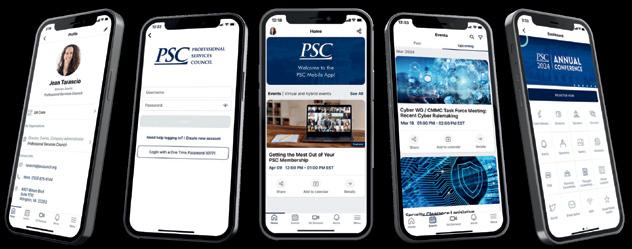
Single sign-in
Register for events
Update your profile

Conference-specific dashboards
Get PSC alerts
View member meetings

Scan the QR code to learn more about the app or visit pscouncil.org/app
Access PSC resources Renew membership Join PSC










For more information on PSC membership, contact membership@pscouncil.org. View all of PSC’s member companies at pscouncil.org/members
by Stephanie Sanok Kostro, President, PSC
The pace of Executive Orders and voluntary staff reductions throughout the government has eased over the last months. The Senate has recently confirmed a host of political appointees for high-ranking positions in federal agencies. On the contracting front, the flurry of efficiencyrelated Stop Work Orders (SWOs) and Terminations for Convenience has also lessened. However, the government has remained active on several other fronts, especially as the lapse of appropriations has triggered shutdown-related SWOs and, for the first time in recent memory, significant reductions-in-force for government employees.
What are we watching at PSC – and what impact will recent government policy changes have on the contracting community?
Every single time full-year or continuing appropriations acts expire, there is a chance for a federal government shutdown. At 12:01am on Thursday, October 1, 2025, there was such a lapse in appropriations to fund operations of the federal government. Agencies activated contingency plans (see PSC’s Government Funding & Shutdown Resource Center to see those plans that are publicly available). Many civil servants were furloughed, making industry engagement with contracting officers and program officials more difficult. Within the first two weeks of the shutdown, some contractors received Stop Work Orders.
Other contractors—if their contracts had prior year funding in place—continued apace, unless and until: (1) they required access to a government employee or facilities that were unavailable; (2) an authorized government official issued a stop work order or termination; or (3) they reached the end of their funding or period of performance. Contracts that depended on fresh Fiscal Year 2026 money were forced into a holding pattern, pending passage and enactment of a continuing resolution.
PSC continues to ask members for data and anecdotes related to the shutdown’s economic and business effects; companies can send impact statements to shutdown@pscouncil.org or fill out a simple form at https://www.pscouncil.org/shutdownfeedback. In addition to supporting our advocacy efforts on the Hill and with agencies, PSC will analyze this information and compile a “lessons learned” paper that can help industry better navigate any future shutdown.
On June 27, Small Business Administration (SBA) Administrator Kelly Loeffler announced that SBA’s Office of General Contracting and Business Development will conduct an immediate, full-scale audit of the agency’s 8(a) Business
Development Program. Long considered a cornerstone of government efforts to promote small business growth and competitiveness, this program is designed to support socially and economically disadvantaged small businesses.
This ongoing audit covers a 15-year period with a focus on high-dollar and limited-competition contracts through the 8(a) Program across all federal agencies. It has an initial emphasis on sole-source, set-aside, and certain joint ventures. Findings will be referred to the SBA Office of Inspector General and the Department of Justice for enforcement; they may pursue “all available actions to recovered misused funds.” In addition to civil and criminal penalties, steps may also include suspension, debarment, termination from the 8(a) Program.
PSC is working with federal agencies to understand this audit—and its potential impact, if any, on other socioeconomic set-asides.
On September 30, the government issued the final eight “model deviations” that completed the first phase of the Revolutionary FAR Overhaul (RFO), an ambitious and fast-moving initiative to remove most non-statutory language from the FAR, ensure that regulations are written in “plain language,” and offer nonregulatory companion guides to simplify and accelerate federal acquisition. Phase I included model deviations for each part of the FAR. Phase II will include formal rulemaking that will allow industry to provide comments on the revised regulations.
PSC companies can access a members-only “RFO Action Center” to learn about the latest RFO-related changes. This site also allows companies to submit input for PSC comments to the government, especially on rulemaking activities. In addition, PSC plans to review and comment, as appropriate, on companion guides and implementation guidance and welcomes any member input on those documents as well.
The highlights above reflect only a few of the activities in the federal government. Other important efforts (e.g., conference negotiations for the National Defense Authorization Act for Fiscal Year 2026, renewal of Small Business Innovation Research (SBIR) and Small Business Technology Transfer (STTR) authorities that expired on September 30, vehicle consolidations at the General Services Administration) remain critical to our government contracting community. Look for an
updated What to Watch in Washington article in the next Service Contractor. In the meantime, member companies can maintain awareness of critical issues and actions by registering for PSC webinars and committee meetings. And please reach out to your PSC team at policy@pscouncil.org with any specific questions or comments. We are grateful for your steadfast support of PSC and our efforts on behalf of the federal contracting community, and let us know how we can help!
View the digital article by scanning the QR code or visiting pscouncil.org/what_to_watch
as of 10/15/25
October 1
Start of Fiscal Year 2026
Expiration of Several Authorities (e.g., SBIR/STTR, Cyber Info Sharing) START OF SHUTDOWN
September 2 House & Senate Return from August Recess
December 18-19
House Last Day 12/18
Senate Last Day 12/19
November-December OMB Passbacks on FY27 Budgets?
January TBD State of the Union Address
February TBD President’s FY27 Budget Submission to Congress?
September 10
House Passage of FY26 National Defense Authorization Act
October 9
Senate Passage of FY26 National Defense Authorization Act

What to Watch in Washington provides a concise and authoritative overview of the most significant legislative, regulatory, and policy developments impacting the government contracting sector. This regularly issued update highlights emerging issues under consideration by Congress and federal agencies, offering PSC members timely insight into the evolving policy landscape. Designed to support informed decision-making, this resource underscores PSC’s commitment to keeping the federal contracting community apprised of key actions and trends in Washington.

by Tim Borchert, CEO, Tria Federal
Across the federal government, demand for IT modernization has never been greater. Amid rising public expectations, rapidly evolving threats, and pressure to do more with less, agencies are racing to keep pace with advancements in technology.
Investments in cloud, cybersecurity, and artificial intelligence (AI) are no longer differentiators; they are table stakes. Yet, as countless stalled projects and ballooning budgets show, technology alone doesn’t drive modernization. So how can a contractor support mission success while averting costly, drawn-out efforts that never quite deliver?
The X factor is customer intimacy: a profound understanding of the people, processes, and purpose that a modernization initiative is meant to serve.
Customer intimacy enables teams to move faster, pivot intelligently, and build solutions that federal end users can trust. It is the difference between trying — and failing — to make a customer fit the technology, and adapting the technology to how the customer thinks and operates.
As Federal CIO Gregory Barbaccia has written, “We’ve only digitized, not transformed.”1 He’s right: swapping filing cabinets for cloud drives or replacing paper with PDFs is not transformation. It updates the format without rethinking the function.
We’ve seen firsthand that when modernization is reduced to a technology substitution, agencies end up with shinier versions of the same old problems.
True modernization necessitates transformation; it demands reinvention, not replacement. It is not just a question of what tools you bring to the table, but how deeply you understand the customer, their mission and the Americans they’re ultimately serving.
Transformation requires reengineering how government work gets done: how decisions are made, how data flows, how systems interoperate, and — most importantly — how end users experience the tools they use.
Government contractors are rightly investing in AI, intelligent automation, and no-code/low-code development. These technologies hold tremendous promise, but they’re not magic spells that can be cast over the customer. As management expert Peter Drucker famously noted, “culture eats strategy for breakfast.” A customer’s culture and workflows alone can prove to be nearly impassable obstacles if approached with a lack of preparation and understanding.
Success depends less on choosing the “best” algorithm and more on how well the system is integrated into workflows, how decisions are audited, and how trust is maintained. AI should amplify human expertise, not replace it. When misapplied, it can slow progress, increase risk, and erode confidence in the modernization process.
Contractors should view AI not as the centerpiece, but as part of a larger architecture of mission-centered, outcomeoriented design. When layered upon the insights gained through customer intimacy, AI accelerates decisions, automates burdensome tasks, and augments human expertise.
Based on two decades serving the federal government, one insight stands out: the closer we are to the customer’s mission, the higher the likelihood of project success. We’ve seen this prove true while supporting the Department of Veterans Affairs, Centers for Medicare & Medicaid Services, Department of Homeland Security, and many others.
The closer you are to the customer, the faster you can pivot, the smarter you can design, and the more likely your modernization efforts are to improve their ability to achieve their mission.
We’ve seen firsthand that when modernization is reduced to a technology substitution, agencies end up with shinier versions of the same old problems.
So how can a company supporting the federal government develop customer intimacy, especially if they are not a traditional government contractor or are new to the market?
It requires embedding with agency teams, listening before prescribing, and understanding not just the technical environment but the operational culture, constraints, and real-world pain points that federal employees face every day. It requires asking the right questions, observing the friction points in real workflows, and aligning technical strategy with organizational goals.
Too often, technology is introduced without a corresponding understanding of or prescribed shift in how people complete their work. Real transformation requires human-centered design: involving users early, building empathy into every sprint, and constantly validating assumptions. With this approach, agencies gain more than new systems—they gain new capabilities.
Modernization isn’t just a technical exercise; it’s a human one. The most innovative tools in the world won’t achieve
impact if they’re layered onto outdated processes or imposed on disengaged users.
Whether we’re developing a clinician interface for CMS or a business intelligence dashboard for DHS, we design solutions with users—not for them. At Tria Labs, our innovation hub, we co-create solutions with case workers, analysts, and clinicians, ensuring tools are intuitive, efficient, and trusted in real-world environments.
Effective modernization is about designing systems that are reliable, secure, and built for adaptation, while always keeping the agency’s mission front and center.
Whether the goal is improving access to care for veterans, safeguarding national security, or enhancing public health services, modernization must be tied directly to the outcomes that matter most to the agency.
When we develop, prioritize, and cultivate customer intimacy, we deliver mission-critical value to customers with minimal delay. 3
For two decades, federal agencies have relied on Tria Federal companies to deliver digital services and technology solutions that support the health and safety of veterans, service members and civilians. Learn more at https://triafed.com.

by Bill Webner, CEO, Allocore
Despite rapid innovation in the private sector, government IT systems often struggle to keep pace. Decades of custombuilt platforms and siloed workflows have left agencies with brittle legacy systems, mounting technical debt, and costly operations and maintenance. These challenges are well known — but what’s changing now is how the federal government is tackling them.
In April, the Trump administration issued an executive order directing agencies to prioritize commercially available products and services. This move joins a growing set of reforms offering agencies new tools for modernization:
• FAR 2.0: Proposed updates to the Federal Acquisition Regulation that encourage agile, modular procurement — including reduced reliance on past performance and greater use of product demonstrations.
• OMB M-24-15: Updates the FedRAMP process to better support modern cloud adoption and accelerate agency access to secure commercial technologies.
• Expanded OTAs: Allow faster access to emerging technologies and nontraditional vendors.
• Customer experience and design mandates: Recent frameworks and the Trump administration’s “Improving Our Nation Through Better Design” executive order require agencies to modernize digital interactions, establish a Chief Design Officer, and improve usability across digital and physical services.
These tools offer a new playbook for acquiring and scaling federal IT systems. Nowhere is this more urgently needed than in the federal lending ecosystem — a vital but often overlooked area of government technology.
Across the federal government, there are over 130 distinct lending and credit programs — supporting homeownership, small business growth, disaster recovery, higher education,

farming, shipbuilding, and more. These programs affect millions of Americans and collectively manage hundreds of billions of dollars in loans and guarantees.
Yet many of these systems run on aging, fragmented platforms with outdated interfaces and manual processes that slow the disbursement of borrower funds, increase risk, and allow fraud.
These programs are central to federal missions and public trust — but have lagged behind in modernization investment.
In commercial banking, lenders don’t spend five years overhauling core systems. They deploy modern software in 6–12 months — solutions that evolve continuously with customer needs and regulation.
During the COVID-19 pandemic, the Small Business Administration offered a clear example of what modern lending systems can look like. Faced with the urgent need to process emergency loans at massive scale, SBA turned to a commercial cloud-based solution.
Rather than building from scratch, SBA implemented a configurable, secure platform that scaled rapidly and improved the experience for borrowers and administrators alike. The transition took weeks — not years — demonstrating that with the right tools and agile procurement, agencies can move fast and still get it right.
It’s time to apply that lesson across the board.
In commercial banking, lenders don’t spend five years overhauling core systems. They deploy modern software in 6–12 months — solutions that evolve continuously with customer needs and regulation.
These platforms deliver security, real-time fraud detection, digital onboarding, mobile-first design, and analytics — all built to integrate with modern APIs and data standards.
While federal lending has unique requirements, core processes like intake, eligibility, disbursement, and servicing map closely to private-sector systems. That makes these programs ideal candidates for tailored commercial solutions.
One of the most meaningful FAR 2.0 changes is how agencies evaluate vendors. Past performance has long been a barrier for newer entrants. Now, agencies are encouraged to use live product demos and functional testing to assess solutions in real time.
This shift allows commercial products — especially those already proven in other sectors — to compete on what they can do, not just what they claim to do.
For lending programs, this is a game-changer. Agencies can now evaluate platforms under real-world conditions: processing applications, verifying documents, detecting anomalies. They don’t have to rely on resumes or proposals — they can see results upfront.
This makes procurement more competitive, more transparent, and more focused on outcomes.
Not every system is suited for agile acquisition or commercialfirst transformation. But federal lending checks all the boxes:
• High volume: Millions of applications processed each year.
• Standard workflows: Lending follows predictable, repeatable stages.
• Public-facing interfaces: These systems shape public perception of government services.
• Measurable outcomes: Improvements can be directly tied to speed, accuracy, and impact.
With the right acquisition strategy, agencies can pilot commercial platforms, validate performance, and scale quickly. Vendors can offer phased deployments, outcome-based pricing, and risk-sharing models that build trust and deliver value.
None of this happens without action from contracting officers, program managers, and IT leaders. Agencies must embrace the flexibilities now available to them, shift from custom development to product evaluation, and build true partnerships with vendors who bring both technical strength and public-sector fluency.
Industry must also show up differently — ready to demonstrate, not just describe, how their platforms meet mission needs. That means proving functionality, offering clear pricing, and tailoring solutions without demanding months of customization upfront.
Federal lending programs are too important to be held back by outdated, fragmented systems. With new policy tools, procurement flexibility, and successful models like SBA’s COVIDera shift, modernization is no longer out of reach.
By treating lending systems as testbeds for agile acquisition and commercial platforms, agencies can improve speed, security, and user experience — while setting a precedent for modernizing other critical programs.
This sector is ready. The tools exist. It’s time to act. 3
Allocore powers leading government loans, grants, and fraud prevention programs with a unified platform built for efficiency and security. With trillions in loans and grants processed and billions in fraud prevented, Allocore brings the precision of commercial banking technology to the public sector.


by Stephanie Malm, Senior Manager (Aerospace Defense & Government Advisory Group), Aprio
The federal government has drastically shifted how it operates, redefining mission priorities, adopting new technologies, navigating emerging risks, and reshaping the rules and regulations that guide our work. The surge in demand for artificial intelligence (AI) and the anticipated sweeping changes stemming from the Revolutionary FAR Overhaul1 have created substantial uncertainty. Now, industry is faced with recent Executive Orders that have changed the way the federal government operates.
In this evolving environment, contractors must navigate change by focusing on what remains constant. Building strong relationships, proactively shaping opportunities, producing quality proposals, and executing contracts effectively are still key strategies to navigate uncertainties and maintain competitiveness.
It is essential to build and maintain relationships with government employees, key advisors, and other stakeholders, not only to execute existing contracts in a seemingly unpredictable environment, but also to grow business. While many programs and contracts are getting reduced, it is key to keep a pulse on target customers by honing in on their mission needs. Having direct relationships and insights into government preferences for acquiring and managing contracts is the best way to prepare for upcoming opportunities.
Smart partnerships with complementary solutions can also open the door to new opportunities through teaming and information sharing, regardless of the federal acquisition environment. Finding the right partners and teammates can be incredibly fruitful and may lead you into customers and programs you wouldn’t have originally considered, providing past performance references to help expand future capabilities and offerings.
Currently, points of contact are changing, sometimes rapidly. In such cases, maintaining contact with the office in general, or engaging multiple contacts within an area helps offset the slow

or disrupted information flow. Strong customer relationships will still provide a competitive edge in any acquisition, whether it is sole sourced, competitive, FAR-based, or under alternative authorities such as Other Transactions.
Understanding clients’ needs in the current environment has the profound advantage of allowing you to position yourself early, well before requirements are officially released. Requests for Information (RFIs) and Sources Sought notices are great entry points to influence acquisition strategies, but even earlier engagement via strategic relationships and proactive conversations lays the groundwork for framing requirements to your advantage. Tangible leave-behinds benefit both government and contractor alike. Slick-sheets and capability statements help shape the market research that the government conducts regularly. Creating well written and concise white papers can
make an even greater impact, especially when crafted in a way that is immediately actionable. Coupled with trusted relationships or well thought out demonstrations focused on mission needs, you can continue to influence not just acquisitions, but broader office strategies.
The core question that has always made proposal writing an art form should be consistently considered: Am I selling what I want to sell, or am I selling what they want to buy?
Proposals remain the government’s primary method of assessing abilities in competitive environments. Though you may have shaped the competition for your company, evaluators must review what is on the paper that you submit. Incumbents have too often fallen into the assumption that their previous work speaks for itself. If your value isn’t documented clearly, even opportunities that seem guaranteed for the incumbent may go to offerors who wrote a better solution.
In sole source situations, the proposal is the primary way the government understands your value as well. A strong proposal can be the difference between a quick award and endless solution iteration.
AI proposal-writing tools are powerful assets in this process, but the human touch is essential. Federal agencies are also developing and deploying AI tools for evaluating proposals. These AI tools remain vulnerable to mistakes, whether from flawed input data or misinterpreted source material. Through the anticipated first review of proposals for compliance and possibly

even preliminary evaluation, AI reliance will change evaluations in speed and interpretation of proposals. Complete, compliant, and compelling proposals developed through a strong combination of AI and human oversight will help you succeed.
As organizations tighten budgets and explore technologydriven efficiencies (including AI), the expectation for quality contract execution hasn’t changed. Government customers expect to get what they pay for, or possibly more. The use of AI to augment solutions and find efficiencies is promising, and smaller teams may now be the norm due to budget constraints. Even so, the execution must match government expectations.
Execution also remains critical when CPARs (Contractor Performance Assessment Reports) come around so that you are positioned well for the future opportunities.
Under these fundamentals, we can find more elements of government contracting that are familiar, and, more importantly, still work. The best approach now is to remember the basic tenants of this field while remaining adaptable to the evolving landscape. 3
Stephanie Malm is a former Contracting Officer and current proposal and acquisitions advisor. If you would like assistance navigating the federal Business Development, Capture, and Proposal process, Aprio can help. Contact Stephanie.Malm@aprio.com to learn more.



by Danielle Applegate, Vice President for Veterans Affairs, CGI
It’s hard to overstate the importance of financial management for a federal agency. It forms the foundation of good stewardship of taxpayer funding, requiring transparency, accuracy, accessibility and auditability. Far from a simple back-office upgrade, financial management modernization is a mission enabler that impacts virtually every aspect of agency operations.
CGI’s experience with the U.S. Department of Veterans Affairs’ (VA) Financial Management Business Transformation (FMBT) program is a case in point. As part of the FMBT program, CGI’s Momentum® Enterprise solution has been steadily implemented to power VA’s new Integrated Financial and Acquisition Management System (iFAMS), which is becoming the backbone of mission enablement across key priority areas.
VA has already allocated $6.3 billion towards technology modernization, launched over 200 artificial intelligence use cases and is scaling anti-fraud platforms. FMBT/iFAMS lies at the heart of all of these priorities, providing the foundation of financial and operational data integrity.
VA operates one of the largest integrated healthcare systems in the world, serving over 9 million veterans. The FMBT program is shifting the department from a decades-old mainframe system and other legacy platforms to a cloud-based platform which integrates financial and acquisition functions. iFAMS supports real-time data access, automated workflows and compliance with federal accounting standards.

To seriously tackle the challenge, agencies need to derive actionable insights through advanced analytics and automation to detect anomalies, reduce improper payments and safeguard resources.
These features in turn enable VA to enact other advancements, such as embedding AI into invoice processing and anomaly detection. These programs have cut invoice processing time from weeks to minutes for a third of the department’s invoices, and prevented an estimated $500 million in improper payments, respectively.1
Modernization and true digital transformation are not purely technological matters. The business processes that agencies use to carry out their work must change too, to make the most efficient use of new platforms and tools. It is the business processes that deliver the agency’s services to its constituents; the technologies and tools support and facilitate the work.
At VA, American veterans are the key constituents. They depend on VA for their healthcare, and many of them take advantage of programs such as VA mortgages or programs that assist in transitioning from military service to civilian life and careers. The FMBT program will ultimately improve mission fulfillment in all of these areas, but only to the extent that the business processes transform along with the technology.
The FMBT program is not just about modernization — it extends to future-proofing. CGI’s approach, in collaboration with VA, incorporates and anticipates emerging technologies such as AI to further streamline processes and improve efficiencies.
VA is tracking over 200 AI initiatives already, and the FMBT/ iFAMS framework will position the department to embed automation and predictive analytics into workflows throughout its operations 2
A key component of this capability is implementing commercial off-the-shelf (COTS) products. Using readily available commercial products means VA avoids the burden of technical debt in implementing tools, and enables the department to continuously optimize and upgrade as its constellation of COTS products evolves.
All of this contributes to FMBT’s evolution from a foundational system to a platform for continuous innovation. CGI’s iterative, Agile-based delivery model enables VA to readily respond to regulatory changes, user feedback and other inputs aimed at ongoing improvement.
Even more important than the FMBT program’s impact on VA is its replicability. Consider it the basis of a roadmap for digital transformation.
Across the federal government, the demand is growing for integrated, secure and AI-ready platforms built on scalable
architecture and continuous improvement. VA’s financial transformation journey — successes already achieved and the expected future state — offer a blueprint for other agencies seeking to modernize legacy systems while maintaining operational continuity.
CGI’s approach is applicable to a range of mission-critical priorities and programs, including:
• Fraud, waste and abuse prevention: Improper payments and other forms of misspending cost the government billions every year and are directly tied to financial management. VA already has active prevention programs, including “Seek to Prevent Fraud, Waste and Abuse” (STOP FWA), launched in 2017, and VSAFE.gov, which provides fraud education and a hotline for veterans to report suspected fraud. To seriously tackle the challenge, agencies need to derive actionable insights through advanced analytics and automation to detect anomalies, reduce improper payments and safeguard resources.
• Cybersecurity: Driven by a combination of urgency around efficiencies, new regulatory requirements and other factors, VA and other agencies are investing heavily in technology. These investments signal a demand for integrating IT asset management (ITAM) and cybersecurity. ITAM offers full visibility into VA’s ecosystem —mapping dependencies, assessing risks, enabling security-by-design, powering predictive analytics, and providing incident response and supply chain protection.
• Total Asset Visibility: Asset management is another domain where FMBT lessons learned can guide modernization. Faced with millions of physical assets to track, agencies must adopt highly scalable and agile platforms to build solutions on.
As VA continues to advance its mission through modernization, the FMBT program stands as a proven catalyst — quietly powering progress across cybersecurity, AI, asset management and beyond. Its success to date is not just a milestone, but a signal: the infrastructure is in place, the outcomes are real and the potential for future innovation is already taking shape.
Realizing that potential will require partners who understand both the complexity of federal transformation and the urgency of delivering results. CGI delivers that dual lens — combining technical depth with mission fluency — to help agencies not only meet the moment, but shape what comes next. 3
Danielle Applegate (danielle.applegate@cgifederal.com) is an Army veteran and seasoned technology leader known for her expertise in advancing large-scale government modernization programs. In her role, she stewards critical enterprise-wide initiatives to increase interoperability and efficiency at the Department of Veterans Affairs.
1 https://www.meritalk.com/articles/va-financial-services-center-reducing-operational-costs-with-ai/#:~:text=The%20Department%20 of%20Veterans%20Affairs%20%28VA%29%20Financial%20Services,optimize%20its%20benefits%20processing%20and%20 reduce%20operational%20costs.
2 https://digital.va.gov/vision-driven-execution/pioneering-the-future-vas-ai-use-case-inventory/

by Alex Amenabar, Co-CEO and CTO, MBC
Intelligent Automation is transforming how the Department of Defense (DoD) modernizes its business operations, moving beyond traditional system integration to deliver intelligent automation capabilities. The Department of the Navy (DON)’s Automation as a Service (AaaS) initiative, led by the Assistant Secretary of the Navy for Financial Management and Comptroller (ASN FM&C), exemplifies this approach. Developed under the Financial Management Data and Digital Transformation (FMDDT) program, AaaS is transforming how the Navy achieves audit readiness, operational efficiency, and enterprise-wide innovation. FMDDT has partnered with MBC to implement core components of the AaaS framework.
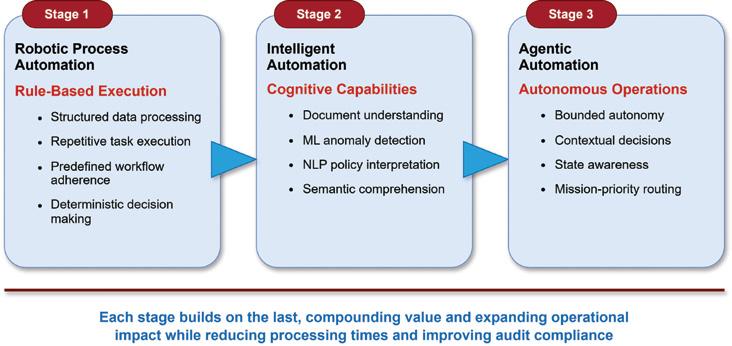
AaaS is built on a continuum of automation capabilities that progress from attended rule-based bots to unattended intelligent systems and, ultimately, agentic artificial intelligence (AI) automation. Each stage builds on the last, compounding value and expanding operational impact, reducing processing times, improving audit compliance, and freeing resources that directly support mission readiness.
• Stage 1: Robotic Process Automation (RPA) - RPA bots execute structured, rule-based tasks such as extracting data from Navy ERP, reconciling transactions across Standard Accounting, Budgeting, and Reporting System (SABRS), and populating forms in Procurement Integrated Enterprise Environment (PIEE). These automations reduce processing time from hours to minutes, delivering immediate efficiency gains.1
• Stage 2: Intelligent Automation - This stage introduces cognitive capabilities. Document understanding models extract context from unstructured invoices and contracts, while machine learning algorithms flag anomalies and predict exceptions. Natural language processing (NLP) interprets policy changes and adjusts validation rules

automatically, moving beyond basic optical character recognition (OCR) to semantic understanding.
• Stage 3: Agentic Systems - The frontier of automation, agentic systems operate with bounded autonomy. For example, a procurement agent could route requisitions based on fund availability, vendor history, and mission priority, escalating only when encountering novel scenarios. These systems maintain state awareness and make contextual decisions, pushing automation toward autonomous operations.
The DON AaaS initiative demonstrates enterprise-scale automation architecture in practice. Faced with audit requirements across more than 70 disparate systems, AaaS is deploying a robust automation architecture using proven platforms:
• UiPath powers the AaaS platform, enabling scalable, consistent automation across Navy financial systems with centralized control, performance tracking, and integration with FMDDT tools for rapid adjustments to mission or audit needs.
• DON Unattended Architecture (DUA) is the secure environment that allows bots to run without human intervention. Designed for high-volume financial tasks, it supports 24/7 operations — critical for scaling automation and meeting audit demands efficiently.
• Document Understanding for Audit Readiness uses automation to speed up the preparation and validation of Key Supporting Documents (KSDs), which are essential for audits. For example, one command (BUPERS) was able to process 4 to 5 times more audit samples thanks to these automations 1
FMDDT’s automation efforts saved over 257,000 hours and cleared $190 million in unmatched transactions, demonstrating the scale and impact of digital transformation.
— FMDDT Annual Report 2024
• Analytics Integration with tools like Jupiter and Advana allows real-time tracking of automation performance, measuring return on investment (ROI), and identifying ways to improve. This transforms automation from a backoffice function into a strategic advantage.2
• Citizen Developer Program trains Navy personnel to build automations using UiPath StudioX and Microsoft Power Platform. This helps scale automation without relying solely on external developers. In 2024, 43 trained personnel created 18 bots across the Navy. 1
The Navy’s automation framework advances from rule-based RPA through intelligent automation to autonomous agentic systems, compounding value at each progressive stage.

FMDDT’s governance framework embeds risk management, with human-in-the-loop validation, data integrity controls, and automated rollback capabilities. Every transaction is traceable, and all automation operates within a cybersecurity-hardened environment that complies with Navy and DoD standards for data protection, access control, and system resilience. In its first quarter of 2024, this infrastructure reduced manual processing time by 60% and flagged over 1,200 compliance exceptions 1
AaaS is more than a technical deployment, it’s a strategic enabler of audit readiness and digital transformation. Its governance framework embeds risk management, with humanin-the-loop validation, data integrity controls, and automated rollback capabilities. Every transaction is traceable, ensuring compliance with privacy and cybersecurity standards 2
AaaS enhances operational agility by enabling rapid adaptation to evolving audit requirements, system changes, and mission priorities, ensuring financial operations remain responsive and resilient in dynamic environments.
By investing in the workforce and embracing the innovation of RPAs, FM&C is simultaneously addressing its immediate operational challenge, cleaning data for audit remediation, and setting a standard for innovation in the future.
2024
1 https://www.secnav.navy.mil/fmc/Documents/2024-FMDDT-AnnualReport.pdf
2 https://www.secnav.navy.mil/fmc/Pages/FMS.aspx
3 https://www.secnav.navy.mil/fmc/Documents/FY25_DON_FM_Strategy_I-Plan.pdf
Crucially, FMDDT balances automation with workforce development. The Citizen Developer program ensures personnel understand the processes behind the tools, preserving institutional knowledge and building resilient operations.
AaaS is already evolving to incorporate emerging technologies like machining learning, large language models (LLM), and agentic AI. These capabilities are being architected into the framework to ensure today’s investments support tomorrow’s innovations.
The FY25 DON FM Strategy3 reinforces this trajectory, prioritizing automation, workforce enablement, and data-driven decision-making as pillars of financial transformation. FMDDT’s success in deploying bots, training developers, and integrating analytics demonstrates how automation can scale across the enterprise while maintaining accountability and strategic alignment 2
The Navy’s AaaS initiative offers a blueprint for modernizing government financial operations. By starting with foundational automation, building intelligent capabilities incrementally, and investing in workforce development, ASN FM&C is transforming how the DoD operates. The result is a more agile, efficient, and audit-ready enterprise: one that sets the standard for innovation in public sector financial management. 3
In his role, Alex Amenabar applies enterprise automation, data science, and AI to drive digital transformation. He focuses on practical innovation that delivers measurable outcomes. Alex can be reached at alex.amenabar@mbc360.com or via LinkedIn at https://www. linkedin.com/in/alexamenabar.

by Gaurav Pal, CEO and Founder, stackArmor, (a Tyto Athene company)
Modernizing the federal Risk Management Framework can strengthen security, return precious time to mission work, and save more than a billion dollars a year — without lowering the bar for compliance.
Before any federal technology can serve the public or support the warfighter, it needs a formal green light to operate. That approval is called an Authority to Operate (ATO). An ATO is a formal authorization by a government entity that certifies a system has met specific security requirements and is safe to operate within a designated environment. The ATO process is designed to help ensure operational safety while protecting against the growing threat of cyberattacks.
This is obtained by following the Risk Management Framework (RMF) — the government’s step-by-step process for assessing and managing security risk, developed by the National Institute of Standards and Technology (NIST). These rules exist for a reason: they keep IT systems and sensitive data secure. But in practice, the path to an ATO can be slow, fragmented, and expensive. When manual paperwork crowds out real security work, everyone pays the price — taxpayers, program teams, contractors, and ultimately the people who rely on federal services.
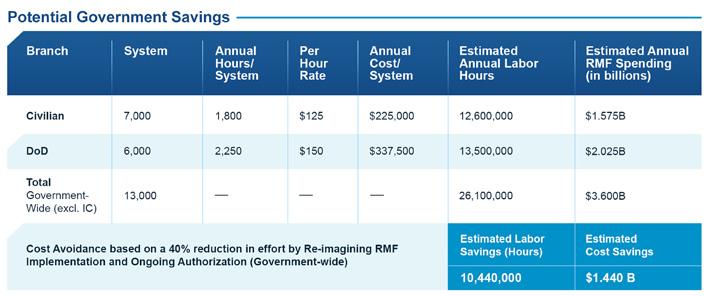
This article clearly explains why RMF and ATOs matter, what obstacles exist today, and how pragmatic modernization can preserve rigor while dramatically reducing manual work, potentially saving the government over a billion dollars annually. Based on the analysis of public data and program experience, federal agencies and contractors collectively spend roughly 26 million hours and about $3.6 billion each year on RMF/ATO activities across approximately 13,000 systems. A practical shift toward digital evidence, reusable security patterns, and consistent acceptance criteria could cut
that effort by around 40%, saving more than $1.4 billion annually and freeing scarce cyber talent to focus on the threats that matter.
Across agencies, the pattern is familiar. Evidence lives as static Word files, spreadsheets, and screenshots that age the moment they’re created. Control implementations are separated from the systems they are meant to protect, so experts spend time proving that something is secure rather than making it more secure. The result is a talent drain: highly skilled cybersecurity professionals are pulled towards responding to evidence calls, formatting Excel spreadsheets and uploading static documents into legacy GRC platforms. None of this strengthens assurance; it slows mission delivery. For example, let’s say a benefits portal team prepares a small release to fix a confusing form that drives call-center volume. The code is ready in days or weeks. However, the lack of an ATO causes delays: writing voluminous control narratives, collecting & collating the body of evidence and formatting outputs to conform to an assessor’s requirements are just some of the steps that must be executed. Nothing about the system’s security posture changes, but the go-live slips a quarter. The public sees no improvement, the team loses momentum, and cyber staff spend weeks formatting documents instead of hardening systems. How many times have you faced this situation?
Modernizing RMF does not mean cutting corners. It means proving security with better signals and fewer handoffs. Start by turning artifacts into data: draw evidence from pipelines, platforms, and configuration management systems that already know what’s running. When a policy check fails in a deployment pipeline, that result can be captured as structured evidence mapped to a specific NIST SP 800-53 control. When a configuration drifts, an automated attestation can log the change and kick off remediation—evidence and action in one motion. Pair this with approved, reusable security patterns—platform baselines, hardened images, and Infrastructure-as-Code modules—so programs inherit controls rather than rebuilding them. Finally, create machine-readable documentation that represents the underlying system along with clear, consistent acceptance logic so reviewers can evaluate the system security state continuously. The outcome is fewer surprises, faster reviews, and a stronger connection between real security and compliance.
Agency executives can set the tone by declaring that acceptable evidence should be machine-readable whenever feasible, and by aligning review teams to the same published criteria. Initiatives like the ACT-IAC’s ATO-as-code maturity model, and programs like
the FedRAMP20x, should be studied as a possible blueprint to help modernize current static information assurance practices. Evolving risk assessment towards using key security indicators (KSIs), specifying conformance queries and reducing the compliance overhead should be top of mind when reimagining the ATO process. Contracting strategies can reward reuse and automation— paying for outcomes and verified assurance instead of hours spent producing static artifacts. On the industry side, delivery teams can invest in security-as-code patterns and pipelines that emit evidence tied directly to NIST control identifiers. Over time, these choices compound: fewer bespoke interpretations, fewer do-overs, and a meaningful reduction in time-to-mission.
RMF and ATOs are here to stay because they protect what matters. The challenge is to honor that purpose while removing the friction that slows delivery and drains talent. By treating evidence as data, building on reusable security patterns, and aligning acceptance criteria, the federal community can strengthen assurance and deliver faster. That means better services for the public, better tools for mission teams, and better use of every dollar entrusted to government technology. The future is code-driven, automated, and continuous. 3
stackArmor provides cybersecurity and compliance engineering services for cloud-focused organizations in regulated industries including government, defense, healthcare, and financial services. Its award-winning platforms, ThreatAlert® and Armory™ ATO Acceleration, are designed to reduce the time and cost of meeting FedRAMP, CMMC, FISMA, and NIST requirements. Headquartered in Reston, VA, stackArmor is a wholly owned subsidiary of Tyto Athene.
To learn more, visit https://www.stackArmor.com or email solutions@stackarmor.com.




by Tom Afferton, President, Cyber Mission Sector
Todd Borkey, Chief Technology Officer and Ravi Dankanikote, Chief Growth Officer, Peraton
In today’s rapidly changing global landscape, the modernization of legacy federal IT systems is not just an operational necessity but a strategic imperative. Government contractors play a pivotal role in driving digital transformation across civilian and defense agencies, enabling mission-critical operations that millions of Americans rely on daily — from filing taxes and delivering mail to securing airports and supporting U.S. forces overseas.
Peraton is partnering with federal agencies to take such transformation beyond traditional IT modernization — bringing a team who can integrate cutting-edge cybersecurity, artificial intelligence (AI), and cloud solutions to build systems that are resilient, agile, and mission tailored helps accelerate the digital transformation.
Another key focus is on equipping operators and decisionmakers with tools built for their operational context rather than forcing missions to adapt to technology. This approach is especially important as agencies confront increasingly sophisticated cyber threats and complex operating environments and can save agencies’ time and taxpayers’ resources alike.
The true impact of transforming federal IT systems will be felt not just across the DC metro and stateside server farms, but at government outposts far removed from a traditional IT
support desk. In modern warfare, kinetic actions like missile launches have predictable outcomes. Yet, for cyber, electronic warfare, and information operations (non-kinetic domains), achieving similar reliability is a major challenge. The key lies in strengthening the connective tissue that enables seamless data flow across security domains and environments.
Another differentiator is designing systems that can function with little to no connectivity—thereby ensuring mission continuity and enabling real-time decision-making under any circumstance. Commanders operating in contested, disconnected environments must be able to analyze data and generate actionable insights locally, then synchronize with enterprise systems when connectivity is restored. Data provenance, the ability to trace the origin and integrity of data, will also play central role in maintaining ironclad security throughout such transformations.
As federal agencies navigate complex operational environments, AI will continue to play a significant role in enhancing mission impact. The ability to leverage AI tools that integrate seamlessly with existing legacy systems is crucial to the U.S. national security strategy.
Tools that consolidate cyber threat data, prioritize risks, and enhance situational awareness without replacing existing infrastructure are becoming foundational. Similarly, collaborative platforms that provide real-time analytics and planning capabilities help operational teams understand

The ability to leverage AI tools that integrate seamlessly with existing legacy systems is crucial to the U.S. national security strategy.
This collaboration between government and industry partners is critical to delivering the next generation of federal IT tools and platforms that are agile, interoperable, and resilient in the face of evolving threats.

and respond to dynamic information environments. Two such examples include Peraton’s ThreatBoard and IRIS (interactive real-time information system) — designed to be system-agnostic, working alongside current infrastructures to meet today’s pressing challenges while supporting the digital transformation journey of tomorrow.
Together, these platforms exemplify the broader federal IT transformation imperative: deploying adaptable, interoperable technologies that strengthen current mission capabilities and pave the way for the integration of next-generation solutions.
The accelerating pace and complexity of federal missions requires technology that is both mission-shaped and AI-fueled. Highly-skilled contracting teams serve as essential partners in this government’s digital transformation, bringing not just
technology but a deep—often firsthand—understanding of mission needs.
This collaboration between government and industry partners is critical to delivering the next generation of federal IT tools and platforms that are agile, interoperable, and resilient in the face of evolving threats. These partnerships help ensure agencies can harness automation, leverage vast volumes of data securely, and deploy adaptable tools that scale with mission requirements. They ensure the United States maintains its decisive technological edge in a rapidly-changing world.
Ultimately, federal IT transformation depends on continued innovation, flexibility, and close alignment between government needs and industry expertise. Contractors, like Peraton, will remain essential in shaping and powering the mission-critical technologies of the future that enable enterprise automation and accelerate comprehensive gains. 3
Tom Afferton has full executive responsibility for the sector’s strategy development and execution, program performance delivering full-spectrum cyber programs, and technical solutions, and growth objectives. Todd Borkey leads the company’s technology strategy, research and development (R&D) portfolio development, and R&D operations.
Ravi Dankanikote is responsible for setting and executing Peraton’s enterprise growth strategy, driving business development across all markets, building strategic customer relationships, and aligning the company’s capabilities to solve mission-critical problems while delivering long-term value.
Contact information: www.peraton.com | media@peraton.com

by John Sharp, Managing Partner, Levia Partners
Modern air traffic control (ATC) systems are undergoing vital technological upgrades —from satellite-based navigation and trajectory-based operations to automated data sharing — that promise safer, more efficient skies. Yet many of these enhancements suffer repeated delays. A recent episode around New York/Newark saw operational cutbacks and downtime affecting flights due to aging systems and deployment setbacks, illustrating how such delays can ripple into real-world disruptions. Clarifying the causes behind
these delivery failures is urgent. The heart of the problem lies in interwoven governance, funding, technical, project management, and supply-chain shortcomings.
Beyond the operational consequences for airlines and passengers, federal contractors play a pivotal role in designing, integrating, and deploying these modernization programs. When schedules slip, contractors face disrupted cash flows, contract modifications, cost overruns, and reputational risk. These knock-on effects reduce incentives for firms to invest in

long-term innovation and discourage new entrants, thereby narrowing the competitive pool of suppliers the government relies upon. Understanding the shared burden between agencies and contractors is essential to designing workable reforms.
Major modernization projects often begin with plausible cost and schedule estimates, but optimism bias and understated risks plague early planning. In the U.S., the Government Accountability Office (GAO) and Office of Inspector General (OIG) consistently flag gaps in risk identification, lifecycle costing, and independent oversight. Unrealistic baselines push contractors to commit to aggressive milestones. When delays inevitably occur, contract renegotiations consume time and money, straining both agency budgets and contractor margins.
ATC infrastructure spans decades — from radar hardware to bespoke communication protocols. Modern upgrades must integrate seamlessly with entrenched systems at thousands of sites. Integration risks multiply as contractors test interfaces against legacy configurations. Each unexpected incompatibility adds months of rework and additional cost.
Safety remains paramount, meaning even small changes require exhaustive approval and testing. Certification timelines, often underestimated at project inception, can stretch for months. Contractors frequently bear the burden of documentation and retesting, creating resource drains and prolonging delivery.
Global shortages in specialized electronics, exacerbated by just-in-time procurement models, lengthen component lead times. Contractors face the dual challenge of securing scarce hardware while meeting contractual delivery dates. Vendor capacity limits often cascade into missed field deployment schedules, putting agencies under pressure to amend agreements or absorb higher costs.
With cyber threats intensifying, “security by design” is mandatory. This requires new threat analyses, validation cycles, and red-teaming efforts. Contractors must add cybersecurity expertise into projects early, raising costs and slowing integration. Though necessary, these additional requirements extend delivery schedules.
Both agencies and contractors struggle with workforce shortages. Scarcity of engineers, integration specialists, and certification staff slows progress at every stage. Contractors often pay premiums to retain scarce talent, but even so, installation, training, and validation work gets bottlenecked.
Modernization projects span multiple vendors, each operating on different timelines, interfaces, and standards. Without strong central governance, coordination falters. Misaligned specifications and late-stage change requests cause breakdowns, forcing contractors to reengineer solutions midstream. In Europe, cross-border harmonization adds complexity, while in the US, federal contractors navigate conflicting agency priorities and evolving performance metrics.
When schedules slip, downstream initiatives—from airspace expansion to carbon reduction targets—also stall. Safety risks mount as legacy systems remain in use longer, exposing vulnerabilities and limiting resilience. Contractors tasked with maintaining outdated systems alongside developing new ones face higher overhead and greater liability exposure.
• Independent Oversight and Realistic Baselines: Require third-party validation of program schedules and cost estimates at project launch.
• Portfolio-Based Planning: Adopt multi-year, portfoliolevel planning to manage interdependencies across modernization initiatives.
• Performance-Based Accountability: Strengthen metrics tied to both delivery outcomes and lifecycle sustainment.
• Modular and Incremental Delivery: Shift away from large, monolithic programs toward modular contracting.
• Public-Private Partnerships (PPP): Explore hybrid funding models where industry co-invests in infrastructure improvements.
• Agile Contracting Practices: Implement agile methods that allow iterative testing and delivery while preserving accountability.
• NextGen (US): Illustrates pitfalls of overpromising but also incremental successes such as DataComm.
• SESAR (Europe): Shows the value of international collaboration, though harmonization challenges persist.

By learning from past failures and adopting pragmatic reforms, policymakers can align procurement models, oversight practices, and contractor incentives to deliver resilient, future-ready ATC systems.
• Defense Acquisition Comparisons: Modular Open Systems Architecture (MOSA) demonstrates the benefits of interoperability and reduced vendor lock-in.
Contractor-Specific Recommendations
• Flexible Contract Terms: Build in mechanisms for shared risk such as adjustable delivery windows.
• Investment in Workforce Pipelines: Expand training programs in partnership with universities.
• Cybersecurity Co-Development: Establish joint validation teams early in the lifecycle.
Strategic Imperatives
• Resilience Over Speed: Prioritize resilience over rushed timelines.
• Transparency and Communication: Public reporting on milestones builds trust and strengthens accountability.
Conclusion
Delays in ATC modernization are not merely technical setbacks — they are systemic challenges with financial, operational, and strategic consequences for federal agencies, contractors, and the flying public. By learning from past failures and adopting pragmatic reforms, policymakers can align procurement models, oversight practices, and contractor incentives to deliver resilient, future-ready ATC systems. The path forward requires balancing safety imperatives with realistic schedules, sharing risk fairly between agencies and industry, and embracing modular, adaptive approaches. Federal contractors, when supported by smarter policy and procurement frameworks, can be partners in accelerating modernization rather than collateral victims of delay. 3
Below are company stories featured in the Protecting Our Borders Compendium, released on Sept. 16, 2025 at the PSC Capitol Hill event that showcased to Congress and their staff the work contractors do to support the U.S. border security mission. Read more at https://hill.pscouncil.org/border-security-compendium

The United States is set to host major global events—including the 2026 FIFA World Cup and 2028 Olympics— presenting a rare chance to redefine national success on the world stage. These mega-events demand strategic action from federal agencies in areas like security, travel, and public engagement. Accenture Federal Services outlines five key focus areas and highlights transformative technologies such as AI, data mesh, and AR/ VR. With the right investments, these efforts can drive lasting improvements beyond the events themselves.

The U.S. faces persistent border threats across vast, varied terrains. Amentum addresses these challenges with advanced, adaptable technologies for air, land, and maritime security. It delivers unmanned systems, counter-drone solutions, and surveillance towers to monitor remote areas and enhance response. Supporting DHS and military operations, Amentum integrates AI, CBRN sensors, and communication networks to create real-time situational awareness. With expertise in systems integration and training, Amentum ensures scalable, efficient, and secure solutions for evolving border threats across all domains.

AMERICAN SYSTEMS supports U.S. Customs and Border Protection (CBP) by enhancing national security through innovative technology and operational excellence. Key efforts include the ADIS Vetting Unit, which uses automation and analytics to detect overstays and support field officers, and the JUMP Team, which deploys and maintains Unattended Ground Sensors to boost border surveillance. These initiatives improve situational awareness, streamline processes, and expand CBP’s reach without added personnel—empowering agents to secure the border more effectively and protect America’s future.


Effective border security requires more than physical barriers and advanced technology—it demands a coordinated, strategic approach. Arc Aspicio emphasizes
the importance of governance, communication, workforce empowerment, and organizational learning to ensure successful implementation. By supporting DHS with governance councils, stakeholder messaging, workforce development, and innovation strategies, Arc Aspicio helps agencies integrate new technologies while staying agile and mission focused. Their holistic approach ensures that border security efforts are not only technologically advanced but also organizationally resilient and adaptable to evolving threats.

Customs and Border Protection (CBP) has migrated most of its systems to the cloud, using advanced tools like generative AI to enhance border security. Cloud-based technologies support threat detection in passenger screening, baggage scanning, and noninvasive vehicle inspections—keeping officers safe and streamlining operations. In remote areas, cloud access enables real-time updates to outdated systems, improving drug and weapon interdiction. CBP emphasizes a human-inthe-loop approach, using the cloud for analysis while ensuring officers make the final decisions on enforcement actions.
AI-Powered Inspection and Surveillance and Leading-Edge Data Analytics Keys to Success for Future Border Security Integration Operations

DLH supports DHS border security by transforming vast data volumes into actionable intelligence using AI-powered surveillance and advanced analytics. Partnering with ICE, DLH enhances enforcement and reduces unauthorized entry. Drawing from military-grade ISR systems, DLH integrates geospatial, biometric, and NII data to deliver real-time situational awareness. Their machine learning models and semantic ontologies enable rapid threat recognition and decision support. With secure, zero-trust cloud architecture and DevSecOps, DLH ensures data integrity while improving agency efficiency, insight, and mission readiness.
At the Intersection of Intelligence, Diplomacy, Technology, and Mission Understanding
Customs and Border Protection (CBP) has migrated most of its systems to the cloud, using advanced tools like generative AI to enhance border security. Cloud-based technologies support threat detection in passenger screening, baggage scanning, and noninvasive vehicle inspections—keeping officers safe and
streamlining operations. In remote areas, cloud access enables real-time updates to outdated systems, improving drug and weapon interdiction. CBP emphasizes a human-in-the-loop approach, using the cloud for analysis while ensuring officers make the final decisions on enforcement actions.

Harmonia partners with DHS to modernize the immigration process through digital solutions that replace outdated, paper-based workflows. Their tools automate asylum processing, detect fraud via the FINCH system, and streamline data sharing through the EGIS platform. The SPEED system enhances H-1B visa processing, cutting time drastically. Harmonia also supports ICE with digital upgrades to booking and case management tools like EAGLE and eRAP. These innovations improve efficiency, reduce errors, and empower agents to act quickly and effectively in the field.

Leidos supports U.S. border security through advanced, AI-enabled technologies that enhance safety while ensuring efficient trade and travel. Their non-intrusive inspection (NII) systems— such as the VACIS® M6500—help detect contraband and disrupt illicit activities. Leidos also provides persistent surveillance tools like the Multi-Function X-Band Radar (MXR), centralized management software for data integration and decision-making, and full-spectrum cybersecurity solutions. By integrating systems and automating workflows, Leidos empowers agencies like CBP to respond to threats quickly and intelligently across land, air, and cyber domains.

ManTech and TrustStamp have partnered to modernize DHS’s Alternatives to Detention (ATD) program by introducing the Tap-In Band, a lowcost, discreet, and user-friendly wearable device that replaces traditional ankle monitors. Designed like a fitness band, it’s tamper-resistant, maintenance-free, and suitable for minors and family units. Paired with ManTech’s advanced Tracking and Data Analytics Dashboard, the solution enables realtime monitoring, geofencing, and secure data access. This approach enhances compliance, protects individual rights, scales cost-effectively, and supports DHS’s mission to manage non-detained immigrants while improving public safety and national security.
ManTech’s MESA-RA is an AI-powered code assist and translation tool designed to help the U.S. government modernize legacy IT systems, such as those written in COBOL. Facing a shrinking pool of legacy-language developers and increasing security risks, MESA-RA enables faster, more secure modernization by translating outdated code into modern languages like C++ or Python. It assists with debugging, documentation, and code
standardization, all under human oversight to ensure accuracy and compliance. MESA-RA reduces technical debt, strengthens cybersecurity, and supports continuity of operations—making it a strategic solution for federal IT transformation.
Parsons is transforming border security with advanced biometric systems for fast, accurate identity verification and the DroneArmor™ platform to detect and neutralize illicit drones. Their AI-powered surveillance monitors remote areas using radar and thermal imaging, while robust cybersecurity protects critical data and communications. Tested in real-world scenarios, Parsons’ integrated solutions enhance threat detection and operational efficiency. Collaborating with government and industry, Parsons has deployed over 270 systems, delivering smarter, technology-driven protection for safer U.S. borders.

Adversarial AI poses a serious threat to U.S. border security by exploiting vulnerabilities in AI systems used by agencies like Customs and Border Protection (CBP). These attacks can cause sensor failures, data manipulation, and mission disruptions, creating openings for criminals. Protecting AI through data provenance and advanced defenses is critical. Peraton’s research develops tools to detect hidden threats and prevent data breaches. Strong collaboration and funding between government and industry are essential to safeguard AI and ensure secure borders.

SOSi highlights how siloed systems in immigration enforcement hinder information sharing, risking public safety and vulnerable populations. Despite the availability of advanced technology and AI, outdated acquisition processes slow integration. SOSi advocates for modern digital solutions that enable seamless collaboration across agencies, improving security and humanitarian outcomes. By investing in these innovations and fostering government-industry partnerships, SOSi believes immigration enforcement can be transformed into a more efficient, secure, and compassionate system.

Interested in submitting a company story to be spotlighted? Visit www.pscouncil.org/spotlightsubmission or contact marketing@pscouncil.org
The annual National Defense Authorization Act (NDAA) continues to progress through Congress, with both the Senate and House completing their respective markups over the summer.
• The Senate Armed Services Committee concluded its markup on July 10 with a strong bipartisan vote of 26-1
• The House Armed Services Committee finalized its version on July 16, passing it by a vote of 55-2
• The full House passed its version of the NDAA on September 10.
• The Senate passed its version on October 10
• While the legislative process typically heads into formal conference negotiations at this stage, lawmakers have indicated that no formal conference is expected this year.
Compiled
by
• Instead, leadership is aiming to reach a conference agreement by Thanksgiving, relying on informal negotiations to reconcile the differences between the two bills.
• Despite this target, sources on Capitol Hill suggest that final passage of the full NDAA is unlikely before the end of calendar year 2025.
As the year closes, all eyes will remain on Congress to see whether the traditionally bipartisan defense bill can once again make it across the finish line—albeit on a delayed schedule.
Tim Brennan, Vice President of Technology Policy and Government Relations








Information as of 9/4/2025
Full-Year Continuing Appropriations and Extensions Act, 2025
Introduced 3/10/2025
Sponsor: Rep. Cole (R-OK-4)
Cosponsor: N/A
Summary: Full year continuing resolution for FY2025
Status: Became Law 3/15/2025
One Big Beautiful Bill Act
Introduced: May 20, 2025
Sponsor: Rep. Jodey Arrington (TX-19)
Cosponsors: N/A
Summary: It is known as a reconciliation bill and includes legislation submitted by 11 House committees pursuant to provisions in the FY2025 congressional budget resolution (H Con. Res. 14) that directed the committees to submit legislation to the House Budget Committee that will increase or decrease the deficit and increase the statutory debt limit by specified amounts. (Reconciliation bills are considered by Congress using expedited legislative procedures that prevent a filibuster and restrict amendments in the Senate.)
Status: Became Law 7/4/2025
SPUR Act, Small Business Procurement and Utilization Reform Act of 2025
Introduced: January 28, 2025
Sponsor: Rep. Stauber (R-MN-8)
Cosponsor: Rep. Cisneros (D-CA-31), Perez (D-WA-3), Goodlander (D-NH-2), Meuser (R-PA-9), LaLota (R-NY-1)
Summary: Requires federal agencies to include on the annual scorecard for small business contracting the number of small businesses that receive a prime contract for the first time and are owned and controlled by service-disabled veterans, qualified HUBZone small business concerns, small business concerns owned and controlled by socially and economically disadvantaged individuals, or small business concerns owned and controlled by women.
Status: Passed House on February 24th, 2025; referred in the Senate to the Committee on Small Business and Entrepreneurship
Safe and Smart Federal Purchasing Act
Introduced: January 31, 2025
Sponsor: Rep. Donalds (R-FL-19)
Cosponsor: Rep. Connolly (D-VA-11)
Summary: This bill requires the Office of Management and Budget (OMB) to evaluate the procurement activities of federal agencies to determine whether provisions of the Federal Acquisition Regulation related to the lowest price technically
acceptable source selection process have created any national security risk and report to Congress.
Status: Passed House 3/4/2025
Decoupling from Foreign Adversarial Battery Dependence Act
Introduced: January 31, 2025
Sponsor: Rep. Gimenez (R-FL-28)
Cosponsor: Rep. Green (R-TN-7), Rep. Moolenaar (R-MI-2), Rep. Pfluger (R-TX-11), Rep. Meuser (R-PA-9)
Summary: Bill prohibits DHS from using funds to procure a battery produced by certain entities, particularly six specific companies owned and operated in China. Prohibition begins on October 1, 2027.
Status: Passed House 3/11/2025
PATHS Act
Introduced: January 31, 2025
Sponsor: Rep. Guest (R-MS-3)
Cosponsor: Rep. Thanedar (D-MI-13)
Summary: This bill extends through FY2028 the authority of the Department of Homeland Security (DHS) to use other transactions (OT) to carry out research and prototype projects when the use of contracts, grants, and cooperative agreements is not feasible or appropriate. (OTs, in contrast to traditional procurement contracts, are exempt from many federal procurement laws and regulations.) DHS must notify Congress within 72 hours of using or extending this authority for research and development projects related to artificial intelligence technology and must offer to brief Congress on the rationale for such a decision.
The bill also lowers from $4 million to $1 million the minimum value of contract awards that DHS must publicly report on its website.
Status: Passed House 3/12/2025
Plain Language in Contracting Act
Introduced: January 28, 2025
Sponsor: Rep. LaLota (R-NY-1)
Cosponsor: Rep. Tran (D-CA-45), Rep. Thanedar (D-MI-13), Rep Goodlander (D-NH-2)
Summary: Referred in the Senate to the Committee on Small Business and Entrepreneurship
Status: Passed House 6/3/2025
SPEED Act, Streamlining Program Efficiency & Expedited Defense
Introduced: June 9, 2025
Sponsor(s): Rep. Rogers (AL-3)
Cosponsor: Rep. Smith (WA-9)
Summary: To authorize appropriations for fiscal year 2026 for military activities of the Department of Defense, for military construction, and for defense activities of the Department of Energy, to prescribe military personnel strengths for such fiscal year, and for other purposes. SPEED is the base text for NDAA which handles acquisition reform across the Department of Defense
Status: Passed the House 9/10/2025
Information as of 9/4/2025
Coast Guard Authorization Act of 2025
Introduced: February 11, 2025
Sponsor: Sen. Cruz (R-TX)
Cosponsor: Sen. Cantwell (D-WA), Sen. Sullivan (R-AK), Sen. Baldwin (D-WI)
Summary:To authorize appropriations for the Coast Guard and for other purposes.
Status: Passed Senate 3/10/2025
Allowing Contractors to Choose Employees for Select Skills Act or “ACCESS Act”
Introduced January 13, 2025
Sponsor: Sen. Lankford (R-OK)
Cosponsor: Sen Peters (D-MI)
Summary: Prohibits solicitations from minimum education requirements for proposed contractor personnel.
Status: Referred to Committee on Homeland Security and Governmental Affairs
Federal Subaward Reporting System Modernization and Expansion Act
Introduced January 16, 2025
Sponsor: Rep. Langworthy (R-NY-23)
Cosponsor: Reps Houlahan (D-PA-6), Lawler (R-NY-17), Davis (D-NC-1), Craig (D-MN-2), Guest (R-MS-3), Hageman (R-WY)
Summary: 180 days after enactment inspector general of GSA shall submit a report containing a review of the FFATA subaward reporting system, with recommendations for improvement.
Status: Referred to House Committee on Oversight and Government Reform
Domestic SUPPLY Act of 2025
Introduced: January 23, 2025
Sponsor: Rep. Morgan (R-VA-9)
Cosponsor: N/A
Summary: HHS Secretary in collaboration with Assistant Secretary for Preparedness and Response and CDC shall establish a program of entering into partnerships with eligible domestic manufacturers to ensure the availability of qualified personal protect equipment for preparing for and respond to public health emergencies.
Status: Referred to Committee on Energy and Commerce and Committee on Oversight and Government Reform
Helping Small Businesses THRIVE Act
Introduced: January 23, 2025
Sponsor: Sen. Shaheen (D-NH)
Cosponsor: Sen. Cassidy (R-LA)
Summary: SBA administrator shall establish a pilot program to assist eligible entities in limiting the risk from rising input costs from commodities.
Status: Referred to Committee on Small Business and Entrepreneurship
Fast-Track Logistics for Acquiring Supplies in a Hurry Act of 2025 or “FLASH Act of 2025”
Introduced: January 28, 2025
Sponsor: Rep. Garcia (D-CA-42)
Cosponsor: N/A
Summary: Amend the Public Health Service Act to authorize BARDA to award follow-on production contracts or transaction, procure supplies for experimental or test purposes, and acquire innovative commercial products and commercial services.
Status: Referred to House Committee on Energy and Commerce
Ensuring Accountability and Dignity in Federal Contracting
Introduced: February 5, 2025
Sponsor: Rep Valadao (CA-22)
Cosponsors: Rep. Turner (OH-10), Rep. Krishnamoorthi (IL-8), Rep. Magaziner (RI-02)
Summary: To provide for modifications to ending trafficking in government contracting and for other purposes.
Status: Pending committee review by House Committee on Foreign Affairs
SBIR/STTR Reauthorization Act of 2025
Introduced: May 1, 2025
Sponsor: Sen. Markey (MA)
Cosponsor(s): N/A
Summary: To amend the Small Business Act to reauthorize and modify the Small Business Innovation Research and Small Business Technology Transfer Research programs.
Status: Referred to Committee on Small Business and Entrepreneurship
SBIR/STTR Reauthorization Act of 2025
Introduced: May 1, 2025
Sponsor: Rep. Velazquez (NY-07)
Cosponsor(s): N/A
Summary: To amend the Small Business Act to reauthorize and modify the Small Business Innovation Research and Small Business Technology Transfer Research programs.
Status: Referred to Committee on Small Business and Committee on Science, Space, and Technology
Information as of 9/4/2025

ARCA Act of 2025, Acquisition Reform and Cost Assessment
Introduced: May 9, 2025
Sponsor(s): Sen. Moran (KS)
Cosponsor: N/A
Summary: To reorganize the acquisition structure of the Department of Veterans Affairs and to establish the Director of Cost Assessment and Program Evaluation in the Department.
Status: Awaiting committee markup
Strengthening Agency Management and Oversight of Software Assets Act
Introduced: May 9, 2025
Sponsor(s): Sen. Peters (MI)
Cosponsor: Sen. Cassidy (LA), Sen. Ernst (IA), Sen. Tillis (NC), Sen. Lankford (OK), Sen. Wyden (OR)
Summary: To improve the visibility, accountability, and oversight of agency software asset management practices.
Status:Referred to Committee on Homeland Security and Governmental Affairs
Protecting AI and Cloud Competition in Defense Act of 2025
Introduced: May 15, 2025
Sponsor: Sen. Warren (MA)
Cosponsor(s): Sen. Schmitt (MO)
Summary: To provide for certain requirements relating to cloud, data infrastructure, and foundation model procurement.
Status: Referred to Senate Committee on Armed Services
Protecting AI and Cloud Competition in Defense Act of 2025
Introduced: May 15, 2025
Sponsor: Rep. Fallon (TX-4)
Cosponsor(s): Rep. Jacobs (CA-51), Rep. Deluzio (PA-17)
Summary: To provide for certain requirements relating to cloud, data infrastructure, and foundation model procurement.
Status: Referred to House Committee on Armed Services
Federal Contractor Cybersecurity Vulnerability Reduction Act of 2025
Introduced: May 22, 2025
Sponsor: Sen. Warner (VA)
Cosponsor(s): Sen. Lankford (OK)
Summary: To require Federal contractors to implement a vulnerability disclosure policy consistent with NIST guidelines.
Status: Referred to Committee on Homeland Security and Governmental Affairs.
Defense Technology Hubs Act of 2025
Introduced: June 5, 2025
Sponsor(s): Sen. Schmitt (MO)
Cosponsor: Sen. Hickenlooper (CO)
Summary: To enhance national security and technological superiority by requiring the Secretary of Defense to establish a network of regional defense technology hubs to foster innovation, collaboration, and rapid development of defense-related technologies to attract talent from across the United States.
Status: Awaiting committee markup
National Defense Authorization Act for Fiscal Year 2026
Introduced: July 15, 2025
Sponsor(s): Sen. Wicker (MS)
Cosponsor: N/A
Summary: This bill sets forth policies and authorities for FY2026 for Department of Defense (DOD) programs and activities, military construction, and the national security programs of the Department of Energy (DOE). It also authorizes the Defense Nuclear Facilities Safety Board for FY2026. The bill authorizes appropriations but it does not provide budget authority, which is provided by appropriations legislation.
Status: On the Senate Floor with amendments. Currently stalled due to issues with appropriations/nominations.
Updated by Tim Brennan, Vice President of Technology Policy and Government Relations, PSC
On Aug. 1, PSC CEO James Carroll was invited as a special guest to the White House for Sam Brown’s installation as Under Secretary of Veterans Affairs for Memorial Affairs. PSC looks forward to future opportunities to collaborate with Under Secretary Brown and his office.

PSC Partners with NASA Kennedy Space Center Office of Procurement to Host Reverse Industry Day and Strengthen Acquisition Collaboration
PSC partnered with the NASA Kennedy Space Center Office of Procurement to host a Reverse Industry Day on Thursday, Aug. 7. This full-day event focused on bridging communication gaps between NASA and industry partners during the acquisition process and sharing strategies to foster successful government–industry collaboration. Thank you to the PSC members who presented during the event: PQC Solutions, CGI Federal, Lockheed Martin, Global Exploration Advisors, FMP, KBR, and Amentum.
PSC and the Northern Virginia Chamber Announce 23rd Annual Greater Washington GovCon Awards Finalists
PSC and the Northern Virginia Chamber (NVC) announced the Greater Washington Government Contractor Awards® finalists during the invitation-only reception on Aug. 21 at the Westwood Country Club.
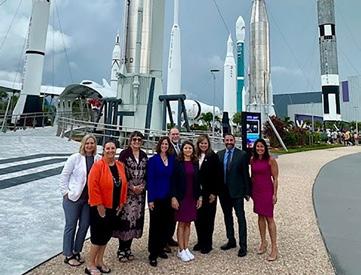

PSC CEO Speaks at National Fentanyl Prevention and Awareness Day Event in Times Square
On Aug. 21, PSC CEO Jim Carroll spoke alongside federal law enforcement and national leaders at the Fourth Annual National Fentanyl Prevention and Awareness Day — a powerful, visual, and emotional call to action against the deadliest drug crisis in U.S. history. Federal contractors continue to support the mission of the federal government to ensure the safety of the American people.


PSC Partners with Grant Thornton to Present One Big Beautiful Bill Act (OB3) and Beyond: The Tax and Tariff Landscape for Government Solutions Providers
PSC CEO James Carroll hosted a panel discussion with leaders from Grant Thornton, PilieroMazza, and Lockheed Martin on tax provisions of the recently passed OB3, the rollout of new tariffs, and the implications for federal contractors and solutions providers.
Over a Dozen Member Companies Participate in PSC On The Hill: Protecting Our Borders Open House
On Sept. 16, member companies joined PSC at the Rayburn House Office Building to showcase the vital work federal contractors are undertaking to strengthen U.S. border security. Companies engaged in informative conversations with more than 100 Congressional staff, including Congressman James Walkinshaw.
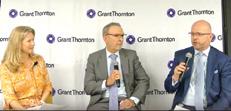
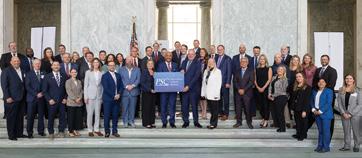

PSC CEO Attends White House Event “Anchored in Faith: Standing Strong for Our Heroes”
PSC CEO James Carroll attended the White House event “Anchored in Hope: Standing Strong for Our Heroes,” in recognition of Suicide Prevention Month and Recovery Month. Pictured here with Kathryn Burgum, Former First Lady of North Dakota and wife of secretary of interior Doug Burgum, and Chad Jackson, Chair of the DC Opioid Abatement Commission.
September 30, PSC organized a meeting with tech industry leaders and the Office of White House Counsel to discuss key AI priorities and how federal contractors can best support the White House’s AI agenda and serve federal government missions. Industry representatives from a dozen companies joined PSC CEO James Carroll and President Stephanie Sanok Kostro for this discussion.
On October 2, PSC’s CEO James Carroll, President Stephanie Sanok Kostro, and VP of Civilian Agencies Krista Sweet had a chance to meeting with ICF leaders at their Reston HQ this week. We look to what’s ahead!

On October 3, PSC member companies met with OMB Deputy Director Eric Ueland on strengthening the industry relations with the Administration and incentivizing a more collaborative, innovative, and outcomes-based federal procurement environment. Industry leaders joined PSC CEO James Carroll and President Stephanie Sanok Kostro for this excellent dialogue.
On October 6, PSC CEO Jim Carroll and ManTech CEO Matt Tait met to discuss the impact of the government shutdown on American contractors as well as ManTech’s important role in supporting the U.S. mission in both defense and civilian agencies.
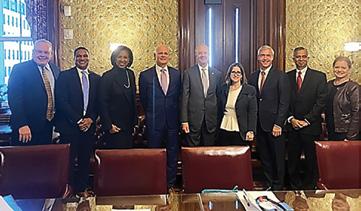
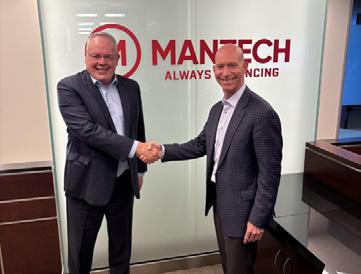
On October 7, Fed Gov Today Host Francis Rose interviewed PSC CEO James Carroll to spotlight the impact of the government shutdown on federal contractors and the businesses that keep government operations running behind the scenes.
Congrats Federal News Network on 25 years!! On October 9, PSC’s President Stephanie Sanok Kostro celebrated the radio and digital news organization’s milestone with Tom Temin and Terry Gerton.
PSC’s Vice President of Defense and Intelligence Steve Harris and Capgemini’s Head of U.S. Defense Sector Sam Hussain at the Association of the United States Army (AUSA) Annual Meeting and Exposition on October 13. AUSA’s three-day event is where the global defense community converges to shape the future of national security.




PSC offers a variety of high-visibility opportunities for your company throughout the year, including event sponsorships, advertising, and year-long partnerships.
Advertising options include: View all options at:
Service Contractor Magazine
The PSC Daily e-Newsletter
Social Media
Council Spotlight e-Newsletters specific to Acquisition and Business Policy, Civilian Agencies, Defense and Intelligence Agencies, International Development & Technology

PSC offers sponsorships for key events at a variety of levels so they’re accessible for small, mid-sized, and large companies:

1-3, 2025