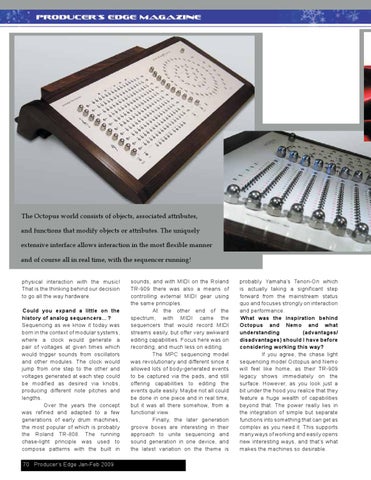
The Octopus world consists of objects, associated attributes, and functions that modify objects or attributes. The uniquely extensive interface allows interaction in the most flexible manner and of course all in real time, with the sequencer running! physical interaction with the music! That is the thinking behind our decision to go all the way hardware. Could you expand a little on the history of analog sequencers…? Sequencing as we know it today was born in the context of modular systems, where a clock would generate a pair of voltages at given times which would trigger sounds from oscillators and other modules. The clock would jump from one step to the other and voltages generated at each step could be modified as desired via knobs, producing different note pitches and lengths. Over the years the concept was refined and adapted to a few generations of early drum machines, the most popular of which is probably the Roland TR-808. The running chase-light principle was used to compose patterns with the built in 70 Producer’s Edge Jan-Feb 2009
sounds, and with MIDI on the Roland TR-909 there was also a means of controlling external MIDI gear using the same principles. At the other end of the spectrum, with MIDI came the sequencers that would record MIDI streams easily, but offer very awkward editing capabilities. Focus here was on recording, and much less on editing. The MPC sequencing model was revolutionary and different since it allowed lots of body-generated events to be captured via the pads, and still offering capabilities to editing the events quite easily. Maybe not all could be done in one piece and in real time, but it was all there somehow, from a functional view. Finally, the later generation groove boxes are interesting in their approach to unite sequencing and sound generation in one device, and the latest variation on the theme is
probably Yamaha’s Tenori-On which is actually taking a significant step forward from the mainstream status quo and focuses strongly on interaction and performance. What was the inspiration behind Octopus and Nemo and what understanding (advantages/ disadvantages) should I have before considering working this way? If you agree, the chase light sequencing model Octopus and Nemo will feel like home, as their TR-909 legacy shows immediately on the surface. However, as you look just a bit under the hood you realize that they feature a huge wealth of capabilities beyond that. The power really lies in the integration of simple but separate functions into something that can get as complex as you need it. This supports many ways of working and easily opens new interesting ways, and that’s what makes the machines so desirable.