BLUEKOFF
I
PROFILE
S
P
E
C
I
A
L
I
T
Y
stirs Thai society
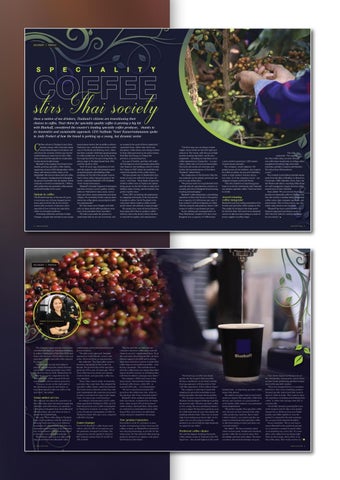
Once a nation of tea drinkers, Thailand’s citizens are transitioning their choices to coffee. Their thirst for speciality quality coffee is proving a big hit with Bluekoff, considered the country’s leading specialty coffee producer, thanks to its innovative and sustainable approach. CEO NutRada ‘Noon’ Kunavivattananon spoke to Andy Probert of how the brand is perking up a young, but dynamic sector.
C
offee culture in Thailand is just three decades young. Still, it has had a deep and profound impact on drinkers: not only from the contents of their cup but the mushrooming at street level of the coffee shop sector and the popularity of speciality locally-derived coffee beans. Bluekoff is the leading Thai brand in the rapidly growing speciality coffee market, supplying at least 6,000 independent coffee shops and national coffee chains of its delightfully-flavoured Arabica-derived coffee. The company, headquartered in Bangkok, has grown in parallel with the market, which annually is worth an estimated $1.1 billion, with predictions the premium coffee market could well double in five years.
Opium to coffee The Bluekoff journey of the last 20 years is one borne out of sheer-dogged persistence and no-little risk by its creator, mixed with an ounce of tenacity and a spoonful of love to bring his speciality coffee to a broader audience. From deep within the notorious Golden Triangle, a region that extends across a large
2
Inside Food & Drink
mountainous border that straddles northern Thailand, Laos, and Myanmar at the confluence of the Ruak and Mekong rivers, there has been a seismic shift from opium-growing to coffee production. It is one of the countless legacies left by the great King Rama IX, whose reign in Thailand lasted from 1946 until his death in 2016. “Over 50 years ago, King Rama IX initiated the project for hill tribe people to grow economical plants, distributing coffee seedlings for the hill tribe people to grow. That’s when coffee replaced opium in the north,” explained Bluekoff’s CEO NutRada ‘Noon’ Kunavivattananon. “Bluekoff’s founder Supachai Srivittaporn had been trying to source quality Arabica coffee in Thailand for many years, across many provinces, many mountains and many villages. He eventually found a special place where the coffee plants are productive with very good quality.” The first steps were fraught with difficulty as these small coffee producers were wary of involvement from ‘outsiders’. “We had to persuade the growers to understand that we are not an investor, and
we wanted to be a part of their community,” explained Noon. Add to that, there was deception: coffee beans were being trucked in from other provinces to be sold as beans from Ban Doi Chang, in Chiang Rai province, at premium prices. In a case of ‘build it, and they will come’, Mr Srivittaporn out of frustration poured his own finances into building a factory in Ban Doi Chang in 2007 where he could directly control the quality of the coffee cherry. “We have grown rice in Thailand for hundreds of year, but coffee for less than 60 years,” said Noon. “King Rama IX gave the Arabica coffee trees to replace the opium being grown by the hill tribes to help their families make a living, and the industry has grown rapidly since. “From 2007, we built up the plantations by engaging with heads of the households to produce coffee. North Thailand is the only place where Arabica coffee can be grown where the altitude is high enough.” The project has since attracted farmers from many hill tribes to produce coffee, which is sent to the factory where the best is selected for quality and manufacture.
“The first step was securing a robust supply chain which we had full sight and control of. The result, with the use of highquality roasting machines, world class equipment – including our machines at our coffee plantation in Chaing Rai – is a speciality coffee that is fresh and memorable. The taste and aroma stir emotions and evokes the mysteriousness of Northern Thailand,” added Noon. The uniqueness of the brand is that the raw material can be picked, processed and put in a cup within days. “We process until it is in parchment form and take that dry parchment to a factory in a nearby province to Bangkok for processing, roasting and packaging.” Bluekoff’s coffee plantation, a wet milling operation in Mae Suai District, Chiang Rai, has a capacity of 2,400 tonnes per year. It buys around 3 million kilograms of coffee cherries annually and produces about 1,500 tonnes of coffee in parchment per year. Its dry milling and roasting facility in Phra Phutthabat, Saraburi Province, near Bangkok, has a capacity of 7,000 tonnes
a year, while it processes 1,500 tonnes of green beans annually. The company, which employs 120 people across all its facilities, also exports its coffee to clients in Laos and Cambodia, while a small amount of green beans – less than 1% of the company’s total – are shipped to Japan and South Korea. “The only intention of exporting green beans is to let the world know that Thailand can produce specialty coffee,” Noon was keen to clarify.
Award-winning coffee integrator Bluekoff is only just raising awareness of its brands and speciality coffee options to the Thai public by turning to the retail sector for the first time. The secret to its domestic success to date has been acting as a back-ofhouse supplier to coffee shops.
The CEO explained: “We support the Thai coffee shop, not only through our coffee bean brands but in selling coffee equipment including high-end coffee machines, grinders, roasters and blenders. We sell at least 400 machines a year.” This extends to promoting branded equipment from the likes of Modbar, La Marzocco, Fiorenzato, CIME, Blendtec, Froco, Kees van der Westen and others, ensuring coffee shops are well-equipped to supply the best coffee experiences to their clientele. Noon added: “We are not only the biggest producer of speciality coffee in Thailand but also the country’s leading totally-integrated coffee value chain company upstream and downstream. This is from crop to cup; the whole value-chain is one-of-a-kind. “Bluekoff has had a solid business to business approach and always seeks to offer the best industry-setting standards for our clients.”
Inside Food & Drink
3