Digitalisation & Smart Cities Sydney Trains
CREDIT: RAILGALLERY.COM.AU
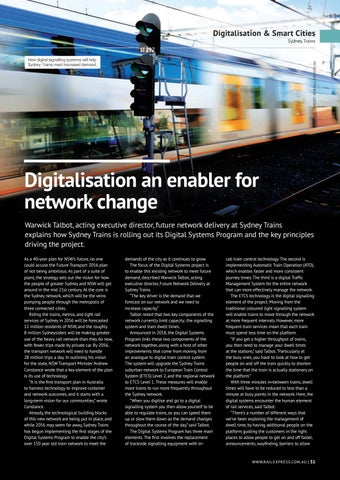
New digital signalling systems will help Sydney Trains meet increased demand.
Digitalisation an enabler for network change Warwick Talbot, acting executive director, future network delivery at Sydney Trains explains how Sydney Trains is rolling out its Digital Systems Program and the key principles driving the project. As a 40-year plan for NSW’s future, no one could accuse the Future Transport 2056 plan of not being ambitious. As part of a suite of plans, the strategy sets out the vision for how the people of greater Sydney and NSW will get around in the mid 21st century. At the core is the Sydney network, which will be the veins pumping people through the metropolis of three connected cities. Riding the trains, metros, and light rail services of Sydney in 2056 will be forecasted 12 million residents of NSW, and the roughly 8 million Sydneysiders will be making greater use of the heavy rail network than they do now, with fewer trips made by private car. By 2056, the transport network will need to handle 28 million trips a day. In outlining his vision for the state, NSW Transport Minister Andrew Constance wrote that a key element of the plan is its use of technology. “It is the first transport plan in Australia to harness technology to improve customer and network outcomes, and it starts with a long-term vision for our communities,” wrote Constance. Already, the technological building blocks of this new network are being put in place, and while 2056 may seem far away, Sydney Trains has begun implementing the first stages of the Digital Systems Program to enable the city’s over 150 year old train network to meet the
demands of the city as it continues to grow. The focus of the Digital Systems project is to enable this existing network to meet future demand, described Warwick Talbot, acting executive director, Future Network Delivery at Sydney Trains. “The key driver is the demand that we forecast on our network and we need to increase capacity.” Talbot noted that two key components of the network currently limit capacity; the signalling system and train dwell times. Announced in 2018, the Digital Systems Program links these two components of the network together, along with a host of other improvements that come from moving from an analogue to digital train control system. The system will upgrade the Sydney Trains suburban network to European Train Control System (ETCS) Level 2, and the regional network to ETCS Level 1. These measures will enable more trains to run more frequently throughout the Sydney network. “When you digitise and go to a digital signalling system you then allow yourself to be able to regulate trains, so you can speed them up or slow them down as the demand changes throughout the course of the day,” said Talbot. The Digital Systems Program has three main elements. The first involves the replacement of trackside signalling equipment with in-
cab train control technology. The second is implementing Automatic Train Operation (ATO), which enables faster and more consistent journey times. The third is a digital Traffic Management System for the entire network that can more effectively manage the network. The ETCS technology is the digital signalling element of the project. Moving from the traditional coloured light signalling system will enable trains to move through the network at more frequent intervals. However, more frequent train services mean that each train must spend less time on the platform. “If you get a higher throughput of trains, you then need to manage your dwell times at the stations,” said Talbot. “Particularly at the busy ones, you have to look at how to get people on and off the train quickly to shorten the time that the train is actually stationary on the platform.” With three minutes in-between trains, dwell times will have to be reduced to less than a minute at busy points in the network. Here, the digital systems encounter the human element of rail services, said Talbot. “There’s a number of different ways that we’ve been exploring the management of dwell time, by having additional people on the platform guiding the customers in the right places to allow people to get on and off faster, announcements, wayfinding, barriers to allow
WWW.RAILEXPRESS.COM.AU | 31