WATER/WASTEWATER
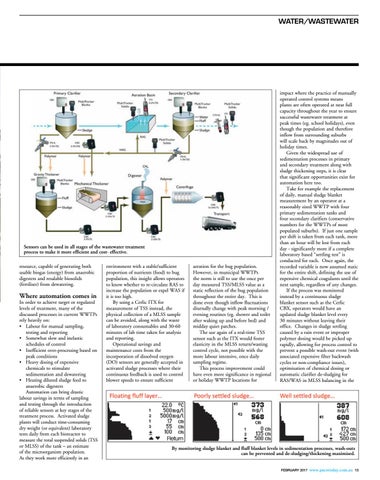
Sensors can be used in all stages of the wastewater treatment process to make it more efficient and cost- effective. resource, capable of generating both usable biogas (energy) from anaerobic digesters and resalable biosolids (fertiliser) from dewatering.
Where automation comes in
In order to achieve target or regulated levels of treatment, many of the discussed processes in current WWTPs rely heavily on: • Labour for manual sampling, testing and reporting • Somewhat slow and inelastic schedules of control • Inefficient over-processing based on peak conditions • Heavy dosing of expensive chemicals to stimulate sedimentation and dewatering • Heating diluted sludge feed to anaerobic digesters Automation can bring drastic labour savings in terms of sampling and testing through the introduction of reliable sensors at key stages of the treatment process. Activated sludge plants will conduct time-consuming dry weight (or equivalent) laboratory tests daily from each bioreactor to measure the total suspended solids (TSS or MLSS) of the tank – an estimate of the microorganism population. As they work more efficiently in an
environment with a stable/sufficient proportion of nutrients (food) to bug population, this insight allows operators to know whether to re-circulate RAS to increase the population or expel WAS if it is too high. By using a Cerlic ITX for measurement of TSS instead, the physical collection of a MLSS sample can be avoided, along with the waste of laboratory consumables and 30-60 minutes of lab time taken for analysis and reporting. Operational savings and maintenance costs from the incorporation of dissolved oxygen (DO) sensors are generally accepted in activated sludge processes where their continuous feedback is used to control blower speeds to ensure sufficient
aeration for the bug population. However, in municipal WWTPs the norm is still to use the once per day measured TSS/MLSS value as a static reflection of the bug population throughout the entire day. This is done even though inflow fluctuations diurnally change with peak morning / evening routines (eg. shower and toilet after waking up and before bed) and midday quiet patches. The use again of a real-time TSS sensor such as the ITX would foster elasticity in the MLSS return/wasting control cycle, not possible with the more labour intensive, once daily sampling regime. This process improvement could have even more significance in regional or holiday WWTP locations for
impact where the practice of manually operated control systems means plants are often operated at near full capacity throughout the year to ensure successful wastewater treatment at peak times (eg. school holidays), even though the population and therefore inflow from surrounding suburbs will scale back by magnitudes out of holiday times. Given the widespread use of sedimentation processes in primary and secondary treatment along with sludge thickening steps, it is clear that significant opportunities exist for automation here too. Take for example the replacement of daily, manual sludge blanket measurement by an operator at a reasonably sized WWTP with four primary sedimentation tanks and four secondary clarifiers (conservative numbers for the WWTPs of most populated suburbs). If just one sample per shift is taken from each tank, more than an hour will be lost from each day - significantly more if a complete laboratory based “settling test” is conducted for each. Once again, the recorded variable is now assumed static for the entire shift, defining the use of expensive chemical coagulants until the next sample, regardless of any changes. If the process was monitored instead by a continuous sludge blanket sensor such as the Cerlic CBX, operators would have an updated sludge blanket level every 30 minutes without leaving their office. Changes in sludge settling caused by a rain event or improper polymer dosing would be picked up rapidly, allowing for process control to prevent a possible wash-out event (with associated expensive filter backwash cycles or non-compliance issues), optimisation of chemical dosing or automatic clarifier de-sludging for RAS/WAS in MLSS balancing in the
By monitoring sludge blanket and fluff blanket levels in sedimentation processes, wash-outs can be prevented and de-sludging/thickening maximised. FEBRUARY 2017 www.pacetoday.com.au 13