The Hawkei from Thales was a prime centrepiece at NMW.
Pavilion and showcased the capabilities of Australia’s precision engineering and advanced manufacturing industry. As well as featuring a diverse array of Australian component manufacturers, precision engineering firms, toolmakers, advanced manufacturers and general engineering companies, major exhibits featured were original equipment manufacturers (OEMs), including the Hawkei protected mobility vehicle from Thales, and a prime mover from Paccar. International machine tool companies like Amada, DMG Mori
and Swiss laser cutting experts, Bystronic, virtually stole the show with massive booths that demonstrated their commitment to Australian manufacturing. “There is a good case for large precision engineering companies to invest their products here in Oceania especially since the industries that require large-scale, precision cutting machines are restructuring to meet the increased demands of their clients,” said Johan Elster, president of business units, Bystronic. Recipients of the Victorian Government’s 2017 Victorian Manufacturing Hall of Fame and
Manufacturers’ Monthly’s Endeavour Awards were both announced during the event, each celebrating excellence and outstanding achievements of Australia’s manufacturing movers and shakers. Major partners included the Victorian Government, Advanced Manufacturing Growth Centre, Australian Advanced Manufacturing Council, CSIRO, Innovative Manufacturing CRC, Supply Chain and Logistics Association of Australia, Welding Technology Institute of Australia and the Institute of Instrumentation Control and Automation.
A chat about augmented reality
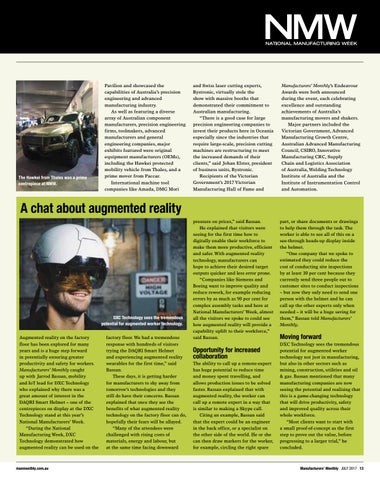
DXC Technology sees the tremendous potential for augmented worker technology. Augmented reality on the factory floor has been explored for many years and is a huge step forward in potentially ensuring greater productivity and safety for workers. Manufacturers’ Monthly caught up with Jarrod Bassan, mobility and IoT lead for DXC Technology who explained why there was a great amount of interest in the DAQRI Smart Helmet – one of the centrepieces on display at the DXC Technology stand at this year’s National Manufacturers’ Week. “During the National Manufacturing Week, DXC Technology demonstrated how augmented reality can be used on the
manmonthly.com.au
factory floor. We had a tremendous response with hundreds of visitors trying the DAQRI Smart Helmet and experiencing augmented reality wearables for the first time,” said Bassan. These days, it is getting harder for manufacturers to shy away from tomorrow’s technologies and they still do have their concerns. Bassan explained that once they see the benefits of what augmented reality technology on the factory floor can do, hopefully their fears will be allayed. “Many of the attendees were challenged with rising costs of materials, energy and labour, but at the same time facing downward
pressure on prices,” said Bassan. He explained that visitors were seeing for the first time how to digitally enable their workforce to make them more productive, efficient and safer. With augmented reality technology, manufacturers can hope to achieve their desired target outputs quicker and less error prone. “Companies like Siemens and Boeing want to improve quality and reduce rework, for example reducing errors by as much as 90 per cent for complex assembly tasks and here at National Manufacturers’ Week, almost all the visitors we spoke to could see how augmented reality will provide a capability uplift to their workforce,” said Bassan.
Opportunity for increased collaboration The ability to call up a remote-expert has huge potential to reduce time and money spent travelling, and allows production issues to be solved faster. Bassan explained that with augmented reality, the worker can call up a remote expert in a way that is similar to making a Skype call. Citing an example, Bassan said that the expert could be an engineer in the back office, or a specialist on the other side of the world. He or she can then draw markers for the worker, for example, circling the right spare
part, or share documents or drawings to help them through the task. The worker is able to see all of this on a see-through heads-up display inside the helmet. “One company that we spoke to estimated they could reduce the cost of conducting site inspections by at least 30 per cent because they currently send three people out to customer sites to conduct inspections – but now they only need to send one person with the helmet and he can call up the other experts only when needed – it will be a huge saving for them,” Bassan told Manufacturers’ Monthly.
Moving forward DXC Technology sees the tremendous potential for augmented worker technology not just in manufacturing, but also in other sectors such as mining, construction, utilities and oil & gas. Bassan mentioned that many manufacturing companies are now seeing the potential and realising that this is a game-changing technology that will drive productivity, safety and improved quality across their whole workforce. “Most clients want to start with a small proof-of-concept as the first step to prove out the value, before progressing to a larger trial,” he concluded.
Manufacturers’ Monthly JULY 2017 13