ASSOCIATIONS qldwater
Streamlining the dark art of trade waste Streamlining trade waste management in Queensland’s regional water utilities is long overdue. By cutting through the complexities, compliance can be achieved without overwhelming councils. TRADE WASTE MANAGEMENT in Queensland’s regional water utilities is often seen as a “dark art,” where the lack of a coordinated, state-wide framework leads to inconsistent practices across the state. In a recent presentation, industry veteran Col Hester explored what he terms a “stream of consciousness fever dream” about trade waste management in regional Queensland and asked a critical question: what is the least you could do and still claim to be a competent trade waste manager? This question is pertinent given Queensland’s vast geography and diverse regional communities. The lack of a unified approach means that trade waste management, typically seen as an administrative burden, is often overcomplicated or under-managed, particularly in remote areas. As Hester explains, the absence of meaningful guidance from regulators has forced regional councils to either ignore their obligations or develop individual policies. This leads to inefficiency and inconsistent outcomes across the state. The challenge: regional disparities Queensland’s sheer size presents a unique challenge. Many regional centres are located further from the state’s capital than they are from cities in neighbouring states, making regional challenges particularly acute. While larger centres like Cairns, Townsville, and Mackay have the resources to implement trade waste management frameworks that rival their metropolitan counterparts,
56
smaller and more remote towns struggle. Some small towns are challenged to maintain sewerage schemes serving fewer than 500 people. In these areas, trade waste management can become an afterthought. Yet, under Queensland’s Water Supply (Safety and Reliability) Act, water service providers must have a system to assess and approve trade waste discharges into their sewerage systems. The absence of a clear and coordinated model leaves many councils reinventing the wheel. One example Hester provides is Mornington Island’s small community of Gununa, where fewer than 1,000 residents rely on a sewerage system. Despite this small scale, commercial activities such as hospitals and schools technically discharge trade waste into the system. Under Queensland legislation, these activities should be the subject of a regulated system of assessments and approvals. Yet, the scale and scope of the community make significant trade waste management efforts impractical. So, how can regional councils balance compliance with practicality? Hester proposes a simple yet effective solution: an efficient, minimalistic approach to trade waste management that ensures compliance while reducing unnecessary burdens. A model trade waste management plan Hester’s answer to the problem lies in a Model Trade Waste
INSIDE WATER November/December 2024
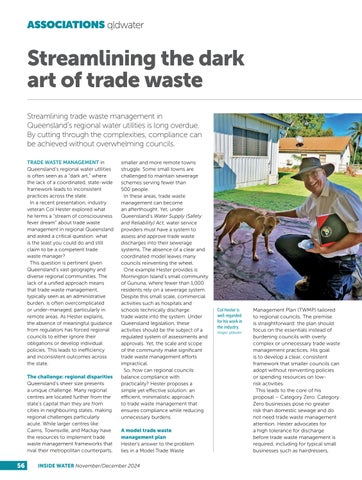
Col Hester is well regarded for his work in the industry. Images: qldwater
Management Plan (TWMP) tailored to regional councils. The premise is straightforward: the plan should focus on the essentials instead of burdening councils with overly complex or unnecessary trade waste management practices. His goal is to develop a clear, consistent framework that smaller councils can adopt without reinventing policies or spending resources on lowrisk activities. This leads to the core of his proposal – Category Zero. Category Zero businesses pose no greater risk than domestic sewage and do not need trade waste management attention. Hester advocates for a high tolerance for discharge before trade waste management is required, including for typical small businesses such as hairdressers,