Tapping the earth’s stored energy with a
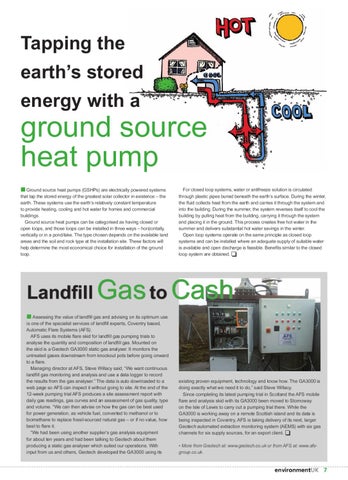
ground source heat pump n Ground source heat pumps (GSHPs) are electrically powered systems that tap the stored energy of the greatest solar collector in existence – the earth. These systems use the earth’s relatively constant temperature to provide heating, cooling and hot water for homes and commercial buildings. Ground source heat pumps can be categorised as having closed or open loops, and those loops can be installed in three ways – horizontally, vertically or in a pond/lake. The type chosen depends on the available land areas and the soil and rock type at the installation site. These factors will help determine the most economical choice for installation of the ground loop.
For closed loop systems, water or antifreeze solution is circulated through plastic pipes buried beneath the earth’s surface. During the winter, the fluid collects heat from the earth and carries it through the system and into the building. During the summer, the system reverses itself to cool the building by pulling heat from the building, carrying it through the system and placing it in the ground. This process creates free hot water in the summer and delivers substantial hot water savings in the winter. Open loop systems operate on the same principle as closed loop systems and can be installed where an adequate supply of suitable water is available and open discharge is feasible. Benefits similar to the closed loop system are obtained. q
Landfill Gas to Cash n Assessing the value of landfill gas and advising on its optimum use is one of the specialist services of landfill experts, Coventry based, Automatic Flare Systems (AFS). AFS uses its mobile flare skid for landfill gas pumping trials to analyse the quantity and composition of landfill gas. Mounted on the skid is a Geotech GA3000 static gas analyser. It monitors the untreated gases downstream from knockout pots before going onward to a flare. Managing director at AFS, Steve Willacy said, “We want continuous landfill gas monitoring and analysis and use a data logger to record the results from the gas analyser.” The data is auto downloaded to a web page so AFS can inspect it without going to site. At the end of the 12-week pumping trial AFS produces a site assessment report with daily gas readings, gas curves and an assessment of gas quality, type and volume. “We can then advise on how the gas can be best used for power generation, as vehicle fuel, converted to methanol or to biomethane to replace fossil-sourced natural gas – or if no value, how best to flare it. “We had been using another supplier’s gas analysis equipment for about ten years and had been talking to Geotech about them producing a static gas analyser which suited our operations. With input from us and others, Geotech developed the GA3000 using its
existing proven equipment, technology and know how. The GA3000 is doing exactly what we need it to do,” said Steve Willacy. Since completing its latest pumping trial in Scotland the AFS mobile flare and analysis skid with its GA3000 been moved to Stornoway on the Isle of Lewis to carry out a pumping trial there. While the GA3000 is working away on a remote Scottish island and its data is being inspected in Coventry, AFS is taking delivery of its next, larger Geotech automated extraction monitoring system (AEMS) with six gas channels for six supply sources, for an export client. q • More from Geotech at: www.geotech.co.uk or from AFS at: www.afsgroup.co.uk.
environmentUK