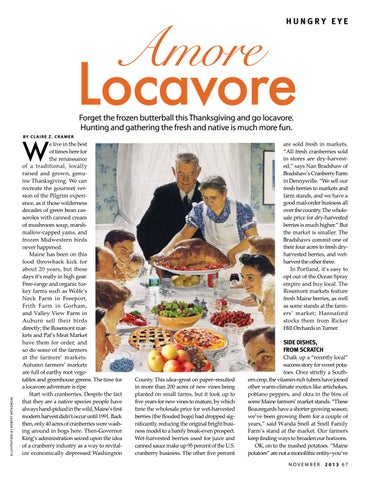
Amore Locavore
hungry eye
Forget the frozen butterball this thanksgiving and go locavore. Hunting and gathering the fresh and native is much more fun.
by c l a i r e Z . c r a m e r
illustratioN by robert witkowski
W
e live in the best of times here for the renaissance of a traditional, locally raised and grown, genuine Thanksgiving. We can recreate the gourmet version of the Pilgrim experience, as if those wilderness decades of green bean casseroles with canned cream of mushroom soup, marshmallow-capped yams, and frozen Midwestern birds never happened. Maine has been on this food throwback kick for about 20 years, but these days it’s really in high gear. Free-range and organic turkey farms such as Wolfe’s Neck Farm in Freeport, Frith Farm in Gorham, and Valley View Farm in Auburn sell their birds directly; the Rosemont markets and Pat’s Meat Market have them for order, and so do some of the farmers at the farmers’ markets. Autumn farmers’ markets are full of earthy root vegetables and greenhouse greens. The time for a locavore adventure is ripe. Start with cranberries. Despite the fact that they are a native species people have always hand-picked in the wild, Maine’s first modern harvest didn’t occur until 1991. Back then, only 40 acres of cranberries were washing around in bogs here. Then-Governor King’s administration seized upon the idea of a cranberry industry as a way to revitalize economically depressed Washington
are sold fresh in markets. “All fresh cranberries sold in stores are dry-harvested,” says Nan Bradshaw of Bradshaw’s Cranberry Farm in Dennysville. “We sell our fresh berries to markets and farm stands, and we have a good mail-order business all over the country. The wholesale price for dry-harvested berries is much higher.” But the market is smaller. The Bradshaws commit one of their four acres to fresh dryharvested berries, and wetharvest the other three. In Portland, it’s easy to opt out of the Ocean Spray empire and buy local. The Rosemont markets feature fresh Maine berries, as well as some stands at the farmers’ market; Hannaford stocks them from Ricker Hill Orchards in Turner.
side dishes, from scratch
County. This idea–great on paper–resulted in more than 200 acres of new vines being planted on small farms, but it took up to five years for new vines to mature, by which time the wholesale price for wet-harvested berries (the flooded bogs) had dropped significantly, reducing the original bright business model to a barely break-even prospect. Wet-harvested berries used for juice and canned sauce make up 95 percent of the U.S. cranberry business. The other five percent
Chalk up a “recently local” success story for sweet potatoes. Once strictly a Southern crop, the vitamin-rich tubers have joined other warm-climate exotics like artichokes, poblano peppers, and okra in the bins of some Maine farmers’ market stands. “These Beauregards have a shorter growing season; we’ve been growing them for a couple of years,” said Wanda Snell at Snell Family Farm’s stand at the market. Our farmers keep finding ways to broaden our horizons. OK, on to the mashed potatoes. “Maine potatoes” are not a monolithic entity–you’ve November
2013 67