Vet Insight
Knowledge
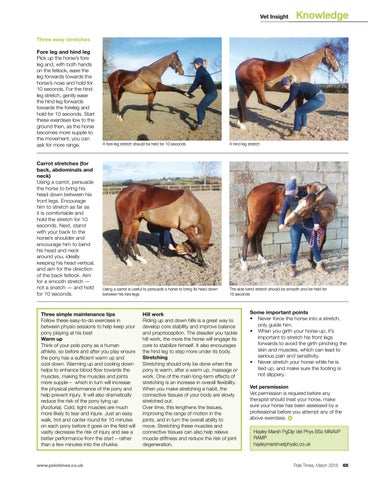
Three easy stretches Fore leg and hind leg Pick up the horse’s fore leg and, with both hands on the fetlock, ease the leg forwards towards the horse’s nose and hold for 10 seconds. For the hind leg stretch, gently ease the hind leg forwards towards the foreleg and hold for 10 seconds. Start these exercises low to the ground then, as the horse becomes more supple to the movement, you can ask for more range.
A fore leg stretch should be held for 10 seconds
A hind leg stretch
Carrot stretches (for back, abdominals and neck) Using a carrot, persuade the horse to bring his head down between his front legs. Encourage him to stretch as far as it is comfortable and hold the stretch for 10 seconds. Next, stand with your back to the horse’s shoulder and encourage him to bend his head and neck around you, ideally keeping his head vertical, and aim for the direction of the back fetlock. Aim for a smooth stretch — not a snatch — and hold for 10 seconds.
Using a carrot is useful to persuade a horse to bring its head down between his fore legs
The side bend stretch should be smooth and be held for 10 seconds
Three simple maintenance tips Follow these easy-to-do exercises in between physio sessions to help keep your pony playing at his best Warm up Think of your polo pony as a human athlete, so before and after you play ensure the pony has a sufficient warm up and cool down. Warming up and cooling down helps to enhance blood flow towards the muscles, making the muscles and joints more supple – which in turn will increase the physical performance of the pony and help prevent injury. It will also dramatically reduce the risk of the pony tying up (Azoturia). Cold, tight muscles are much more likely to tear and injure. Just an easy walk, trot and canter round for 10 minutes on each pony before it goes on the field will vastly decrease the risk of injury and see a better performance from the start – rather than a few minutes into the chukka.
www.polotimes.co.uk
Hill work Riding up and down hills is a great way to develop core stability and improve balance and proprioception. The steadier you tackle hill work, the more the horse will engage its core to stabilize himself. It also encourages the hind leg to step more under its body. Stretching Stretching should only be done when the pony is warm, after a warm up, massage or work. One of the main long-term effects of stretching is an increase in overall flexibility. When you make stretching a habit, the connective tissues of your body are slowly stretched out. Over time, this lengthens the tissues, improving the range of motion in the joints, and in turn the overall ability to move. Stretching these muscles and connective tissues can also help relieve muscle stiffness and reduce the risk of joint degeneration.
Some important points • Never force the horse into a stretch, only guide him. • When you girth your horse up, it’s important to stretch his front legs forwards to avoid the girth pinching the skin and muscles, which can lead to serious pain and sensitivity. • Never stretch your horse while he is tied up, and make sure the footing is not slippery. Vet persmission Vet permission is required before any therapist should treat your horse, make sure your horse has been assessed by a professional before you attempt any of the above exercises. Hayley Marsh PgDip Vet Phys BSc MNAVP RAMP hayleymarshvetphysio.co.uk
Polo Times, March 2018
65