PTAugust 2009 p58-59 Feeding YC MB
24/7/09
11:13
Page 3
Feeding The knowledge Lorna Jowett, specialist equine nutritionist, gives expert advice on all things edible
Why do some players muzzle their ponies? What are the pros and cons? Good question! Basically, the idea is to stop ponies eating their bedding, so they don’t get colic or so their performance isn’t hindered from being “heavy”. However, personally I don’t think there are any benefits to using muzzles, unless your vet advises it. And, as far as drawbacks are concerned, where do I start?
Buena pregunta! Básicamente para evitar que los caballos se coman la viruta de las camas sufran cólicos, o que su desempeño se vea afectado por estar “pesados”. En lo personal, no creo que existan beneficios en el uso de trompetas, a menos que lo haya prescrito el veterinario. Desventajas: por dónde empiezo?
Psychologically, it’s depressing for a horse not to be allowed to chew. Chewing is natural for animals that have evolved to trickle-feed, which is why many ponies try to scoop bedding into their muzzles – only to have the top and holes taped up. Scientific research proves that horses deprived of fibre are more likely to develop behaviour such as wind-sucking, cribbing and weaving, leading to a more acidic gut and further behavioural issues.
Psicológicamente, es deprimente para el caballo que no le permitan masticar. El masticar es un acto natural en animales que han evolucionado con la necesidad de comer en forma casi constante pequeñas cantidades, es por eso que el caballo entrompetado tiende a levantar viruta por los agujeros, hasta que estos son tapados.
Physically, the digestive tract is compromised and the beneficial bacteria in the hindgut are disrupted, increasing the risks of colic and affecting overall health, fitness and exercise tolerance. The gut is mechanically compromised when empty, which heightens the chance of twisted gut and gas colic. When polo ponies stand for several hours wearing a muzzle, they cannot chew, so saliva is not produced. Saliva acts as a “buffer” to the acid that is constantly produced in the stomach and, if the stomach is empty for long periods, this acid “spits” into unprotected areas, causing ulceration.
Investigaciones científicas demostran que caballos a los que se los priva de fibra son mas propensos a desarrollar un comportamiento estereotipado como chupar aire y el amaqueo, generando otras complicaciones serias como un intestino ácido y problemas de conducta. Físicamente, el sistema digestivo se ve comprometido cuando bacteria benéfica en el intestino se ve alterada, aumentando el riesgo de cólicos y afectando a la salud del animal, su estado físico y su respuesta al ejercicio. Mecánicamente el intestino se ve comprometido al estar vacío, lo que incrementa las posibilidades de un intestino retorcido y cólicos por gases.
Excess acid may also eventually enter the small intestine and hindgut, where absorption of nutrients (hard feed) and fibre will be disrupted considerably, killing off beneficial bacteria.
Cuando los caballos de polo pasan varias horas entrompetados, no pueden masticar por lo que no producen saliva. La saliva actúa como defensa contra el ácido que produce el estómago y, si el estómago esta vacío por períodos prolongados, el ácido salpica áreas desprotegidas, ocasionando úlceras. El exceso de ácido eventualmente puede llegar a los intestinos donde se produce la absorción de nutrientes y fibra, eliminando bacterias beneficiarias y ocasionando considerables incovenientes.
Overall, muzzles are not good news for polo ponies. F
En general, entrompetar es perjudicial para el caballo. F
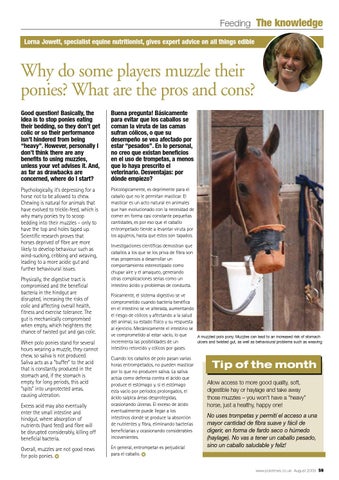
A muzzled polo pony. Muzzles can lead to an increased risk of stomach ulcers and twisted gut, as well as behavioural problems such as weaving
Tip of the month Allow access to more good quality, soft, digestible hay or haylage and take away those muzzles – you won’t have a “heavy” horse, just a healthy, happy one! No uses trompetas y permití el acceso a una mayor cantidad de fibra suave y fácil de digerir, en forma de fardo seco o húmedo (haylage). No vas a tener un caballo pesado, sino un caballo saludable y feliz!
www.polotimes.co.uk August 2009 59