OIKO_POLIS
GENERATIVE PROCESS FROM CELL TO ORGANISM Student: Supervisor:
Saimir Kristo Skender Luarasi
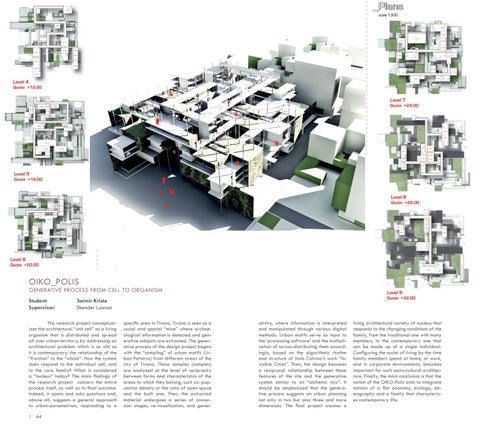
This research project conceptualizes the architectural “unit cell” as a living organism that is distributed and spread all over urban territory, by addressing an architectural problem which is as old as it is contemporary: the relationship of the “fraction” to the “whole”. How the system does respond to the individual cell, and to the core family? What is considered a “nucleus” today? The main findings of the research project concern the entire process itself, as well as its final outcome. Indeed, it opens and asks questions and, above all, suggests a general approach to urban-parametrism, responding to a | 44
specific area in Tirana. Tirana is seen as a social and spatial “mine” where archaeological information is detected and generative subjects are extracted. The generative process of the design project begins with the “sampling” of urban motifs (Urban Patterns) from different areas of the city of Tirana. These samples (samples) are analyzed at the level of reciprocity between forms and characteristics of the areas to which they belong, such as: population density or the ratio of open space and the built one. Then, the extracted material undergoes a series of conversion stages, re-visualization, and gener-
ativity, where information is interpreted and manipulated through various digital methods. Urban motifs serve as input to the ‘processing software’ and the multiplication of across-distributing them accordingly, based on the algorithmic rhythm and structure of Italo Calvino’s work “Invisible Cities”. Then, the design becomes a reciprocal relationship between these features of the site and the generative system similar to an “alchemic mix”. It should be emphasized that the generative process suggests an urban planning not only in two but also three and more dimensions. The final project creates a
living architectural variety of nucleus that responds to the changing conditions of the family, from the traditional one with many members, to the contemporary one that can be made up of a single individual. Configuring the nuclei of living by the time family members spend at home, at work, and in corporate environments, becomes important for such socio-cultural architecture. Finally, the main conclusion is that the notion of the OIKO-Polis aims to integrate notions of a flat economy, ecology, demography and a family that characterizes contemporary life.