Three important POINTS on the site
IO AT
em
r
ar Ma Bajrakt
The Bajaraktar Tyrbe was built in honor of Sultan Murat's standard-bearer, who was killed during the battle in 1389. The tomb is an important sanctuary for the followers of the Sadije dervish order, of which Sultan Murat's standard-bearer is believed to have been a member.
In
leu uso
Gjinolli. Since 1957 the group of buildings Including the servants,guest house and family house belongs Museum. On the left side of the main door the court may be the only building that has survived
t ura
m
Me
r we l To
ria
r kta
jra
Ba
DRIVING FORCE - INPUT - PICTOGRAM
uso Ma leu
In order to prevent, protect and create a green and sustainable environment we need to appropriate an ecological Ribon in between. After we ensure the site th element, the three with that historic POINTS are now connected via flexible and dynamic PATH.
Regi o
Mehmet II al-Fatih - Conqueror, only eight years after the fall of Constantinople. It is located in the heart of the old city center, and is the largest mosque and most prominent Pristina. Its cupola was once the largest in the region, while today it is the only mosque built by Sultan Mehmet II still survives in these areas. The square in front of the Mosque has always been a popular place for meetings
The patterns and motifs on kilim rugs have a symbolic language. Thus, any of symbolic, iconic or indexical motifs (signs) on kilim rugs can help transfer the cultural data of that time to the present day, therefore kilims are media of ttransferring cultural heredity as well.
Scu
lptu re
Gar den
n
2 km
ral ltu Cu
ati o
Rehearsal & Artisanal Space
Green M arket
The original bell was brought from Moldavia and carrying date . In the old mechanism was changed in electric system. Sahat kulla has difficulties to show the correct time
en ter Re cycl in
g Rin Cen tral
ace
Trai ls
Sustain
tum ore
Performing Arts
Arb
Celebrate
gC
l Ev ents
Mu sica
s&
er
use
en
City Bord
Ho
ard eG tiv Na
built in the early XV century by Sultan Bayazid to commemorating the victory of the Ottoman forces in in 1389. This mosque is the oldest building in Prishtina today. In the past Mosque Carshi covered bazaar of Pristina. today there nothing left of the old bazaar, just name Bazaar Mosque serves us remember it. Many subsequent changes for its repair have altered original of this mosque, but its symbol - topped minaret - has survived for more than 600 years. The mosque is also called 'Stone Mosque
ters ea
Th
HISTORIC ZONEWhere Place OF THE CITYTell Its Story
was a wealthy citizen of Pristina and Skopje governor in 1842. According to inscriptions inside the mosque, it was built in 1834. Original gate is destroyed by expansion of the traffic road
&G
ree nsp
on
ibiti
Exh
Info rm
nineteenth century. After a fire Organize upper part was rebuilt with brick.
Vis ito r
s&
n&
rie
Ori
en tati o
PROGRAM DIAGRAM Gaddes in Throne ABSTRACT
lle Ga
The building of the Austro-Hungarian style, initially built for the regional administration of Kosovo. From 1945 until 1975, it served as headquarters for the National Yugoslav Army From1963, it is Museum Kosovo with collection of extensive archaeological and ethnological artifacts
e on lZ na tio ea cr s Instalation Re ld Fie nal n atio atio Educ v lti Cu
nal Road
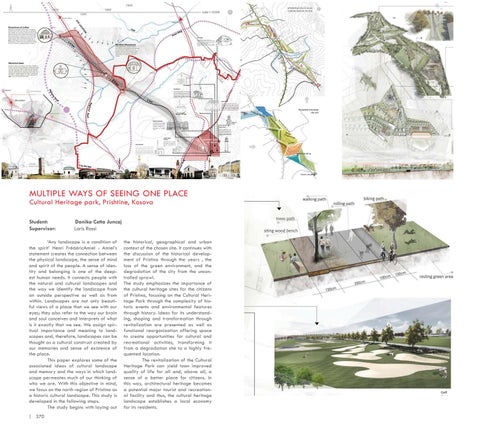
Design is Synagogue clear and bold. One continuous meandering line, an ecological spine that wanders through the park to frame distinct and memorable "Parks within the Park", reconnecting history environment , recreation and edu education. This wandering line, rich with woodland walks and outlooks, combines architecture and landscape to enhance the topography of the site, • link multiple programs, and offer dynamic views of the park. From the city to the park, Once there was a fundamental part of complex King Mosque (Fatih) and has served as social meeting the park to the historic monuments, and from the historic monuments to the ecological place for both men and City women. According to legend, Sultan Mehmet Al-Fatih has ordered all workcorridor and recreational places, design for Culture heritage Park weaves ers, who worked on the construction of Fatih mosque Hamam to have a right to be washed every day. tapestries of prior histories and new futures into a place where the Following a fire 1994 was severely destroyed and lost its functionality. Nowadays becoming restoration natural and manmade identities, cultivation and civilization Historic Building are free to wander and overlap – inviting both the Mosque of Llap citizens of Pristina and visitors around the world to create their own tapestry of new experiences
m
km
oa d
g
Rin
.the destruction of the old bazaar During the 1990s, this complex is used as a museum of nature From 2003, is turned into an ethnological museum
nM
ulta
fS mo
6 0.
R ay hw Hig
CONCEPT & PROGRAM
m usoleuner
We have three monumental / historical POINTS in which they create very flexible and dynamic Triangle Module
Ma Was built in 1953 to pay tribute to the heroes of battle of Kosovo. The tower 25m was designed by Aleksandar Deroko is of stone set in the middle of a large concrete base which have been added later and to circular concrete tubes that have been added after the original base construction. It is in the shape of a medieval tower. The Tower is reached from the Pristinë - Mitrovicë highway, on a 50 m hill above the plain, ca. 5 km north-west from Pristina.
ria
M
N
km
Prof. Loris Rossi Student: Donika ÇETTA-JUNÇAJ
OC EL
1.6
er ow lT
rive
3D VISUALISATION
Prof. Loris Rossi Student: Donika ÇETTA-JUNÇAJ
SIT
Build by his son Bayazid in 14th century. It is believed that the tomb is in the same spot where he died at the Kosova Battle. The mausoleum of Sultan Murad is a small, pleasant, domed structure made of stone which looks like a mosque without a minaret. It is one of the oldest Ottoman monuments in Balkan and is one of the most visited religious, historic and cultural monuments in Kos Kosovo. Descendants of the sultan’s Turbedary family (tomb-keeper in Turkish) have maintained the tomb site for over six centuries, hosting thousands of visitors.
APPROPRIATION OF KILIM CONFIGURATION ON SITE
urat
ltan M
m of Su
oleu Ma us
PROGRAM DIAGRAM ON SITE
Pon Play ds geou
scale 1:2000
nds
Lounge Rid e ing itheatr Amph
Sustainability Education
The developing a suggested program is based on community feedback, analysis of physical opportunities of the site, and professional expertise of municipal official and proffesionals. Program Opportunities This park has three distinctive areas of focus that recommends building a program to encompass: • Organize: The park should serve as the central location for ‘organizing the visitor experience’ in the Cultural heritage park area. • Celeb Celebrate: The Park can serve as the premier outdoor event space for celebrating the heritage, culture, and special events that make this Park unique. • Sustain: Reflective of community priorities, this park should focus on sustainable practices.
Historic Building infopoint Flo we r
Ga
rde
n
Historic Building
MULTIPLE WAYS OF SEEING ONE PLACE Cultural Heritage park, Prishtine, Kosova Student: Supervisor:
Donika Cetta Juncaj Loris Rossi
‘Any landscape is a condition of the spirit’ Henri FrédéricAmiel - Amiel’s statement creates the connection between the physical landscape, the sense of mind and spirit of the people. A sense of identity and belonging is one of the deepest human needs. It connects people with the natural and cultural landscapes and the way we identify the landscape from an outside perspective as well as from within. Landscapes are not only beautiful views of a place that we see with our eyes; they also refer to the way our brain and soul conceives and interprets of what is it exactly that we see. We assign spiritual importance and meaning to landscapes and, therefore, landscapes can be thought as a cultural construct created by our memories and sense of existence of the place. This paper explores some of the associated ideas of cultural landscape and memory and the ways in which landscape permeates much of our thinking of who we are. With this objective in mind, we focus on the north region of Pristina as a historic cultural landscape. This study is developed in the following steps. The study begins with laying out | 370
the historical, geographical and urban context of the chosen site. It continues with the discussion of the historical development of Pristina through the years , the loss of the green environment, and the degradation of the city from the uncontrolled sprawl. The study emphasizes the importance of the cultural heritage sites for the citizens of Pristina, focusing on the Cultural Heritage Park through the complexity of historic events and environmental features through history. Ideas for its understanding, shaping and transformation through revitalization are presented as well as functional reorganization offering space to create opportunities for cultural and recreational activities, transforming it from a degradation site to a highly frequented location. The revitalization of the Cultural Heritage Park can yield toan improved quality of life for all and, above all, a sense of a better place for citizens. In this way, architectural heritage becomes a potential major tourist and recreational facility and thus, the cultural heritage landscape establishes a local economy for its residents.
scale 1:2000
Golf Fields