CRITICAL REVIEW OF RESTAURATION
METHODOLOGY OF THE ARCHITECTURE HERITAGE ADOPTED IN ALBANIA IN THE LAST 20 YEARS AS A SORT OF TOOLS TO RECONSIDER STRUCTURE AND THE TRADITIONAL COMPONENTS AS AESTHETIC Student: Supervisor:
Ardit Lila Vera Bushati
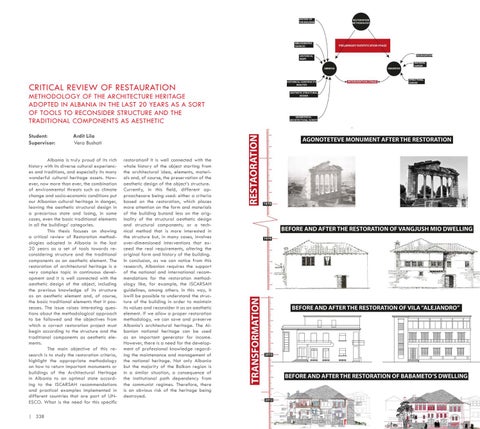
Albania is truly proud of its rich history with its diverse cultural experiences and traditions, and especially its many wonderful cultural heritage assets. However, now more than ever, the combination of environmental threats such as climate change and socio-economic conditions put our Albanian cultural heritage in danger, leaving the aesthetic structural design in a precarious state and losing, in some cases, even the basic traditional elements in all the buildings’ categories. This thesis focuses on showing a critical review of Restoration methodologies adopted in Albania in the last 20 years as a set of tools towards reconsidering structure and the traditional components as an aesthetic element. The restoration of architectural heritage is a very complex topic in continuous development and it is well connected with the aesthetic design of the object, including the previous knowledge of its structure as an aesthetic element and, of course, the basic traditional elements that it possesses. The issue raises interesting questions about the methodological approach to be followed and the objectives from which a correct restoration project must begin according to the structure and the traditional components as aesthetic elements. The main objective of this research is to study the restoration criteria, highlight the appropriate methodology on how to return important monuments or buildings of the Architectural Heritage in Albania to an optimal state according to the ISCARSAH recommendations and practical examples implemented in different countries that are part of UNESCO. What is the need for this specific | 338
restoration? It is well connected with the whole history of the object starting from the architectural idea, elements, materials and, of course, the preservation of the aesthetic design of the object’s structure. Currently, in this field, different approachesare being used: either a criteria based on the restoration, which places more attention on the form and materials of the building butand less on the originality of the structural aesthetic design and structural components; or a technical method that is more interested in the structure but, in many cases, involves over-dimensioned interventions that exceed the real requirements, altering the original form and history of the building. In conclusion, as we can notice from this research, Albanian requires the support of the national and international recommendations for the restoration methodology like, for example, the ISCARSAH guidelines, among others. In this way, it iswill be possible to understand the structure of the building in order to maintain its values and reconsider it as an aesthetic element. If we allow a proper restoration methodology, we can save and preserve Albania’s architectural heritage. The Albanian national heritage can be used as an important generator for income. However, there is a need for the development of professional knowledge regarding the maintenance and management of the national heritage. Not only Albania but the majority of the Balkan region is in a similar situation, a consequence of the institutional path dependency from the communist regimes. Therefore, there is an obvious risk of the heritage being destroyed.