DURANA
Albania’s New Sustainable Image Branding T i r a n a - R i n a s Corridor
A Project of the Joint International PhD Program POLIS University, Albania – Ferrara University, Italy
KOMUNA MANEZ
PREZE
AIRPORT
Vore
KOMUNA MAMINAS
MAMINAS
KASHAR
KOMUNA KASHAR
KOMUNA NDROQ
TIRANE
Tirana 2015
NDROQ UNIVERSITY
dipartimento architettura ferrara UNIVERSITY
Albania’s New Sustainable Image Branding Tirana-Rinas Corridor
A Project of the Joint International PhD Program POLIS University, Albania – Ferrara University, Italy Authors: POLIS University – Ferrara University © POLIS University - Ferrara University IKZH, Research and Development Institute ISBN: 000 000 000 00 Printed by: Botime Pegi Editors: Prof.PhD. Besnik Aliaj, PhD. Loris Rossi Advisors: Prof. PhD. Roberto Di Giulio, Prof. PhD. Vezir Muharremaj, Prof. PhD. Daniele Pini, Prof. PhD. Gastone Ave, Prof. PhD. Romeo Farinella, Prof. PhD. Antonello Stella, Prof. PhD. Luca Emanueli Layout & Design : Sonia Jojic English Editing: Kleitia Vaso POLIS University Contact: Rr. Bylis 12, Autostrada Tiranë-Durrës, Km 5, Kashar Kodi Postar 1051, Kutia Postare 2995 Tiranë, Albania Tel: +355.(0)4.2407420 / +355.(0)4.2407421 Fax: +355. (0)4.2407422 Mob: +355 (0)69.40.88111 Email: contact@universitetipolis.edu.al Website: www.universitetipolis.edu.al Ferrara University, Contact: Dipartimento di Architettura Via della Ghiara 36, 44121 Ferrara Tel. +39.0532.293600 +39.0532.293609
CONTENTS 2.1 Prof. PhD. Antonello Stella Department of Architecture, IDAUP University of Ferrara
1.1 Prof. PhD. Besnik Aliaj Rector, POLIS University, Tirana Albania ALBANIA The Role of Design, Planning and Landscaping for the National Growth, Image Building and Branding [ p.8 ]
3. TIRANA, NEW METROPOLIS: REINVENTING A NEW SUSTAINABLE (SPATIAL) IMAGE FOR ALBANIA
2. INTERDISCIPLINARY EXCHANGES
1. INTRODUCTION AND PRESENTATION OF THE RESEARCH
New Dimensions of Urban Living [ p.16 ]
2.2 Prof. PhD. Romeo Farinella Department of Architecture, IDAUP University of Ferrara
3.1 Tirana, New Metropolis: Reinventing a new Sustainable (spatial) image for Albania [ p.38 ] 3.2 Dritan Shutina PhD Researcher Metropolitan Governance in Albania. The Case for Tirana – A theoretical debate or an absolute necessity? [ p.54 ]
Re-thinking the city Through strategic Urban projects [ p.22 ] 2.3 Prof. PhD. Gastone Ave Department of Architecture, IDAUP University of Ferrara
3.3 Anila Gijka PhD Researcher
The strategic role of an enterprise zone along the axis Rinas International Airport – Tirana [ p.24 ] 2.4 PhD. Loris Rossi Deputy director of IKZH Polis University, Tirana Albania Creative processes in comparison. Energy, material and hidden logics [ p.28 ]
Planning and financing Infrastructure in the city through land value capture instruments. The case of Tirana – Rinas Corridor [ p.64 ]
3.4 Rudina Toto PhD Researcher Highlights to informed spatial planning in the growing suburbs of Tirana. The need to mainstream Ecosystem Services valuation into metropolitan land use planning decisions [ p.74 ] 3.5 Elona Karafili PhD Researcher Agricultural cluster development in peri-urban areas [ p.82 ]
4. STRIPE 1 GREEN VECTOR CONNECTING POLYCENTRIC VOID SYSTEM 4.1 Green vector. Connecting polycentric Void system [ p.100 ] 4.2 Laura Pedata PhD Researcher Tirana’s landscape through the lens of time, space and movement [ p.116 ]
5. STRIPE 2 SEMI-URBAN ECO-SENSITIVITY 5.1 Semi-urban Eco-sensitivity [ p.132 ] 5.2 Sotir Dhamo PhD Researcher Unlimited Tirana(s) – New Dimensions [ p.144 ] 5.3 Dorina Papa PhD Researcher Ecological-urbanism in semi-urban areas after sprawl. The case of Tirana North. [ p.156 ]
3.6 Habib Ymeri PhD Researcher The impact of airport in urban development of area [ p.90 ]
6. CONCLUSIONS & RECOMMENDATIONS 6.1 Besnik Aliaj, Sotir Dhamo, Elvan Dajko, Ledian Bregasi & Urban Design Studio Polis University, Tirana Albania The hidden regional layer: Lost architecture/urbanism Don’t glorify, but don’t forget the past! [ p.164 ] 6.2 Prof. PhD. Besnik Aliaj Rector, Polis University, Tirana Albania Prof. PhD. Gastone Ave Department of Architecture, IDAUP, University of Ferrara The need for strategic projects for a new urban gate to Tirana as a business card for Albania [ p.180 ]
1.1 Prof. PhD. Besnik Aliaj Rector, POLIS University, Tirana Albania ALBANIA The Role of Design, Planning and Landscaping for the National Growth, Image Building and Branding
1.
.
INTRODUCTION & PRESENTATION OF THE RESEARCH
ALBANIA The Role of Design, Planning and Landscaping for the National Growth, Image Building and Branding Prof. PhD. Besnik Aliaj Rector, Polis University, Tirana Albania
Background: Between 1945-1990, Albania experienced one of the harshest authoritarian regimes of the Cold War period, and was considered the “Northern Korea” of Eastern Europe. The country prohibited any form of organized religion, private initiative, and freedom of movement. No foreigners could enter the country, practically. Indeed it was considered a strict “no fly zone” for tourists and any international transportation mean, both from east and west. The rest of the world was considered by the authoritarian regime of that time as “degenerate and corrupt”! Despite heavy preaching by the communist leaders which considered Albania the “center of the world” and “the only real” communist country, the reality during the 80s looked bleak. The whole country could be considered entrapped in a national imprisonment, where people lived from hand to mouth. Since early 1991, Albania entered a radical process of change and nowadays the country is totally transformed from its state directly emerging from its dictatorial heritage. The transition towards pluralism, democracy and market economy during the
90s was harsh and often traumatic and included several episodes of national social and political unrest, because of the collapse of pyramidal investments schemes, as well as war in Kosovo. During the last decade Albania experienced a stage of stabilization and rapid socioeconomic growth with an average GDP increase of 6% per annum. The country joined NATO, and it has since progressed regarding its EU membership, despite continuous internal political quarrels. Meanwhile foreign investments have gradually increased, but not at the expected potentials. This is mainly because of problems due to unclear land restitution policies. The country, in the meantime, has placed a lot of hopes on the growing industries of tourism, mining, alternative energy production, and bio- agriculture. Nevertheless the global economic crisis, especially in the neighboring EU countries like Greece and Italy, hinted at a crisis for the Albanian economy as well. In addition, remittances from emigration dropped from 50% during the 90s to 20% at present time. Despite such a slowdown, during the last years the economy is still growing at an av-
erage of 1-2%, remaining far better than many neighboring countries in the region. Most of such relative success relies both on certain liberal policies from authorities and on the entrepreneurial spirit of Albanians. However, the economy still remains largely informal. It is estimated that 50% of Albania’s economy operates out of formal channels, and more is to be done to achieve EU’s average standards.
Context: Until 1990, Albania was considered the most rural-oriented society of Europe, with only 35% of population living in urban settlements. Authorities were discouraging urbanization with all the available means because they were neither capable nor willing to support freedom of movement, and the consequences of housing, infrastructure, and job opportunities for the new settlers. Instead, young people and cadres were sent by force to work in remote and rural areas based on similar ideological inspirations borrowed by the “Chinese Cultural Revolution”. During this period the country’s population was growing at the dramatic trends of 3% per annum, while small towns were strictly planned according to the local “pseudo-modernist” ideological principles, as well as the logic of economic savings and self-reliance. During the 90s, when private initiative was introduced, authorities were focused on other emerging political and economic issues of national importance, thus not being able to guide the dramatic growth rates of 5-10% per annum towards main urban centers. At the present time the speed has slowed down to 2-3% per annum, while the real estate boom has entered a crisis stage. In a few words a rapid and dramatic urbanization process has happened in the last 20 years, predominantly of an informal character, where housing constructions in the periphery and business spaces in the center have been the main typologies of development. Nowadays almost 60% of the nation’s population lives in urban areas, while 1 in 4 Albanians lives abroad. This urbanization happens in tandem with a continuous process of the decentraliza-
tion of power and finances from the central government towards local communities. However, this is also associated with negative externalities such as: urban sprawl, environmental degradation, loss of public space as well as inefficiency of public infrastructure and services, corruption and informality, etc. Despite such vivid but chaotic urban models, often more typical of Latin American cities, it is to be recognized that the people’s energy has been immense and crucial to the growth and progress of the country. If authorities are able to initiate intelligent processes of planning as well as administration of the territory and resources, Albania could become more attractive to the foreign investors and the growing number of visitors/tourists. This process needs not only a consolidation of the existing legaleconomic reforms, but also implementation of several strategic programs of urbanrural governance; territorial management; resource conservation and planning; landscape planning and qualitative urban design; national image building and branding, etc. Better organization and management of the spatial developments is also needed in areas such as: the coastal-touristic regions; the metropolitan regions; national parks; main national corridors and trunk infrastructure; (inter-) national airports, ports and entry borders/customs, etc., and so on. All these are becoming of crucial importance to improving the country’s reputation, to boasting economic performance, as well as winning the trust of local communities and foreign investors. Therefore, POLIS University, a leading Albanian school of territorial policies, in collaboration with its partners is highly interested in exploring such issues.
U_POLIS, UNIFE and their Joint International PhD Program: POLIS University is a new educational and research alternative established in Albania, with impact in the Western Balkans, focused on the issues of Design, Architecture, Engi-
8 9
neering, Planning and Environmental studies. U_POLIS is institutionally and program accredited, and member of several international and European university and research networks. It provides programs of Bachelor, Masters and PhD levels, and undertakes research and innovation of scientific and applied nature. Thanks to the previous exchanges of staff and students, as well as an agreement between Rectors, a Double Degree PhD program is jointly organized with the University of Ferrara (UNIFE). At a second stage the program will be joined also by two European schools of architecture and planning in Bratislava and Malta.
The team, Theme, Objectives & Structure of the Project: In order to strengthen this cooperation and contribute with a vision for the country, the researchers of the PhD program and students of Postgraduate Programs at U-POLIS, during 2013-2014 undertook an envisioning research project in one of the main strategic corridors of the metropolitan area Durres-Tirana in Albania. A total of 12 PhD researchers and 9 postgraduate students, were organized in three teams of mixed professional backgrounds and life experiences. Most of them had already solid professional and/or educational-research-intellectual expertise both at an Albanian and international level, including some of the most reputable universities or international development organizations in EU and USA. Three selected PhD researchers from UNIFE also joined the project team. This team was then jointly guided by the academic staff of the PhD Programs of POLIS and UNIFE. The teams were organized in this way: Team 1: Dritan Shutina, Rudina Toto, Anila Gjika, Elona Karafili, Habib Ymeri (PhD researchers) & Lorin Cekrezi, Saimir Kristo (post-Master student), Carlo Ruyblas Lesi (UNIFE), Stefania Cellini (UNIFE). Team 2: Sotir Dhamo, Dorina Papa (PhD researchers), Gjergj Dushniku, Rezart Struga,
Nevila Zajmi (post-Master students), Mario Assisi (UNIFE) Team 3: Endrit Marku, Laura Pedata, (PhD researchers), Mario Shllaku, Joana Dhiamanti (post-Master students), Elena Dorato (UNIFE), Chiara Canevazzi (UNIFE). Workshop coordination Prof. Antonello Stella (UNIFE) PhD. Loris Rossi (POLIS) Tutors from UNIFE Prof. PhD. Roberto di Giulio (Dean of the Faculty of Architecture at UNIFE) Prof. PhD. Daniele Pini (Vice-Dean of the Faculty of Architecture at UNIFE) Prof. PhD. Antonello Stella Prof. PhD. Romeo Farinella Prof. PhD. Luca Emanueli Planning the sustainable development as well as the transformation of this corridor as a new symbol of “Albania in the 21st century” - a role-model for the rest of country - has been the core subject of the research project described in this publication. Therefore, the main theme of the project and PhD laboratory was: Building the image for Albania’s 21st Century! Boosting positive spatial developments, economic growth and a smart aesthetic vision on the region between Tirana’s International Airport and City Center. Mother Theresa Airport is the main and the only international air gate of Albania, redeveloped thanks to a PPP concession managed since 2005 by a German-Canadian company, and currently bought as a profitable airport by an international operator. This shift in ownership has dramatically increased the number of flights landing/ departure per day and the influx of travelers, and is considered an international best practice with a very positive impact on the local economy and country image. More on this visit: www.tirana-airport.com.al. Tirana is the main city and capital of Albania. The municipality counts at least 700,000 inhabitants, but the metropolitan area along with the adjacent communities and the neighboring city of Durres, the
main port city of Albania, all in total counts around 1 million inhabitants. See: www.tirana.gov.al. The corridor between the TiranaAirport and Durres Port is the real heart of Albania’s economy along with interesting services and a rich agricultural-landscape valley. However, the positive developments of this corridor are limited due to the lack of a clear policy and territorial administration from the local as well as the metropolitannational authorities. It desperately needs to promote good urban-spatial governance, encouraging foreign direct investments and tourism growth.
The structure of the research project was organized over one year, with three main workshops in Tirana, and a forth one in Ferrara where projections and conclusions were finalized: •
Workshop 1: Spatial planning and economic boosting, including image, branding and marketing, tourism and services promotion, etc (Tirana).
•
Workshop 2: Sustainable development, including landscape planning and architecture, green and smart developments, etc (Tirana).
The objectives of the research projects were:
•
ban design issues (Tirana). •
•
To analyze the existing situation and developments of the territorial, economic and landscape/environmental patterns in the area between the Tirana city center and its international airport.
•
To conceptualize and develop a pilot program/project on the necessary improvements towards coordinated territorial management of a space which is the economic and services’ engine of Tirana’s Metropolitan Area.
•
To make concrete proposals from: a spatial planning point of view; from an image, design & architectural perspective; as well as from the environmental and landscaping aspects, and so on…
•
To bring all analyses, researches and graphical visualizations together and produce a document capturing the vision which will hopefully be used by Albanian authorities and local businesses.
•
Preferably, to mobilize interest on a potential project that better manages the area under study, and potentially initiate in this way a process of positive transformations on the basis of this preliminary research document to be further elaborated and detailed in another cooperation of POLIS & FERRARA Universities with Albanian authorities and society.
Workshop 3: Strategic architectural and ur-
Workshop 4: Final presentation and conference (Ferrara).
10 I sincerely thank all the researchers involved. A special acknowledgment goes to the colleagues of POLIS Albania and UNIFE Italy. We all hope that this project is useful to Albanian authorities, and that it is a good first step towards our joint contribution for a better Albania.
11
Concept MetroPolis Studio 2010, Reactivating Durana Railway Connection
13 13
2.1 Prof. PhD. Antonello Stella Department of Architecture, IDAUP University of Ferrara New Dimensions of Urban Living
2.2 Prof. PhD. Romeo Farinella Department of Architecture, IDAUP University of Ferrara Re-thinking the city Through strategic Urban projects
2.3 Prof. PhD. Gastone Ave Department of Architecture, IDAUP University of Ferrara The strategic role of an enterprise zone along the axis Rinas International Airport – Tirana
2.4 PhD. Loris Rossi Deputy director of IKZH Polis University, Tirana Albania Creative processes in comparison. Energy, material and hidden logics
2.
.
INTERDISCIPLINARY EXCHANGES
2.1 New Dimensions of Urban Living Prof. PhD. Antonello Stella Department of Architecture, IDAUP University of Ferrara
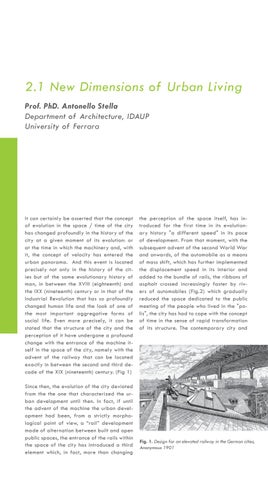
It can certainly be asserted that the concept of evolution in the space / time of the city has changed profoundly in the history of the city at a given moment of its evolution: or at the time in which the machinery and, with it, the concept of velocity has entered the urban panorama. And this event is located precisely not only in the history of the cities but of the same evolutionary history of man, in between the XVIII (eighteenth) and the IXX (nineteenth) century or in that of the Industrial Revolution that has so profoundly changed human life and the look of one of the most important aggregative forms of social life. Even more precisely, it can be stated that the structure of the city and the perception of it have undergone a profound change with the entrance of the machine itself in the space of the city, namely with the advent of the railway that can be located exactly in between the second and third decade of the XIX (nineteenth) century. (Fig 1) Since then, the evolution of the city deviated from the the one that characterized the urban development until then. In fact, if until the advent of the machine the urban development had been, from a strictly morphological point of view, a “rail� development made of alternation between built and open public spaces, the entrance of the rails within the space of the city has introduced a third element which, in fact, more than changing
the perception of the space itself, has introduced for the first time in its evolutionary history "a different speed" in its pace of development. From that moment, with the subsequent advent of the second World War and onwards, of the automobile as a means of mass shift, which has further implemented the displacement speed in its interior and added to the bundle of rails, the ribbons of asphalt crossed increasingly faster by rivers of automobiles (Fig.2) which gradually reduced the space dedicated to the public meeting of the people who lived in the "polis", the city has had to cope with the concept of time in the sense of rapid transformation of its structure. The contemporary city and
Fig. 1. Design for an elevated railway in the German cities, Anonymous 1901
Tirana MetroPolis, Berlage 2003
17 17
Fig. 2. Motorways, Los Angeles ‘70
Fig. 3. Chongqing, China, 2009
the development of the western metropolises of the XIX (nineteenth) century up to the contemporary and even more abnormal development of the eastern city, particularly Asian and, specifically Chinese (Fig. 3), shows us the infrastructure of the city in the near future, rather than its original structure made of "full and empty spaces populated by man", one of the elements of most interest and attention from the urban planners’ perspective. Certainly, it has to pass from a monocentric idea of the city to a polycentric idea, namely a city that has built some pockets not necessarily inhabited, in the strict sense, by the inhabitant, but rather just crossed by the same. And as if inserted in the traditional differentiation between city and landscape, a third dimension emerges without internal clear limits that contains them both, and where the transport infrastructure becomes the key element of the structure of the city. To visualise this idea, think, for example, of Los Angeles or many Chinese and Asian metropolises. In the framework briefly described here, it is clear that the very instruments of the urban project have been thoroughly reviewed in these last years and there is still a search of new methodologies and new tools of in-
vestigation and reading of the urban fabric, in order to better interpret the future development of the cities. Also, it is evident that in the last decades the urban analysis has increasingly favored the analysis of urban spaces rather than that of the built ones, and the tools of the project are increasingly focused on the attribution of a new meaning to these empty spaces. The urban project has become increasingly less volumetric and increasingly more project of soil, up to being pushed to its most extreme hypothesis and if we want paradoxical to restore the natural landscape inside the city itself in a Utopian and anachronistic attempt to return to nature, we have to contrast that process previously described of increasingly major infrastructure of the polycentric city. But this "pseudonatural" attitude, which sees the proliferation of green facades, artificial hills (Fig 4) or "vertical woods" (Fig 5), does little other than remove the real understanding of the complexity of the phenomenon. Thus, in the future, the tools of the project will increasingly focus on interpreting relations rather than the elements themselves. Intervening on the relations means therefore understanding the empty and interstitial space of the city going so far as to pass the same physical limits of the city itself, if these still exist,
Fig.4. Vertical woods, Stefano Boeri, Milan
presenting, in some way, the reason of the prophecy developed by Jean Gottman between the 60s and 70s of the last century, of an urban universe consisting of continuous Megalopolises that exceed the concept of the metropolises. With the advent of the computer it was mistakenly believed that the end of human activity was one’s own home, or office, from which it was possible to govern everything comfortably seated behind his/her desk, showing the interior domestic and work space at the center of human and, therefore, even urban activities. The advent of mobile devices has instead turned such a centrality, bringing in the center of attention the other areas of the city: if it was the Square in the Polis, the workplace in the industrial city, after the war and until recent times, the domestic living quarters in relation to new ways of labor, in the contemporary city there are no more predetermined limits; we can work on the subway, in the park, in the hall of an airport as well as at home and in our office. This is the real revolution of urban living of the contemporary city - that between domestic living and the public one, a new way of inhabiting is inserted in the city, representing a third dimension, all of it to analyze and solve. One thing is certain: the home, office and square are no longer
18 able to represent the fullness of living in the contemporary city. In the context briefly described here, the experience of the Tirana / Rinas workshop falls precisely in the will to interpret these new dimensions of living, the space of the contemporary city that privileges the relation between urban phenomena (such as Aldo Rossi would call them) rather than an analysis of their nature. Tirana, more generally, which is a quadrant included in the urbanized space between the city and the airport area named Rinas, analyzed in the workshop, represents, in this sense, an interesting field of experimentation in several respects. First, because of its physical characteristics, that see an urban development along three very important infrastructural corridors for the city, (Fig. 6) or the pair consisting of the fast road to four lanes which connects Tirana and Durres and the parallel railroad, and the quadrant towards the north that reaches beyond Rinas International Airport, through the articulated joint of Berxull and the axis of urbanization of Kamza, the area is characterized by the admixture of primary urbanization , infrastructures and landscape with natural characteristics. Such physical characteristics are combined then to produce
19
Fig.5. Atelier Jean Nouvel, competition design for a Museum in Burgos, Spain
the social particularity of the metropolitan condition of Tirana: a metropolitan area developing in between being a city established in the national territory of Albania, but still with major margins of development, and therefore still to be defined as a sort of virgin land where similar European contexts can be viewed as a learning experience the same mistakes of which must be avoided and to experience the new dimensions of the contemporary urban living described above. Among others is the decision to focus on the area between the city and the airport is not accidental: in all the contemporary metropolises, the development between these two poles represents the strategic junction of development in a vision of the global net-
work of the cities. In this sense, the design assumptions formulated in the tables of the analysis and in those most foreshadowing of possible future scenarios, represent and tell their willingness to intervene over more relational spaces than on the existing body of the city. They try to interpret Tirana in its entirety more like a polycentric and polymorphic complex with many internal borders, in the will to interpret not only the space as the "time inside the city" of which the infrastructure is a key to the future development. In conclusion to this brief analysis on the general aspects of the reflection on urban development of the contemporary metropolis and the particular decline of the theme,
21 21
through the opportunity provided by the exercise of the developed project in the area under study, I would, however, underline the value of the cultural exchange represented by the cooperation program created between our two schools in 2011, with the first rounds of workshops and lessons, and that is not confronted on the highest level of education with the International PhD IDAUP, which sees the confrontation between the two schools and therefore two different didactic models. Above all, two also different models of socio-economic development, are found, in the direct and joint confrontation of a similar vision of the city in "a human dimension" which may appear as a banality or a commonplace, but this is not the result after
a long collaboration between the students and teachers who find themselves, after having started from very different points and experiences, practicing a completely analogous language of the project, regardless of the analyzed territory and the economic and social reality.
References: • • •
Rossi, A., 2011, L’architettura della Città, Quodlibet. Lynch, K., L’immagine della Città, Marsilio. Schivelbush, W., 2003, Storia dei viaggi in Ferrovia, Einaudi.
2.2 Re-thinking the city through strategic urban projects Prof. Romeo Farinella Department of Architecture, IDAUP University of Ferrara Preliminary reflections on the nature of the strategic urban project In Europe the experience of urban design, in its best expressions, has highlighted three different operative levels tightly bound to each other. First of all, the definition of a program through which to interpret the political, economic and operative will of the different actors -both private and public-, followed by the launch of policies aiming at creating consensus; equally important are the reflections and experimentations about the rules of urban construction; last, but not least, communicative and consensus-building strategies are to be pointed out for projects dealing with big communities and various actors and interests (Portas, 1998). Obviously, urban projects acquire meaning and legitimacy if included in wider strategies concerning the future of a city. Very briefly, we might say that urban project are structured around two axes: one concerning the “process”, with all its socio-economic and cultural implications, and the second one concerning the “morphology” and so the control of physical space. Considering the results that many Italian cities have achieved through programs of urban requalification, during these past few decades, some recurring elements appear. The first is an idea of an urban re-qualification so wide that it can include any intervention operating with the logic of “building replacement”. It has often happened that obvious mistakes made during the process of urban planning were considered as operations of urban re-qualification, in cases of ordinary and questionable projects in terms of design and urban relationships and accessibility. A second element can be found in the weakness -if not lack- of a public direction ca-
pable of creating, and also pretending, standards of quality tied to urban and landscape peculiarities of every investigated context. Basically, the lack of a well-structured reflection on the features of the specific urban landscapes has led to the construction of “re-qualified” city areas that are expressions of a very low urban quality and complexity. Practicing city planning through the instrument of “urban project” (Masbungi 2001) requires, most of all, a capability in managing the processes of transformation and negotiation with private actors and local communities, guaranteeing scheduled timings to the operators, but also requiring high standards of urban quality. It also requires the creation of a vision able to detect the issues and legitimate these transformation processes, fostering the common good (of the city and its citizens) instead of peculiar and private interests. Manuel de Sola Morales (1989) defines “urban project” as a process through which we can reflect on urban geography and work on the city’s complexity, instead of focusing on its structural simplification through an inductive procedure “generalizing what is peculiar, strategical, local, generative”. Let’s clear the field from any ambiguity that urban project represents a simple extension of the rules of architectural design at a wider scale. Architectural design is an objective representation of reality, while urban project defines a process and not an object. Urban project deals with relationships, capable of defining both flexibility and strictness; it allows a careful project direction to guarantee the variety and quality of urban morphology. Claiming the work on urban morphology as a
fundamental component of the urban project process does not mean designing strict urban plans, but to define a framework, a grid that could also accommodate what today still appears undefined. Nowadays, a reflection on the “urban project” as an operative instrument of urban planning cannot avoid reflecting on the dynamics that are concerning our cities and their transformations, especially in those areas characterized by massive urban sprawl. Such processes are progressively changing the physical and social geography of many ancient European regions, starting to consolidate new diffused urban areas made by groups of linear settlements facing the road, interchanging historical centers, low density towns, productive areas and light industrial plants, infrastructural spaces, etc... In 1968 Ludovico Quaroni raised, in a very sharp and lucid way, the issue of the new dimension of the city. “The city will no longer be clearly identifiable in a “built” as opposed to a “non-built” entity, in a walled-up continuum as opposed to the green emptiness of the countryside”. According to the roman architect, the city will become an urban landscape without clear boundaries; such a characteristic will not allow it any more to be considered a compact element, but its structure will have to be conceived as a combination of various different parts. Which shape and articulation can the urban space assume in a context affected by such dynamics? If the principles of overlaying and stratification have driven the construction of the historic city, today the model we can find in the “territorial city” seems to be a random combination of different buildings. Such trend, leading to morphological simplification, highlights some questions about the designing approach. For instance, if we are going towards the obsolescence of the city as a compact structure and the consolidation of a broad territorial urbanization, which characteristics are to be defined within this new form of urbanity? Does the use of morphology -as a project category- still makes sense if we are moving inside a “city of objects”? Which role to attribute to urban public spaces in physical and functional relationships that are to be established among the most densely built areas of our cities, sub-urban, natural and rural areas? Let’s try to give some answers. Undoubtedly “open space”, in order to become a structural factor of the “territorial city”, will have to assume more and more the characters of a system of integrated spaces, able to connect the compact city to the surrounding areas, strengthening urban relationships at different scales through the intervention on rural
landscapes and pathways, waterways and dismantled productive areas. The great fragmentation of the contemporary city is one of the consequences of the overcoming of individual needs of urban space, no longer compatible with the promiscuity of the historic cities or with their accessibility issues. We are talking about a “shape” and a “morphology” that need to be able to interpret this fragmentation, not re-proposing grotesques imitations of the historic city -to which a certain architectural revival has accustomed us-, but experimenting new balances between built and empty spaces, new meanings and spatial articulations that can measure themselves with the issues of urban discontinuity. Debating about the “discontinuous city” already means to question oneself on a context in which urban (built) areas and natural (empty) ones might define a framework of connections capable of producing a complex system, linking together the diversities deriving from the nature of its structuring parts, as Edgar Morin (1992) reminds us. In such perspective, the urban project becomes a tool of re-interpreting the historic urban structure as well as the site’s morphological features (the city geography of which de Sola Morales talks about) and of enhancing the value of discontinuity through the interaction of different elements of the landscape. The contemporary city project requires a deep comprehension of the processes of urban transformation and the acknowledgment of the historical relevance of fractures and discontinuities within such processes. Coherently, the urban project will have to be based on a skillful articulation of sequences and pauses, edges and frames, urban fabric and new architectural icons. (Italian to English translation by Elena Dorato)
References: • •
• •
• •
Quaroni, L., 1981, Urbanistica e architettura. Verso una nuova dimensione in La città fisica, Laterza, Roma-Bari. De Sola Morales, M., 1989, Un’altra tradizione moderna. Dalla rottura dell’anno trenta al progetto urbano moderno, in Lotus International, n.64. Morin, E., 1992, Il metodo. Ordine, organizzazione, disordine, Feltrinelli, Milano. Choay F., 1993, Le règne de l’urbain et la mort de la ville, in La ville, art e architecture en Europe, 1870-1993, Ed. Centre Pompidou, Paris. Portas, N., 1998, L’emergenza del progetto urbano, in Urbanistica n. 110. Masboungi, A., 2001, De l’intention à la réalitation, in A. Masboungi (dir), Fabriqu la ville. Outiles et méthodes: les aménageurs proposent, La Documentation Française, Paris.
22 23
2.3 The strategic role of an enterprise zone along the axis rinas International Airport – Tirana Prof. PhD. Gastone Ave Department of Architecture, IDAUP University of Ferrara
The first section of the road axis between Rinas Airport and Tirana has untapped development potentials which could benefit the whole country, serving as a show-case of quality real estate and urban landscape projects which could be replicated elsewhere in Albania.
Focus on the first part of the axis The axis between Rinas Airport and Tirana is probably the most sensitive development area in all of Albania. This axis is basically composed of two distinct sections. The first section refers to the road from the Rinas Airport to the intersection with the multi-lane road which connects Tirana to Durres. This intersection located in the Kashar commune is known as the Berxull Node and has already drawn specific attention from a planning viewpoint. The second section of this sensitive axis goes from the Berxull Node to the center of Tirana. This last section is also influenced by its position as part of the Tirana-Durres road. Nevertheless, a high share of development pressure is motivated by transit flows to and from the airport service area. Thus, the whole axis should be seen as a unique entity. In the same area, the Kamza urban corridor can play a key role in developing a new image of Tirana, but it appears that its highest and best use lies more in the
residential and service sectors for local residents, as it is close to the airport but it is not the main road to access it. The Rinas Airport – Tirana axis is the main “business card” that the country can hand out to business and touristic visitors. It is a showcase which, during the time-lapse required to commute from the airport to the capital, presents a powerful synopsis of the whole country. Certainly, this long-lasting first impression is provided by both sections of the axis as previously defined, but mostly by the first section. Thus, this article claims that, while there is evidence that any analysis of the Rinas International Airport and Tirana axis should include both road sections and certainly the Berxull Node, a special attention should be given to the first part of this axis, namely the space between the airport and the intersection of the Tirana-Durres at the Berxull Node.
Tirana Urban Plan, 2007, Urba Plan, Co-PLAN and Municipality of Tirana.
Urban planning beyond the demolitions phase of informal development It has been stated that “experience shows that legalization, penalties and even demolition has not completely stopped informal development” (UN-HABITAT, 2010, p.5). If this is true referring to Greece and Albania and, generally speaking, to the southern part of Europe, it must also be said that legalization, penalties and even demolition are tools which are far from being utilized on a large scale in these countries. What happens in most cases is a lack of action, any action, by local governments. For decades, this laissezfaire attitude has been the only urban policy in Albania. It is a well-known fact that, in the last two decades, Albania has lost a large percentage of its rich, agricultural land and its coastal zones, especially those close to urban centers. Most of the strategic areas are under constant threat from illegal developments and, in many urban areas, there is a large number of disputes over illegal developments related to the interpretation of environmental and cultural areas due, among other things, to a lack of maps that clearly define legal boundaries and devel-
24 25
opment rights in these areas. The challenge of urban development in Albania in the post-communism age is still to be analyzed in depth. However, some detailed analyses of the development of Tirana and its surrounding area after the fall of the dictator Enver Hoxha in 1991 have already been produced (see: Aliaj, Lulo, Myftiu, 2003; Ruijsink, Duka, Toto, 2013). According to these detailed studies, illegal buildings sprung like mushrooms all over the country in the first years of the postcommunist era. For example, by the mid90s in Tirana, there were “at least 2.000 kiosks of which only about 500 were with provisional permits. (…) Whole quarters of illicit buildings were constructed in the outskirts of Tirana as a result of the free movement of people who came mainly from the northeastern regions of the country, where economic problems were even more complicated” (Aliaj, Lulo, Myftiu, 2003, p. 69). The first demolitions of illegal construction date back to 1998 after the unrest of 1997 pushed Albanian authorities to act
more firmly in order to show the presence of the State in the country. However, the turning point was the intervention of Edi Rama, mayor of Tirana, in the center of the capital city. The success of the clearance of about 550 illegal constructions (including some 10-story buildings) along a 4 km length of the Lana river in the 1998-2003 period, demonstrated to all that cities could be governed and planned even in a country like Albania where informal development had apparently become the only rule. In the first part of the last decade, demolitions of illegal constructions, big or small, conducted by the Municipality of Tirana in cooperation with the Construction Police “stopped the trend of breaking urban rules which cause destruction of public interest and damage image of Tirana city” (Aliaj, Lulo, Myftiu, 2003, p. 71). The point is that in Tirana, as well as in other Albanian cities, there are also “a great number of buildings which are ‘legal’ from a point of view of official urban planning, though they do not respect even the most elementary rules of urban development, because they are built on green spaces between existing buildings and provide accommodations only, without other important functions of urban existence such as green spaces, room for car parking, emergency exits etc.” (Aliaj, Lulo, Myftiu, 2003, p. 70). Given the situation of Tirana as briefly described above, it has been maintained with reference to Albania as a whole, that: “If the environment is to be effectively safeguarded then priority must be given to the legal delineation of environmentally sensitive areas and resources with maps provided to monitor these areas for any informal development. Spatial planning laws and zoning regulations must be supported with mapping.” (UN-HABITAT, 2010 p.30).
A swift planning action centered on the first part of the axis: a new Gate to Albania Program. The whole axis between Rinas Airport and Tirana has development potential which is still largely untapped, especially regarding its first part, located between the airport and the Berxull Node. In this part of the axis the so-called informal development, i.e. real estate speculation and illegal activities connected to it, has not yet taken the lead.
Pure land speculation occurs when somebody buys land in the hope that its value will increase without any further action and that the sale occurs in a short time period at prices that incorporate the benefits of public investments in infrastructures to which the landlord has not given any special contribution. Swift public action is the key to preventing land speculation. How? Here, as in other parts of Albania one could rightfully pose the question “To Build or not to build ? “ and “Who owns the right ?” as some have recently done (see: Toto, 2011). Here however, much more than in any other parts of Albania, time is the key of to any public role in the area. A “perfect” plan for a public positive role in land control and regulation of private development would probably require too much time to be drafted and approved. In the meantime, the whole potential of the area would probably be lost forever. As a response to this potential loss, local authorities must recognize the strategic value for the whole nation of this axis and act accordingly. A special plan must be provided in a seamless way, and it must be simple, sustainable and pro-growth with special attention paid to architectural quality and the environment. It should lead to the implementation of urban projects to the best of the capacities available in Albania today. The answer to the “to do what?” Question must not be an ideological one, nor a “wait and see” attitude. An ideological answer would produce, for example, an urban plan with very strict regulations and limits, which would discourage investors or would direct them on areas just on fringe of the strictly planned area. And this would be the positive scenario, while the negative and most realistic scenario would be one where a very strict, theoretically efficient plan, to preserve agricultural land, would be bypassed or ignored altogether by powerful developers. To ruin the great potential of a positive “business card” like the Rinas-Kashar axis, the area need not fully be developed ignoring the rules of a comprehensive urban plan. It would be sufficient that some illegal developments of a certain size would occur here and there along the road from the airport and the intersection with the Tirane-Durres axis, so that the scattered pattern of the new constructions would spoil
the integrity of the area. The “laissez-faire” option is also a constant danger. Given the new hopes emerging in the country with the election of Edi Rama, the prime minister, this option has lost ground but the danger of it coming back should not be ruled out.
First projects of the “New Gate to Albania Program”. Firstly, local authorities should freeze any change along this axis, to prevent unwanted conversions of agricultural land which still exist. Secondly, the area should be planned as an enterprise zone, subject to special intervention powers of the Municipality supported by the by central government. Thirdly, the enterprise zone named Rinas-Kashar (or more precisely Rinas Airport- Berxull Node) should be divided into three sub areas: the red zone nearest to the airport, the green zone nearest to the Berxull Node, and the blue zone in between the other two areas. For marketing reasons, the enterprise zone could be identified as the “New Gate to Albania Program” and should be given top priority in the Municipality procedures, which means, for example, the appointment of a single office in charge of all planning powers with a one-stop shop capability. A mix of incentives should be directed to these three sub-areas which could become, as a whole, the first special economic zone of Albania from a planning viewpoint, to be replicated in a very few other areas of special national interest. While some common architectural rules should be issued for the front lines of the axis in all the three sub areas, planning incentives should be varied from one subarea to another. The red sub-area should receive the highest incentives and only top quality developments should be allowed there. Incentives should then decrease in the blue and green area but still remain at a significant level so as to mark a difference between being inside or not the enterprise zone. A buffer zone should be designed around the boundaries of the enterprise zone. To kick off development along this axis, a number of single projects should be identified. The Albanian Government and the
Municipality of Tirana have activated a number of technical assistance program with various foreign governments and cities. For example, in 2012, Japan promoted in tandem with the city of Tirana, a technical transfer project entitled “Project for Tirana Thematic Urban Planning". This study was expected to formulate short and medium term projects and programs on urban infrastructure. Similar projects sponsored by various foreign subjects should be asked to concentrate on this enterprise zone and should be utilized to identify direct foreign investments, primarily of an institutional nature, to which to allocate on a competitive basis a land parcel in the new development area, a piece of the “New Gate to Albania” as a necessary area for fostering bilateral relations.
References : • Aliaj, B., Lulo, K., Myftiu, G., 2003. Tirana the Challenge of Urban Development. Tirana: SEDA and Co-PLAN. • Ruijsink, S., Duka, I., Toto, R., 2013. Urban planning and the free market in Albania. • Toto, R., 2011. To Build or not to build - Who owns the right? , Tirana: Open Forum U_POLIS, 15th December 2011. • UN-HABITAT, 2010. Informal Urban Development in Europe - Experiences from Albania and Greece. Nairobi: United Nations Human Settlements Programme.
26 27
2.4 Creative processes in comparison. Energy, material and hidden logics. PhD. Loris Rossi Deputy director of IKZH Polis University, Tirana Albania
Design workshops in schools of architecture can generally be defined as design activities where creativity processes and operative tools are strongly connected to time-related issues. The design experience is exercised to the best of its potential, emphasizing the interweaving of creative processes and practical issues; Polis University is one of the few platforms, in the Albanian context, in which the concept of workshop represents an interesting way of developing research by design In this frame of work, the concept of design becomes a moment of research application and theoretical reflections. The workshop’s object was designed as a platform for sharing skills and knowledge applied to the study of an area full of contradictions and undiscovered potential. The area to which we refer is one of the main ones surrounding the city of Tirana; specifically, it is located between the Rinas Airport and the municipality of Kamza. In this extended area the urban development is still in a phase where the boundaries between agricultural patterns and informal settlements are confused. In this site informality is preventing the advancement
of future development stages of the city. The refraction elaborated during the past years, on this specific area, has been useful as a background for the development of two important international workshops organized in the same area and sharing the same characteristics. (Fig 1) The first was an international workshop Viral Ecologies -organized in the framework of Tirana Design Week (TDW) 2014 in cooperation with the department of Kuma Lab from the University of Tokyo. The aim of the workshop was the creation of a new image for the city of Tirana. The second one - Tirana, New Metropolis- was organized in the framework of the international Joint PhD Program POLIS University - Ferrara University (IDAUP). The purpose of this second workshop was the creation of a New Sustainable Image for Albania. My paper will address both experiences, not through a description of the end results, but in an attempt of underlining the process that anticipated the design project through personal reflections on design issues related to creativity and architecture. (Fig.2)
Before developing this comparison between the results of the two workshops, I would like to retrace some important topics which, I hope, could prove useful in facilitating the reading of Tirana’s complexity. The topics I am referring to can be considered investigative tools which filter a reality where urban disorder renders less obvious some basic principles which are still active and waiting to be rediscovered and repeated within new design processes.
completely upside down. In the logic of reverse meanings there are some topics where disorder can create events or accidents capable of being rediscovered through specific tools. Like in a painting by the Swiss artist Ursus Wehrli 1 , where the meaning of disorder can become a basic concept for prefiguring a new decoding system and the concept of disorder is explored through ironic contra-positions between disorder and order. (Fig.3)
My first visit to Tirana occurred back in 2011 and, on that occasion, my understanding about the concept of order was
1 Ursus Wehrli born 1969 is a Swiss comedian and artist. His paintings are famous for the elaboration of “clean up” concept. He published books in which he "tidies up" works of art.
Low Density Housing area devel[ped according the rectangular grid system.Its spatial system follows the agricultural partial existing system and that of the older settlement of Kamez[center].
28 29
Zona me mbizoterim te boshit Bujqesi, Toka.....
Aeroporti Rinas
Domje
Miniera
Stalla
Kamez
Domje
Laknas Durrasak
Bovilla E Re Low densitry Housing area bregu i lumit
Kodra Kamez
Breg Lumi[Ura]
Pratiker
Fig.1 – Urban System
Rritje E Peshkut
Rritje E Peshkut
What fascinated me more than anything else as I visited Tirana was the way in which the concept of energy and matter were completely perceivable in all the surrounding buildings. The relationship between energy and matter is something that still persists as an indelible sign in Tirana’s context. To support this argument I will present some important reflections suggested by Aldo Rossi. In his scientific autobiography, there is an interesting quotation by the physicist Max Planck, which clarifies the meaning of energy conservation through an anecdote about a mason who is bringing up a stone on a roof of a house and the stone falls off: “The mason was struck by the fact that expended energy does not get lost; it remains stored for many years, never diminished, latent in the block of stone, until one day it happens that the block slide off the roof and falls on the head of a passer-by, killing him.” (Rossi, 1994, p.1) The strange mason story immediately offers us the clue that some important meanings are not visible, and our task as Architects or Planners is to investigate and discover them. It is a simple exercise which combines creative activities with some weak instruments, thus facilitating the se-
Fig.2 – Viral Ecologies workshop. POLIS University 2013
Fig.3 - Representations of Ursus Wehrli
lection of important design tools. Man's energy is retained and preserved inside the building’s material and, in the majority of cases, is reflected on aspects connected to creative actions. Some events, apparently extraneous or with transversal meanings, can be useful in activating the everyday mood destabilizing the normal balance of a specific place. The experience described by Aldo Rossi through Max Planck’s reflection, provides interesting scenarios where different disciplines can interact with each other by means of similar conceptual processes. Drawing inspiration from Planck’s theory, we can easily transfer the same concept to the relation between human energy and creativity. In others words, we can use the creative energy originated by the inhabitants, expressed through informal constructions, and use it as an operative tool. This first reflection attempts to investigate some perceptual theoretical issues in which Tirana, with all its contradictions, can be seen through multiple interpretations. In the specific case of the workshop, the area under study introduces cognitive mechanisms linked to the bottom-up logic in which micro design action can influence the surrounding environment. From another prospective, the relation between scale and site of intervention recalls a series of conceptual analyses in which many architects anticipated their design
Fig.4a – Example of Froebel Blocks
selection; a typical approach of many contemporary urban designers. The topic of large-scale intervention frequently brings with it issues and dilemmas of how to intervene in a specific area (like ours) especially in terms of architectural scale and urban scale. Today, the debate is centered on the urban planning front; in fact, in the last years, Tirana has been object of too much rational planning and, unfortunately, very little attention has been paid its image through a comprehensive vision. Observing Tirana from above, we can clearly read the traces of infrastructures and recognize their origin in the pattern of agricultural fields; from above, the city describes itself through signs and meanings activated by men through time and space. Through this logical interpretation we could say that there are hidden force fields able to reactivate urban processes and historical meanings. In the book about Francis Bacon, Gilles Deleuze argues that there is a possibility of prefiguring a hidden logic in each creative process and he quotes Paul Klee’s famous formula: “Not to render the visible, but to render visible” (Deleuze, 2003, p.53) Deleuze focused on the idea that some forms of art, such as music and painting, must be able to make visible forces that are not, in this way forces are strongly connected with sensations.
Fig.4b – Field condition by Stan Allen
30 31
In relation to the above mentioned hidden forces it is interesting to notice the case of Frank Lloyd Wright and, in particular, his approach to architecture especially in the phase that anticipates the design process. In his drawings of modular grids we can clearly recognize the connection with past experiences. It is well known that he was fascinated by “froebelian” games and by the traces that certain agricultural machinery leaves on the ground. (Fig.4a, Fig.4b, Fig.4c), ( Riley, Reed, 2000, p.17). The abstract grids that transformed his vision by consecutive design activities focused on the objectification of architectural works. The grids reinterpreted by Wright are nothing but reorganizing means of complex systems pertaining to urban disarray. Returning to our topic, I think that both workshops can be synthesized through the previous considerations. Tirana and the specific area under discussion have been observed and interpreted not from a logic of traditional planning but filtered through interpretive actions aimed at the repositioning of Tirana in the international debate. In the Viral Ecologies workshop the creation of a new image for Tirana was preceded by the identification of typical cases of spontaneous architecture in the existing informal settlements and by the definition of viral design actions, which can be useful as a repeatable tool. The idea was to select in the project area common methods or creative errors which could be analyzed and used as operative tools for the design project.
In conclusion the hidden logic of such a complex area has been experienced and reorganized through creative paths linked to the value of the urban as well as the architectural scale. Both projects tried to establish concepts related to the value of persistence of meanings in complex urban settings. Perhaps, both experiences have in common an investigation of Tirana’s urban development from a new perspective, where discontinuity of signs and meanings become a characterizing element that future generations can further investigate and introduce in the contemporary debate, unveiling the beauty of an “interrupted” 2 Tirana.
References: • Rossi, A., 1984, A ScientificAutobiography, MIT Press, London. • Deleuze, G., 2003, Francis Bacon: the logic of sensation, Continuum, London. • Riley, T., Reed, P, (Edit by), 2000, Frank Lloyd Wright Architetto 18671959, Milano, Electa. • AA.VV., 2004, Tirana Metropolis, The Berlage Institute, Rotterdam.
The second workshop, Tirana New Metropolis. Reinventing a New Sustainable Image for Albania, was centered firstly on the dimensional factor of the site; since the analytical phase the will to separate, order and reorganize the existing functions has supported what is commonly defined as layer phasing.
Every trace operated by man leaving an imprint on the territory had been analyzed and seen as a relevant action that ought to be understood and re-elaborated. In this case the PhD students developed a project through overlapping layers integrated to an abstract grid, representing the city through a sequence of.
2 Tirana Interrupted takes inspiration from one of the most important moments in the history of Rome during the 70’s, when 12 architects gathered by Piero Sartogo started to work on the idea of Rome interrupted. The main objective was to delete two hundred years of history characterized by speculation, reconfiguring an image for Rome starting from the plan drawn by Giovanni Battista Nolli in 1748 . Through this concept, Piero Sartogo froze the beauty of Rome exactly in the moment when Nolli, in the 18th century, offered to the Pope Benedetto XIV the first plan for the center of Rome.
33 33
Fig.4c – Agriculture Phases, Tirana
Image of Vora from panoramic hills, MetroPolis 2013
Dajti-Adriatic Regional Park, MetroPolis 2013
35 35
3.1 Tirana, New Metropolis: Reinventing a new Sustainable (spatial) image for Albania 3.2 Dritan Shutina PhD Researcher Metropolitan Governance in Albania. The Case for Tirana – A theoretical debate or an absolute necessity?
3.3 Anila Gijka PhD Researcher Planning and financing Infrastructure in the city through land value capture instruments. The case of Tirana – Rinas Corridor
3.4 Rudina Toto PhD Researcher Highlights to informed spatial planning in the growing suburbs of Tirana. The need to mainstream Ecosystem Services valuation into metropolitan land use planning decisions
3.5 Elona Karafili PhD Researcher Agricultural cluster development in peri-urban areas
3.6 Habib Ymeri PhD Researcher The impact of airport in urban development of area
3.
.
TIRANA, NEW METROPOLIS: REINVENTING A NEW SUSTAINABLE (SPATIAL) IMAGE FOR ALBANIA
3.1 TIRANA, NEW METROPOLIS: REINVENTING A NEW SUSTAINABLE (SPATIAL) IMAGE FOR ALBANIA Dritan Shutina, Rudina Toto, Anila Gjika, Elona Karafili, Habib Ymeri (PhD researchers) Lorin Cekrezi, Saimir Kristo (post-Master student), Carlo Ruyblas Lesi (UNIFE), Stefania Cellini (UNIFE).
Most of the urban growth of Albania has taken place within Tirana-Durrës-Fushë Kruja triangle. For the past 24 years Tirana has been expanding organically beyond its administrative boundary, especially in the northwest and south. Similarly, all Tirana’s neighboring local governments have been expanding in size and increasing in population forming an urban agglomeration, which is part of Tirana-Durrës metropolis. This paper builds on the case of an area 1 situated at the core of Tirana-Durrës metropolis, northwest of Tirana. The area gives the impression of a natural amphitheater shaped by the mount Dajti (east), the hills’ systems (south and southwest), and the Ishmi spill openness (northwest). It is surrounded by Tirana-Durrës axis (with more than 250 businesses and around 15,00020,000 daily commuters, and a number of Universities adding up to the cluster-formation potential 2) and the North axis crossing the “spontaneous” urban settlement of 1 For reading convenience we will refer to our study area as “the area” 2 This data are estimated through field surveys (socialeconomic and visual) carried out by POLIS University in the framework of master workshops and research studies.
Kamza. The international Airport is found at the edge, in the northwest. The area is also trespassed by the railroad, heading towards DurrĂŤs and the North, and has a surface of more than 50 Km2, currently administrated by 7 local governments (Fig1).
39 39
Fig1. The strategic location of the area within the Tirana-DurrĂŤs metropolis
VENDODHJA STRATEGJIKE E VORES
LALEZ
KOMUNA MANEZ
KOMUNA MAMINAS
SUKTH
MAMINAS
SHIJAK
KOMUNA NDRO
DURRES
Fig1. The strategic location of the area within the Tirana-Durrës metropolis
NDRO
FUSHE KRUJE
KOMUNA PREZE PREZE
AIRPORT
Vore 40
KOMUNA BERXULL
41
KASHAR
KOMUNA KASHAR
OQ
OQ
TIRANE
With the upcoming territorial reform the area will be under the jurisdiction of three local governments, Tirana, Kamza, and Vora. Before the 90’s the main land use of the area was agriculture, with few supporting settlements in the center of Kamza and in the south-east. Because of this agriculture potential, the Agriculture University of Tirana was, and still is, located within the area. Urbanization has converted large portions of the agricultural land stock, but still the latter remains twice as large as the urban part (Fig 3). The area is adjacent to the “Josif Pashko” construction industrial zone, which extends within the area with a brick factory, currently out of use. An abandoned former coal mining industry is also situated within the area. The area’s estimated population is 55,000-60,000 residents and more than 10,800 buildings (92% erected after 90’s) are identified through the areal Fig 2. Exploratory images
43 43
photo. Field surveys reveal for rather high unemployment and 57% of the employed working in the service sector. The land use analysis focused on the identification of 3 systems (urban, natural, agricultural) and on 4 interventions (built environment, infrastructure, landscape, agriculture), provides key information and proportions between activities, developments and behavior towards the environment. A solid-void picture defines a gradient of porosity moving radially from the entrance of the area towards the Northwest (Fig 4). This matches also with the 1km 2 cell population density analysis that defines a boundary for the Tirana agglomeration.
Fig 4b. Systems analysis
Fig 3. Current land use structure
45 45
Fig 4a. Systems analysis
Due to the fact that in the past agricultural use dominated the area, any zoning or spatial reading attempt uncovers land pattern linked to agricultural activity, and a rich network of drainage and irrigation, which has currently shaped the road network. Apparently water flows will also [re]direct the future mobility configurations of the area. [Urban] Farming, for local and family use, is quite diffused activity, providing potential for urban agriculture promotion/support. The eastern limit of the area (across Kamza) contains settlements’ structures with higher density concentration close to Kamza center and a mixed land use characterized by a balanced distribution of commercial activities and housing, but dominated by housing when moving towards the center of the area. Land values are also higher in the Kamza center (figure 6). Former villages are hardly recognizable as internalized by the nearby centers (Kamza, Kashar, Vora). There is almost no (clear) spatial interruption between them and the rest of the settlement 3. The stronger attractors of the area seem to be the higher density poles, the former villages (when identifiable), the airport and the perimeter corridors. The dominant typology along Tirana-DurrÍs axis is made of large structures hosting mainly commercial activities. A very distinct spatial typology is the one of the airport to the Northwest, while former industrial and mining sites in the area (now depleted and out of use) offer the potential for not simply reviving, but also providing space for missing public services. The hinterland (between Laknas road and Lana valley) has a gradual decrease of densities, dominated by two-three story family houses. From a typological point of view, the minor settlements of communist times stand as unique exceptions to the recently built environment and as leftovers from the previous functional organization 3 Though the area is composed of different spatial structures, these can only be identified in a careful analysis/reading of the area and are not visible at first sight. In fact the whole urban structure of the area, excluding the Tirana-DurrÍs axis, looks like a single large settlements with varying porosity, accessibility, density and land prices.
47
Fig 5. A synthesis of the agricultural system
Fig 6. Overlay analysis
of the area. Factory and state owned farms (cooperatives) workers used to live there. The PCR 4 varies between 40-60% in the dense areas and it may even reach 100% in some isolated cases. The less dense area has a PCR of 10-20% where agricultural land subdivision has happened. But in some cases PCR remains 1% or less as subdivision has not taken place yet. The size of the agricultural parcels varies from around 2000 m 2 to 2 ha. Variation is due to land subdivision or merging. While merging has happened for agricultural purposes, subdivision is linked to housing. Housing plots are usually between 300 and 600 m 2 . Under the same logic, FARs 5 vary from 5 (isolated cases) to 2 in dense areas and as low as 0.2 and 0.01 in low density or agricultural land. 4 Plot Cover Ratio in % 5 Floor Area Ratio in m2/m2
Fig 7. Centralities and development axis
Infrastructure and services are deficient in the area showing for low access to quality services and high risk of environmental pollution. The current situation reflects: i) the spontaneous urbanization, in absence of public response for investments; ii) the fragmentation of LGs 6. Infrastructure is being built across agricultural land, thus leaving room to emerging opportunities for urban development that will further fragment agricultural land and the natural system (river banks and the riparian areas). Water supply is fragmented on different systems, does not cover the entire area and there is no 24-hours supply service. In turn, people rely on individual wells. The drainage and irrigation systems are hardly maintained and most are used also as sewerage. Only former settlements have conventional sewerage infrastructure, while the hinterland and the south axis rely on septic tanks (wholes) or discharge directly through irrigation channels to the Tirana and Lana rivers, without any treatment at all. 6 Local Governments
The road network (defined by the drainage and irrigation canals) has followed the urban expansion. The quality is good (width, asphalt, lightening) in the perimeter axis, in the Airport area, and in few segments within Kamza center, but remains poor (just paths) in the rest of the area. Solid waste (being provided by 7 LGs), is not only inefficient, but almost missing in the hinterland. Households discard waste in riverbanks, or burn it in open air. Power supply network is extended through the entire area. Telecommunication services, being private, are in expansion, but the service is not always reliable. The above situation raises several development challenges to be faced by governments and people in their effort for future prosperity. These challenges are: How to slow down growth and ac• commodate/deal with development pressure (from boundaries towards hinterland), while preserving agricultural land and bringing back nature to the metropolis? Infrastructure is crucial, but cur• rently acts as a wall to civil development. Openness and integration is needed for civilization and social development. Barriers should be eliminated to avoid social segregation. • Positively reversing perceptions on the image of the area and the whole metropolis, is one key to Albania’s future development?
Fig 8. Development challenges
48 49
The challenges are addressed by adopting, promoting solid densification, consolidation regeneration and minor expansion as a tool for sustainable development; reactivation of economic potential through regional and local services and cluster promotion; use of Kamza corridor and other green corridors as a unifying elements and barrier breakers to integrate settlements, while connecting and combining the fragmented voids to invigorate public space; preservation of agriculture as a core system to the area and as an eco-economic potential for the metropolises.
This vision is detailed in the following master plan: From a land use point of view the area will be surrounded by two national axis (south and west) and one urban-mixednational heading north, across Kamza. The south axis will keep being the economic strip – metropolitan corridor, while the east one will be reinforced as an urban-mixed corridor. The hinterland urban growth will extend/consolidate in a gradient like pattern, from the southeast entrance (Tirana Multi modal station and high buildings density) towards northwest (agriculture and
Fig 9. The Vision
50 51
Fig 10. The Master Plan
nature). Three radials are envisaged – the consolidation/regeneration urban area; the intermediary area – ecological restoration and housing; the agriculture eco-park, heading towards the hills. A series of urban centralities (existing and potential) are evidenced, with the Airport and the BerxullÍ node as the main ones (cluster areas). The riverbanks of Lana and Tirana rivers are envisioned as urban and natural corridors combined with recreation activities. The densification will follow the same logic. From a mobility point of view, openness and transport will be enabled through the
strengthening of the Kamza urban corridor and tram line introduction; the connecting transversal from Kamza urban corridor to the southern economic strip; the panoramic and urban panoramic connections completing the network and providing opportunity for ecological restoration; and the introduction of the light rail parallel to the southern economic strip. Land use wise, the light rail will serve also as a borderline for the mix economic strip with the adjacent residential and agricultural area. This plan will integrate the area internally and open it towards the metropolis and the Airport hub.
52 53
3.2 Metropolitan Governance in Albania. The Case for Tirana – A theoretical debate or an absolute necessity? Dritan Shutina PhD Researcher
Governance and territory in Albania – where do cities, agglomerations and metropolises stand? There is currently an established understanding on the difference between government – as political system, with its set of institutions that regulate and exercise power, and governance – as the effective way through which institutions allow for mechanisms and processes to be used by citizens and interest groups, in taking up their responsibilities, engaging in order to mediate conflicting interests and determining the outcome 1. From this perspective, political and administrative decentralization, territorial organization and planning reforms undertaken after the fall of the communist regime in Albania have reformed local government. Yet, they have not improved the governance system. 1 This description tends to be in line with the UNDP’s definition for governance – “The exercise of political, economic and administrative authority in the management of a country’s affairs at all levels. It comprises the mechanisms, processes and institutions through which citizens and groups articulate their interests, exercise their legal rights, meet their obligations and mediate their difference” [UNDP Governance for Sustainable Human Development, New York, 1997, pp. 2-3. See also the draft Working Consensus Definition of Governance presented to the U.N. Consultative Committee on Programme and Operational Questions (ACC/2000/ POQ/CRP.20 of 14 September 2000)].
As a result, intended goals of government reforms are still not met and most likely will not be met also in the future, unless we pay proper attention to the entire spectrum of institutions, actors, processes etc., that enable good governance. This paper is aiming at opening a debate for governance transformation in Albania, based on the reciprocal evolution of territorial structure and government and governance approaches, after 1990. It builds on the motto “territory as a fundamental feature of political and social life” (Keating, 1998). The features of urban development and the proposed master plan for the area described in section 3.1, shall serve as input to the discussion in the paper. Due to the complexity of the phenomenon analyzed in this paper – territorial structure formation and (metropolitan) governance systems that best fit the situation, the paper will not intend to provide final solutions, but rather stipulate recommendations. The latter will mainly highlight principal, societal valuebased and/or paradigmatic changes that are needed to govern the large variety of
territorial relationships, in Albanian situations of conflicting social-economic-urban boundaries on one side and administrative ones on the other. Since the early ‘90s Albania embarked on a process of government`s decentralization. Initially, this resulted in a political and administrative decentralization, while more substantial decentralization (functional and fiscal) was enabled starting as off in1998, with the adoption of the new Constitution of Albania. The latter defined decentralization as a basic principle for establishing local governance and the principle of local autonomy as the basis for implementing local governance. Following that, the organic law “On Local Government Organization and Functioning” 2 was adopted in 2000. As a result, 373 local governments (LGs – urban and rural) and12 Qark Councils (regional councils) were established. The Organic Law defined exclusive local government`s powers, including operationalization of principles such as: democratic governance, transparency, participation, accountability, etc. All these had to be taken into account by the different sectorial legislation that in turn had to devolve power from line ministries to LGs. However, the sectorial strategies and respective legislation were either lagging behind or, when devised, did not establish a clear framework for division and sharing of power. As a result the decentralization process for LGs turned into a set of not clearly defined and mostly unfunded mandates. The decentralization strategy and the organic law did not account for asymmetric development of urban (municipalities) and rural (communes) LGs. As a result, non-performing local governments were used as a justification by line ministers and government in general not to decentralize functions at local level. Worse, local governments, while striving to consolidate their power, failed to collaborate with the regional government (Qark) and among themselves so as to provide jointly the services that require economies of scale, i.e: public transport, waste col2 Law no. 8652, date 31.7.2000.
lection and disposal, water and waste water treatment, etc. In the absence of: a culture and tradition of cooperation, strong local actors, business associations, and genuine pressure -exercising community groups, any solution was/is sought at the central level (for state institutions to intervene) All these effects of ambiguity on power division and execution have resulted in “wild” rivalry among state institutions (central and local) and this can be best seen at the territorial level. Before the 90’s, because of the central planning system, all political and economic decisions affecting the territory were taken at the central government level. The regional development approach was heavily subsidized by the state and it materialized on the territory with the construction of state owned enterprises and establishment of new settlements that housed labor force for these enterprises (i.e.oil-related cities Ballsh or Patos, textile industry with its new related neighborhoods of Tirana and Berat, coal or hydro power cities Memaliaj, Kukes etc.). Establishment of these cities were strategic, sectorial and employment interventions, without any consideration of local actors. This top-down approach of city formation had a major impact on the urban-rural structure of the territory. This system, was very efficient in terms of decision making, but proved to be uncompetitive, very inefficient and not self-sustainable. With the collapse of the centralized system in 1990, the Albanian society embarked onto the journey of market economy democracy and reformatted itself to a new reality, where many conflicting processes emerged. The oppressed individual became the self-reliant individual, but state institutions did not adapt quickly, so as to become reference points for guiding developments and intervening to correct inefficiencies. The balance between private and public interest was lost in favor of private interests. Adoption of a very liberal approach, with its assumption that market forces would correct all conflicting interests, accumulated many
54 55
problems. In fact, there were many problems and conflicting interests that the market alone could not solve and state intervention was more than a necessity. In the absence of (mature) social capital, the liberal approach resulted in a wild-west redistribution of wealth. In the early 1990, people had no economic base to sustain themselves and, making use of the political change, they quickly moved close to the urban areas for employment and housing. As the state had no capacity to provide housing, people sought their own market solutions, even illegally. So, instead of thriving, the land and real estate sector was/is heavily caught by informality and inefficiencies. To date, there are around 350,000 informal buildings 3. Initially, informal housing was a response to a basic need but, after 2000, when housing construction became an investment opportunity, informality turned into mentality and the primary way of transforming the territory. With underdeveloped capital market, people converted into real estate any saving or remittances they had. At first, people could not afford (later, they did not even care) long bureaucratic building permit processes and had to resort to informality. This phenomenon became widespread and, as it was contributing to economic growth, the government had little incentive to intervene, until the capacity of central/local government in managing urban growth was/is put into question. Seemingly inefficient and with conflicting interests were the high-rise housing constructions made by formal developers, which started to consolidate as of early 2000. This issue is not examined in the paper as it is not present in Tirana`s suburb, subject of section 3.1. However, it is of essential importance to mention that after infilling city centers, these developments expanded in other areas. In the absence of a general/strategic territorial plan and in a context of poor sec3 According the Agency for Legalization Urbanization and Integration of Informal Settlements (ALUIZNI) in 2009, based on self-declaration reports for 20062007 and on estimations made for 2008-2009. The figures may be higher, as informal construction has continued to date.
toral policies, more recent formal developments “invaded” agriculture and/or natural land in the suburb. This was also stimulated by factors such as: developers were looking for inexpensive land, but with good opportunities for access to infrastructure – this was available in Tirana’s suburbs, adjacent to the urban fabric; developers needed to bypass the heavy administrative burden of taking a building permit – this bypassing was possible if one applied for it in the rural communes neighboring Tirana. So, administrative boundaries as physical lines of power extension; in total lack of synchronization with the natural/organic economic power of the society and the market; and in the absence of coordinated planning and joint local government collaboration for delivering public services and making strategic infrastructure investments; became a “magic” tool for more free-riding mentality and unsustainable use of resources. Again, from the government/city perspective, as long as the construction industry contributed to economic growth, local revenues generation 4 and private interest (corruption), there was no inclination to reverse the situation. Interestingly,as provided in the table below, formal private investments in the residential sector for the 1995-2008 period stand as 83% of the total, with only 17% for infrastructure (INSTAT) 5. Thus, private-driven economic development led to the “natural and organic” expansion of cities beyond administrative boundaries. The sizes of cities in terms of this expansion doubled or tripled, and in all cases this happened by converting previous agriculture/ natural land into urban (Fig. 1) (Gjika & Shutina, 2010). Yet, the local government structures both by competences (functions and fiscal autonomy) and capacities, do not operate with the logic of the “economic area” (or functional areas as we call them now) which is much larger than the administrative cities. As such, private interest has overtaken public interest and short-term gains have ac4 Revenues raised through the infrastructure impact tax. 5 Own calculations based on INSTAT data available in http://www.instat.gov.al/al/themes/ndërtimi. aspx?tab=tabs-5
Year
1995
`96
`97
`98
`99
2000
`01
`02
`03
`04
05
`06
`07
`08
Buildings
82%
78%
87%
69%
92%
87%
92%
94%
96%
86%
69%
78%
84%
89%
18%
22%
13%
31%
8%
13%
8%
6%
4%
14%
31%
22%
16%
11%
Infrastructure Total (000 lekë)
18,756 50,665 13,720 24,304 16,533 25,955 24,793 49,217 71,726
Distribution of funds in the formal construction industry. Source of data: INSTAT
38,905 109,742 86,757 38,743 93,949
cumulated long-term liabilities mainly in the public interest sphere. Indeed, the 2012 Census (INSTAT, 2014) visualizes how unguided urban development has taken place along the western part of the country reinforcing a mono-centric spatial structure with Tirana-Durres as the core (Fig 2). The concentration of resources, administrative functions, infrastructure and services at the center has induced that almost 1/3 of the population be located in the Tirana – Fushë Kruja – Durrës triangle (INSTAT, 2014). Other urban centers on the western part have developed in a similar way. Overall, urban developments have taken place organically/spontaneously and have not been guided by strategic planning and infrastructure investments. Administrative fragmentation of local governments have made it difficult to have a strategic approach and different initiatives financed by the central government/donors (Greater Tirana Strategic Plan; Tirana-Durrës Corridor; Regional Development Framework for Tirana-Durrës 2008-2027; Shkodra-Lezha Regional plan 2005-2020; Integrated Costal Development Plan) are not implemented because of conflicting interests of different stakeholders, especially among LGs and between local and central government. Yet, the urbanization rate of Albania is still below 50% and further urbanization is going to take place with its biggest share in the Tirana-Durrës Region. According to INSTAT 6 there are only 5 cities in Albania (based on the distribution of population data in a network of 1 km2 geographical cells), i.e. Tirana, Durrës, Elbasan, Shkodra and Vlora (all comprising urbanized surroundings 7 as well). Further, there are 17 agglomerations (containing 74 current local governments), with more than 20,000 inhabitants. The Durrës agglomeration has 9 local governments and the Tirana agglomeration has 16. Both these agglomerations 8 establish the Tirana-Durrës metropolitan area, which has 932.110 inhabitants, while the other urban areas have 796.449 inhabitants and 1.071.579 inhabitants live in the rural areas (INSTAT, 2014).
6 Studies based on Census 2011 data. 7 According INSTAT, all these cities have at least one local government with more than 50% of the population located in their urban center, while the urban center has more than 75% of the city`s population. 8 Including also Kavaja agglomeration with 2 local governments (INSTAT, 2014)
These figures testify for a huge difference between the territorial structure reality and the government and administrative mechanisms. This doesn't help solve the above conflicts; instead it produces more, both in quantity and complexity. From this perspective, it is important to discuss how territorial developments can be most sustainable by adopting a metropolitan governance approach. The Government of Albania (GoA) has embarked on a territorial-administrative reform, aiming at addressing the effects of the local government’s territorial fragmentation on service delivery. The reform is on its way and by law, the number of local governments will be reduced from 373 to 61. Their establishment will come into effect after the local elections of June 2015. This reform is efficiency-oriented, but it has not properly addressed the array of conflicting issues related to governance and territorial [re]structuring, as analyzed above. Having a top-down approach (appropriate in a pragmatic sense), it does not foresee the very probable effects on and response from other (local) stakeholders, whose role in governing territory is by no means crucial. This is also because it is well understood that territory is the principal basis for political mobilization, (due to its link to identity and for purely practical reasons) and … for political representation, accountability, action and public policy (Keating, 1998). On the other hand, another reform, the one on territory planning is still struggling to strengthen the sector, thus not being able to internalize in full solutions to the territory-governance conflict. This reform, regardless of qualitative technical proposals and legal provisions, is focused mainly on power division and not on cooperation.
Metropolitan governance – Could this be the answer? While discussing balanced territorial development, reducing regional disparities, cohesion strategies, etc., implicitly we proclaim ourselves as against pure market logic. The latter, as shown by its results, enables the best performers to do better and the worst ones to get worse. Seemingly, when asking governments to intervene in addressing environmental problems, market inefficiencies etc. we recognize that even in the best market driven situation, the rational individual
56 57
Fig.2: Expansion of cities in years Source: INSTAT 2014, based on Census 2011
TIRANA *Viti i Ndërmjetëm 1999 58 59
ELBASANI *Viti i Ndërmjetëm 2001 Fig.2: Expansion of cities in years Source: Shutina and Gjika 2010, Policy makers or Policy followers
choice will not necessarily produce healthy societal outcomes. Then, the discussion is no longer whether or not governments should intervene to ensure sustainable territorial development, but rather what their role (central – local) should be and their interaction with private and non-state actors. As a result of coming from a totalitarian centralized system, the course of action in Albania has been that of strengthening private actors, but, unfortunately, without a strong and fully transformed public sector to play its role in the game. The central government still organizes its effort through sectorial strategies without proper considerations of how they integrate at a territorial level. On the other side local governments are both too week and too small to ensure this integration at their territory. For instance, sectorial policies strictly protect agriculture land from conversion for economic activities, while sectorial policies on employment and economic growth look for easier permitting. The outcome? – Neither land is preserved, nor does development takes place efficiently. Seemingly, scattered urban developments have stimulated private mobility against public transport. The latter, being too fragmented/contained within administrative boundaries, does not reflect the need of people for quality service. Solid waste collection and treatment also requires “borderless” cooperating localities. Instead they all individually contract the private operator and none of the rural municipalities around the urban center wants to have the landfill within their jurisdiction. Thus, in short, the functional urban area appears very different from the administrative one and it represents a metropolitan area. INSTAT defines the Tirana-Durrës area as a metropolitan one based on the following definition: large urban areas, composed of several interlinked agglomerations. Usually they have more than 1,000,000 inhabitants (though OECD (Ahrend, Gamper, & Schumann, 2014) defines these areas as counting at least 500,000 inhabitants) and are distinct for their economic specialization, and national and international importance (INSTAT, 2014). Based on Keating’s definition of “the region”, the Tirana-Durrës metropolis has the features of an elusive space, defined by geographical and environmental conditions, common production patterns, complex interdependencies, market linkages and labor markets, social interaction and transportation patterns (Keating, 1998). As such, it cannot be managed by fragmented
(weak) local governments and without getting the key actors involved in the decisionmaking processes. It most probably needs some sort of metropolitan governance. According to Yaro and Rondero, the two basic components of metropolitan governance are participation (and the types of actors included in decision making) and formalization (bureaucracy/institutionalization of the arrangement). In this model, governance arrangements that are inclusive of more diverse actors and, simultaneously have a lower degree of institutionalization, are more versatile and provide the needed flexibility to cope with changing economic, social and political conditions (Yaro & Rondero). This suggests that the degree of involvement of one or of the other component will produce either more flexible, or more rigid types of metropolitan governance. In fact, as Oakerson defines “metropolitan governance can and does occur without metropolitan government and that it can be effective even when a metro-area is highly “fragmented” among a large number of small municipalities (Oakerson, 2004)”. The latter is typically the case for the Tirana-Durrës metropolitan area. Tosics describes the types of metropolitan governance by referring to detailed analysis carried out by METREX 9 in 2006. The approaches vary from structured and predefined to more voluntary and flexible systems. In all cases their aim is to reach more effective integrated, economic, social, environmental and spatial planning and for this purpose they need competencies, capabilities and processes (Tosics, 2011). As Tosics explains, according to METREX, there are three different city-region models used across Europe (formal approach): i) the Comprehensive model; ii) the Core Power model; iii) and the Agency/Voluntary model. The first and second models comprise elected metropolitan authorities (the 1st also the reorganization of LGs), but the difference stands in their power – that could be comprehensive, or on a specified range of issues. The 3rd model comprises appointed metropolitan agencies or joint bodies with strategic planning responsibilities and adviser implementation functions. In all these cases the government provides unified definitions of the metropolitan areas (Tosics, 2011). The flexible approach is based on informal and voluntary cooperation among several 9 The network of European metropolitan regions and areas(Tosics, 2011).
actors and on a flexible spatial structure. The latter provides efficiency, but lacks long-term sustainability (unless strategic spatial planning is involved), which is present in the designated structures which, on the other hand, risk losing contact with people. The flexible approach allows for high participation. In the core city-region model the central city should be proactive in engaging stakeholders, while in a polycentric structure, more negotiation may be employed among stakeholders (Tosics, 2011). Also, in the monocentric system, the chosen governance structure may serve more to those closer to the center, while the polycentric systems provide greater “civic space” and thus, distribution of benefits more justly to the community (Oakerson, 2004). All in all though, the flexible approach is more inclusive, bottom-up, place based, and does not risk the unsuitable regulations that may lead to unwanted asymmetrical results of the reform. Of course, the flexible approach requires good cooperation among cities to provide services or share revenues, which is a type of collective action problem. (Steinacker, 2004). As Steinacker describes, there are 4 characteristics needed to achieve cooperation: i) joint gains should be guaranteed – mostly typical in common property resources very present in a metropolitan area; ii) equality of gains distribution is needed, in both quantity terms and policy choice; iii) acceptable asymmetry of the stakeholders’ (political) power, otherwise the more powerful actors may achieve the outcome even in the absence of cooperation; iv) the stability of the actors’ positions (related to their roles) over time is needed, otherwise those loosing it will put at risk the whole cooperation structure (Steinacker, 2004). Thus, in a situation of preference for the flexible approach, these four characteristics are preconditions to be met for successful results.
The way forward – metropolis and governance The area described in the section 3.1, stands at the core of the Tirana-Durrës metropolitan area and it holds all of the features and issues/conflicts that may be addressed through metropolitan good governance. However, there are exactly these features and conflicts (as also described above) which raise questions on the approach of metropolitan governance that is more suit-
able to the area and the whole metropolis. Any flexible and even incremental approach would be safer and more efficient by focusing only on the specific services that need a regional/metropolitan perspective. This is very relevant in a context like Albania, where metropolitan governance has no history. So one could opt for “go bottom-up and go incremental”. However, it is clear from the analysis that bottom-up approaches require strong and mature social capital, collaborative, aware of the context, the science of the solutions and the outcomes of any choice. Social capital is still in a creation mode, and the free rider phenomenon is extremely active in the Albanian society. State intervention is needed to overcome this problem and help social capital formation. Looking at the 4 preconditions for a flexible approach, the first two (joint gains and equality) seem to be mainly accomplished from the outset in the Albanian context, but the other two (asymmetry of power and stability) remain a challenge and source of uncertainty. So, considering the above, 4 options are explored, each with advantages and disadvantages, due to the level of development of the government and the social capital. Also, the current administrative reform may offer opportunities – less LGs could make cooperation easier, but as these will become very strong actors, there is a high opportunity for power games to resolve unilaterally. 1. The area section 3.1 may be defined as one of particular national importance, based on the planning legislation (parts of it, currently). This means that from a planning point of view it may be managed by a metropolitan agency. At planning level this provides advantages as it avoids fragmented decisions, and it is an incremental approach (less risk). However, if not combined with LGs’ decisions on infrastructure and services, it will keep producing inefficient results. 2. Another incremental approach would be to establish a special purpose authority for the whole metropolitan area, responsible for one or more services (transport, waste, water, etc.) depending on the choice of stakeholders. This approach is similar to any inter-LGs cooperation, a form of voluntary joint power authority. Being voluntary, incremental and services-based, the approach provides good chances for the cooperation to succeed. However, as analyzed above, 2 or 3 powerful LGs could end in a dispute of gains distribution over time.
60 61
3. Establishing a comprehensive metropolitan government responsible for all services – trunk infrastructure and investments, planning, economic development, including land acquisition and development is a 3rd alternative. As a top-down approach, it would be very feasible, if there were government willingness for it. However, the current territorial reform does not foresee any form of regional government, making this scenario very challenging. This is especially true for the new LGs (after reform) that will seek to consolidate their authorities and expand services in their new area. If implemented, it would well harmonize the efforts of development in the main economic engine of the country, while matching the administrative area with the functional one and services with authorities. 4. Finally, a flexible system would be that of bottom-up/private led local development agency establishment. The agency could be an interlocutor among local residents and governments, harmonizing planning initiatives and stimulating area-based projects in the interest of the stakeholders. Its advantage is the flexibility, project-oriented and needs-based character. However this approach risks extreme focus in the economic corridor only, thus not generating full government’s interest. For instance, previously, there was also an initiative from businesses in the area to organize jointly transport service for the workers commuting to the area. Unfortunately, this idea did not prove successful due to free riding. As a result, they never managed to articulate a clear proposal and exercise proper pressure for the government to support the initiative. While it may sound difficult to make a choice, and in fact this requires further analysis, it also make sense to initiate with some minor organization, incrementally and in a flexible loom. For instance, a business association or some other form of NGO could also be established to promote the area and represent the stakeholders, initially versus LGs and maybe later to any form of future metropolitan governance. This association could act as lobbying and/or pressure group, which would support the local actors’ interests. This highlights the fact that the area (metropolis or the study area) needs the stakeholders’ representation and demonstration of its identity, as a key towards sustainable development and better governance.
References: •
•
•
•
• •
•
•
•
•
Ahrend, R., Gamper, C., & Schumann, A. (2014, 04). The OECD Metropolitan Governance Survey: A Quantitative Description of Governance Structures in large Urban Agglomerations. OECD Regional Development Working Papers. Gjika, A., & Shutina, D. (2010). Sfidat e Pushtetit Vendor mbi Zhvillimet Urbane dhe Sektorin e Strehimit në Shqipëri. In R. Toto , & D. Shutina (Eds.), Politikëndjekës apo Politikëbërës, Alternativa mbi Zhvillimin Urban, Menaxhimin e Territorit dhe të Mjedisit. Tiranë: Co-PLAN and POLIS University. INSTAT. (n.d.). Ndërtesat në vite 1945 2001 dhe Objektet e ndërtimit sipas tipit të klientëve sipas lejeve të ndërtimit 19992012. Retrieved November 15, 2012, from www.instat.gov.al: http://www.instat.gov. al/al/themes/ndërtimi.aspx?tab=tabs-5 INSTAT. (2014). Një klasifikim i ri UrbanRural i popullsisë shqiptare, Tipologjia Gjeografike e BE-së e bazuar në të dhënat e rrjetit të qelizave. Tiranë: INSTAT. INSTAT. (2014). Shqipëri, Tipologjia e komunave dhe e bashkive. Tiranë: INSTAT. Keating, M. (1998). The New Regionalism in Western Europe, Territorial restructuring and political change. Cheltenham: Edward Elgar Publishing Limited . Oakerson, R. J. (2004). The Study of Metropolitan Governance. In R. C. Feiock (Ed.), Metropolitan governance: Conflict, Competition and Cooperation. Washington D.C.: Georgetown University Press. Steinacker, A. (2004). Game-Theoretic Models of Metropolitan Cooperation. In R. C. Feiock (Ed.), Metropolitan Governance, Concflict, Competition and Cooperation. Washington D.C.: Georgetown University Press. Tosics, I. (2011). Governance challenges and models for the cities of tomorrow. Retrieved November 15, 2014, from ec.europa. eu: http://ec.europa.eu/regional_policy/ sources/docgener/studies/pdf/citiesoftomorrow/citiesoftomorrow_governance.pdf Yaro, R. D., & Rondero, L. N. (n.d.). Retrieved November 15, 2014, from www.metropolis. org: http://www.metropolis.org/sites/default/files/meetings/first-meeting-metropolis-initiative-metropolitan-governance/ background_paper_2_-_rober_yaro.pdf
63 63
Credits: Gerdi Papa
3.3 Planning and financing Infrastructure in the city through land value capture instruments. The case of Tirana – Rinas Corridor Anila Gjika PhD Researcher
Introduction The demand for infrastructure in Albanian cities is growing rapidly 1 . Hence, accessing sufficient funding in a timely manner is crucial for the development of urban infrastructure. One innovative and increasingly accepted way of funding infrastructure needs is through Land Value Capture instruments. The goal of these instruments is the optimization of development processes on the outskirts of urban areas and the establishment of effective mechanisms for capturing the resources generated by the value increase resulting from these processes (Galeano, 2000). This paper comes as a contribution to the discussion happening in Albania related to limited funding sources for urban infrastructure, 1 Albania has considerable investment needs, for instance in transport, environment or energy infrastructure. To illustrate: in 2011 Albania had 113 km of roads and 14 km of rail per 100 000 inhabitants which represent 13.8 % and 32% of the EU-27 average of 821 km and 43 km per 100 000 inhabitants of roads and rail respectively. A similar picture exists in other sectors requiring infrastructure investments. In particular, water treatment and waste management are at the early stages of their development. The country is susceptible to effects of climate change, in particular flooding and drought, as well as possible electricity shortages due to a high dependence on hydro-power which requires seasonal energy imports.(Commission, 2014)
especially at local government level. It aims to bring some ideas on how to find sources of financing capital infrastructure investments outside general budgets, or avoiding the accumulation of additional debt for local government. The approach suggested in the paper is to first identify the beneficiaries of any proposed capital infrastructure investment / improvement and then explore methods which can involve the direct beneficiaries paying for their part of the benefits. The paper focuses on a proposal developed from a group of researcher’s for the Tirana – Rinas corridor2 , and uses their vision and development options to discuss on potential infrastructure financing through land value capture gains. Though the paper has some limitations in terms of the elaboration of proposals, it still can be used as a reference point or an inspiration for the search for alternative and novel financing instruments of urban capital infrastructure. Albania, like many other developing countries, has, in the past twenty years, introduced fiscal reforms and undertaken many infra2 The proposal “Tirana New Metropolis, Reinventing a New Sustainable Image for Albania’ was the result of a joint PhD workshop, organized by a group of researchers of Ferrara University, Italy and Polis University, Albania during June - December 2013
structure investments in the cities. Through this paper I try to demonstrate how the fiscal reform and urban infrastructure investment concepts are significantly interlinked. Urban infrastructure investment ushers increases in land value, thus enabling the recovery of the capital costs of urban investment by capturing some or all of the “unearned” increments in land value resultant from the investment; this may be accomplished through a fiscal mechanism such as land value finance (tax, incentives, development agreements). (World Bank Staff Working Paper No. 283, 1978)
Planning and Urban Infrastructure Needs Policies regarding local governments and the cities they manage have to do with implementing the new territorial planning system recently restructured3; in addition, they also need to develop ways of funding the creation of infrastructure, amenities and public space 4. In the area of design such policies represent a physical pattern that avoids over concentration and over-dispersion, at least, to service citizens at a lower cost. Since this means changing the distribution of land use rights and obligations, a policy of equalizing costs and benefits is needed. Instruments such as 3 Law nr. 107/2014 on Planning and Development of the Territory 4 Albanian local governments have various sources of revenue and two are related to real estate property: (i) An annual property tax, based on the value of the buildings and not the land, which during 2006 and 2008 accounted for about 20% of the local government’s own revenues (2,4 to 3 billion Lekë), while in 2009 it declined sharply to only 10% of the local government’s own revenue; (ii) and an infrastructure impact tax, the base of which is the value of the investment as stated in an investor’s construction permit and local governments can set the tax rate at between 1 and 3% of this value (2-4% in Tirana). This tax during 2011 represented 25% of all local own revenues. (Planning and Local Governance Project in Albania, USAID , 2011).Nevertheless such revenue is used for general expenditure and not necessarily used to build the infrastructure required by authorized development. In addition, local revenue represents about 33% of total revenues of local governments since the rest are transfers from Central Government, so the said taxes represent only 4% and 5% of total local revenues.
transferring development rights and obligations - mostly, but not only, in built areas, and land readjustment - mostly, but not only in peripheral areas – are the instruments needed. In addition the formation of land-developing stakeholders - public private and/or combined - are to organize this activity better, exist in an ad hoc basis and with mixed results and restricted impact5, because of the high transaction cost of consolidating land6, the instruments mentioned before substantially reduce such costs. In addition, the local government’s need to have more power to collect taxes and fees for their planning and development control activity, the value they create in terms of land is substantial and does not come back to the community in the proportion it should. Infrastructure taxation and the property tax have a poor performance and they do not capture the value of land as they could and should 7. 5 Some property assembling capabilities seem to occur with inner city redevelopment of individual plot occupied by a group of households, in cases of which a building contractor negotiates that they surrender the site to redevelop it at a higher density in exchange of 35% of the floor are to be built (World Bank , 2007) 6 They have included a lengthy permit process (up to 2 years) and cumbersome or non-existing regulations on land subdivisions, although they are expected to improve with the legislation and regulations recently enacted. In addition land in the periphery of cities still falls under the tutelage of the Ministry of Agriculture, in spite of being zoned for urban land uses (World Bank , 2007). 7 It is reported that for redevelopment of low-density sites into high-density sites, 35% of the total value of the project is paid (in kind, i.e. floor area) to those occupying the site. This payment is equivalent to the expected value of land once rebuilt to the new density (World Bank , 2007). Such land value is possible through the permit given by the municipality and the infrastructure that it is required to build. If the infrastructure fee that is paid when the municipality issues the permit is between 2-5% of the building costs - presumably the other 65% of the value of the densified property - the contribution that is done for the increment of the value of land due to government activity (permit and investment in infrastructure) is negligible. That is, the land value captured by the municipality for allowing higher density and providing infrastructure is barely between 3.7% and 9.3% of the value of land. The land occupant is able to keep more than 90% of the value of land. The investment occupants have to dedicate to the property is low-it is estimated to be between 16 and 20% of market value; this implies that any difference that needs to be compensated to the original land owner will have to be covered
64 65
Although there has been substantial decentralization of responsibilities to local governments8 they are still dependent on transfers of funds from national government 9. Local governments should rely more on the sources that their own activity generates. To stimulate this, transfer formulas should openly stimulate local taxation to avoid creating fiscal laziness, present formulas compensating local governments that do not perform financially well 10. by the State (World Bank , 2007).In addition the urban land is not taxed since the property tax in urban areas in Albania is applied only to buildings based mainly on their surface. 8 Responsibilities that have an impact on property values include: "...rehabilitation and maintenance of local roads; sidewalks and public squares; public lighting; public transport; ... city/village decoration; parks and public spaces; waste management...; services of water supply; sewerage and drainage (incl. flood protection canals) in residential areas" (Law 8652/2000). 9 Capital expenditures grow from 2002 (15%) to come to their maximum in 2009 (42%) and fall again after 2009, mainly due to the financial crisis and limitations set either for local borrowing, or for the draw down of the unconditional grants. At the moment, the capital investments remain the most discussed and controversial issue in the structure of the local finances in Albania. While the assignments of local government functions generally have been accompanied with the necessary financial sources or revenue raising instruments, capital investments remain, in most of cases, unfunded, although central government has experimented and is still experimenting with different instruments (competitive grants scheme, regional development fund, etc.) (Gjika, 2012) 10 Apparently the Law no. 9936 "On the management of the budgeting system in the Republic of Albania" (Art 24) and the Annual budgets specific formula (Annex 1) privileges local governments when calculating their unconditional transfers by doubling and quadrupling 70% of such transfers if they are "in need" or are mountainous. If this is associated with low property values and low development, then the law is stimulating those that have the opposite condition to depend more on their
This stimulus can be increased if loans to local governments are conditioned to establish a sound land value capture scheme, which they can do it either through land and property taxation and/or through equalizing cost and benefit instruments referred to previously.
The proposal – Connect, Integrate, Consolidate, Regenerate … Infrastructure and transport provisions come as the main strategies for addressing a number of challenges that the targeted area is facing: (i) how to slow down growth and accommodate development pressure; (ii) how to preserve agricultural land; (iii) how to eliminate physical and social barriers and integrate the suburb in the city; (iv) how to connect and provide services for business operators and industries in the city? The area is extended in the northwest of Tirana for about 50 square kilometers and is surrounded by the Tirana – Kamza corridor in the east, the Tirana – Durres highway in the south and the Rinas – Fushë Krujë corridor in the west. The “Mother Theresa” International Airport is located in Rinas and, as the only airport in the country; it has a huge impact on the activities and developments established in the area. It is also considered as a core feature influencing the infrastructure proposal and land use of the area. There are about 55 to 60 thousand residents living in own sources of revenue; nevertheless a more transparent and direct incentive could be spelled out in the law.
Excludable Rival
Non - Excludable
Private goods Telecommunications Buses
Power generation
Groundwater Urban roads
Local power distribution rail, airport, and port services Piped water supply Sanitary landfill Urban sewerage Rail, airport, and port facilities Street sweeping Traffic signaling
Interurban highways (toll roads)
Public goods
Non-Rival Lower
Externalities
Higher
the area and more than 10’800 buildings, ranging from two to three storey houses to eight storey apartment buildings - 92% of which were constructed after the ‘90s. The area is characterized by a high concentration of businesses and services located mainly along the area boundaries. There are about 250 big businesses concentrated along the Tirana – Durres highway and a considerable number of other businesses focusing mainly in retail and service activities along the Tirana – Kamza corridor. Having such a high concentration of activities, the area hosts daily more than 20’000 commuters mainly from Tirana, but also from Durres, Kamza, Fushë Kruja and other surroundings. The existing main activities and functions of the area are: (i) agricultural land 12 sq.km; (ii) river braid [natural and urban] 6 sq.km; (iii) residential and urban agricultural area 5,8 sq.km; (iv) urban area 1,3 sq.km; (v) urban-agricultural ‘transit’ area 1,4 sq.km; (vi) airport and service area 2 sq.km; (vii) area for economic services 1,8 sq.km; (viii) university of agriculture and services 2,3 sq.km; and mining risk area 0,5 sq.km. The proposed development concept for the area is built around the main features and potentials and envisions connection and integration of the area with the city, reactivation of the economic potential through regional and local services, consolidation, densification and regeneration as tools for sustainable development. To support this vision some strategic interventions were elaborated, such as the proposal of a tram line along the redesigned Tirana –
Kamza – Rinas corridor and a light train along the highway connecting Tirana with Rinas and Durres. These strategic interventions are linked to a number of smaller interventions for providing infrastructure and services within the area: like the proposed green corridors as barrier breakers and connections of public spaces and urban voids, logistic parks and economic areas – like the Berxull Node, etc.
Designing an Infrastructure Financing Strategy The "Henry George Theorem", widely accepted in mainstream economics, states that the value of land in a city is a function of the public investment in that city's infrastructure11 . Under certain ideal conditions, aggregate spending by government will be equal to aggregate land rent; thus, 100% of a city's revenue needs could be provided by a levy on its land rent (Tucker, 1958). The foremost characteristic of city infrastructure is a mixture of public goods and private goods. Private goods are individually purchased and consumed, suitable to be provided in competitive markets, while public goods are non-rival and non-excludable in their supplies and consumption. Being nonrival, serving particular goods to an addi11 Widely adopted in later mathematical models by economists such a William Vickrey, David Robinson and Richard Arnott, this idea was first published by Georgist Advocate Benjamin F. Tucker in his 1958 book The SelfSupporting City. In a recent reprint of this book by the Robert Schalkenbach Foundation, William Batt provides an afterward comparing Tucker's analysis with modern presentations of the Henry George Theorem. (www.henrygeorge.org )
66 67
tional consumer only generates negligible marginal cost, so that any positive price will exceed the marginal cost and therefore is inefficient. Being excludable, it is difficult to exclude non-paying customers from consuming the good or service. As a result, it is uneconomical for the private sector to provide the goods (Trebilcock, 1994). Another possible feature of infrastructure provision is that of a natural monopoly. The provision of these networks involves economies of scale, where large-scale consumption could enhance quality and lower cost of providing such goods. The introduction of competition leads to unnecessary duplication of network systems and this is considered a waste of resources. Public ownership of natural monopolies is justified on the ground that a private monopoly would lead to the exploitation of consumers. However, a natural monopoly may be broken up for competition, such as in telecommunications, power industries and some railroads that are owned and operated privately, under the supervision of certain regulating agencies (Hulten, 1993). Given the fact that urban infrastructure investments tend, at least in part, to generate an increase in land value in the area around a system improvement, planners consider it economically and financially sensible to design tools that can be used to facilitate the provision of the needed urban infrastructure. Arguments to that effect may be found on both ends of the political spectrum. The political right often makes the marginal cost argument on grounds of economic efficiency, as in the prevention of the use of public money to finance ‘white elephants’ or as a mechanism to close the gap between social and private marginal urbanization costs. The left makes a similar argument in favor of value capture but based on the equity based benefit principle. Distribution of the benefits from the money collected becomes more important to the left when the funds are used for redistributive purposes, which may be the case with bonus zoning, inclusionary zoning, and linkage fees (Smolka, 2000). The approach of land value capture finance has a wide and comprehensive literature and numerous applications around the world (Meda and Modelewska, 2011; Fensham and Gleeson, 2003; Smith and Gihring, 2006; Bowes and Inlannfeldt, 2001; Andelson, 2000). Land value capture in general is a mechanism by which the agency responsible
69 69
for the development of the urban transport infrastructure captures part of the financial benefits gained by land developers or the community at large. This benefit is reflected in an increase in the real property values, which can be regarded as a comprehensive index of all the benefits generated by the development, including improved accessibility and an increase in business opportunities (Medda, 2011). Both theoretical models and practical experience lead to the conclusion that value-capture instruments can help make urban infrastructure investments self-financing (Tucker, 1958). Furthermore, they provide economic incentives to help reverse urban sprawl (Gihring, 1999), compact development, by utilizing existing infrastructure, conserve natural and financial resources and promotes walking, cycling, and public transit. Zoning and other land-use controls must be coordinated to ensure appropriate development and the establishment of public open space within urban areas. Last, but not least, a value based property tax should be introduced first in Albania, not only as the instrument that can guarantee real local autonomy, but also as a precondition for applying other land value capture instruments. We can mention some of the most applied ones that could also be explored in the broad Albanian context: betterment charges/ fees; tax on the increment on the value of
land; inclusionary housing, land assembling and land readjusting, and tradable development rights. For all of them in Albania, a substantial revision in the fiscal/public finances legislation is needed, given the fact that the relevant planning and development of territory legislation has already introduced such instruments 12. To conclude with the legal part, not only the Law on Planning and Development of Territory, but also the Constitution of Albania, the Civil Code, the Law on Organization and Functioning of the Local Governments, the Expropriation Law; all provide clear space for introducing value capture instruments. The latter are also in line with EU practices and the EU legislation on human rights.
A “diversified� financing strategy and the way forward In deciding a particular approach on financing strategy for urban infrastructures through land value capture finance, authorities should start by defining a policy objective, whether the objective is cost recovery and whether the direct beneficiaries can be identified. Special Assessment District: As mentioned above, transportation infrastructure invest12 Law nr. 107/2014 on Planning and Development of the Territory, Section II, Art. 30 – 36
ments often confer property value benefits that are geographically limited. In our proposal, the type of infrastructure proposed varies from the light railway that connects both Tirana with Rinas and Tirana with Durres; to the tram line than serves both to the targeted area and urban area of Kamza; to urban infrastructure and green corridors that are mainly used from the area residents. Considering this, one of the proposals for financing infrastructure would be through creating a “special assessment district” – sometimes also referred to as a benefit assessment district. Within the ‘district’, it is assumed that the property owners will obtain a special benefit from the new infrastructure investment. An additional tax or fee is levied within this area to help pay for the infrastructure. The benefits from a new infrastructure investment, as reflected by land values, are most typically pronounced immediately adjacent to a new facility and taper off as the distance between the facility and an individual property increases. Special assessment districts are much less precise than the market in measuring the level of benefits that accrue to each property (Rybeck, 2004). For this reason we should make a somewhat arbitrary decision about where to draw the boundaries and regarding which type of infrastructure. Either a property is inside the special assessment district or it is not. To define a ‘reasonable’ boundary for the ‘district,’ consultations
with real estate professionals can take place. Typically, the special assessment charge for properties inside the district does not directly relate to the benefits each property owner receives from the new infrastructure. But, if officials based the charge on land values, then it would directly relate to benefits received (Rybeck, 2004). Tax Increment Financing (TIF): has become a relatively well-known technique worldwide for financing new infrastructure. It assumes that in the absence of new infrastructure, new private investment in real estate will not occur. Therefore, within a defined area, revenues from one or more taxes are benchmarked. By legislation, any revenues within this area above these benchmarked amounts are diverted from a jurisdiction’s general fund and dedicated to a special fund used to finance new infrastructure (Rybeck, 2004). Based on this questionable assumption about private investment, TIF makes it appear that this infrastructure investment has no cost to the public treasury (because supposedly in the absence of the new infrastructure investment, property, sales, and income tax revenues would remain static). Therefore, the investment of public funds can be made without appearing to cut spending on existing programs or raise tax rates. As with the special assessment district, the boundary of the TIF district will be somewhat arbitrary.
70 71
As a final thought, it should be highlighted that both the two proposed instruments for financing urban infrastructure in the targeted area, are likely to succeed only to the extent that some preconditions are fulfilled: that there is a good database of property titles in place and the property registry system is solid; a value based property tax is introduced; and the instruments proposed are understood and accepted from the broad public, and, especial, from the beneficiaries. Of course, such acceptance requires good central and local administration capacities, fair and transparent administrative practices and broad public participation in the decision-making process.
References: •
•
•
• •
•
•
• •
•
•
•
•
•
Rybeck, R. (2004). Using value capture to finance infrastructure and encourage compact development. Sage Publications . Gihring, T. (1999). Incentive property taxation: A potential tool for urban growth management. Medda, R. F. (2011). Land value capture as a funding source for urban investment, The Warsaw metro system. World Bank. (1994). World Development Report 1994, Infrastructure for Development. Oxford University Press. European Commission. (2014). Instrument for Pre-Accession Assistance (IPA II) - Indicative Strategy Paper for Albania (2014-2020).
Galeano, B. (2000). Application of new and value capture instruments, Columbia Desepaz case study. World Bank Staff Working Paper No. 283. (1978). Urban Land Policy Issues and Opportunities, Volume II. Planning and Local Governance Project in Albania, USAID . (2011). Whitepaper on Fiscal Decentralization in Albania. World Bank . (2007). Urban Sector Review in Albania. Gjika, A. (2012). What reforms are needed to guarantee better service delivery for citizens? A snapshot through local public expenditures in Albania. Tucker, B. F. (1958). The Self-Supporting City. www.henrygeorge.org. Notes on Henry George . Trebilcock, M. J. (1994). Choice of policy instrument in the provision of public infrastructure. (J. M. Preston, Ed.) Hulten, C. R. (1993). Infrastructure Spending: Where do we go from here?. Smolka, M. O. (2000). Value capture for Urban Development: An Inter-American Comparison.
Downtown Tirana, POLIS University 2010
72 73
3.4 Highlights to informed spatial planning in the growing suburbs of Tirana The need to mainstream Ecosystem Services valuation into metropolitan land use planning decisions Rudina Toto PhD Researcher
Land use planning decisions and Ecosystem Services
Many may and have argued that spatial planning is a “probability theory”, as long as it predicts the future use and development strategies for land and operates in an uncertain development context. The more sophisticated the methods and tools for increasing predictability through scientific analysis become, the more increases the number and type of factors to be involved in the complex models that spatial planning uses. As a result, proposing good and appropriate planning solutions remains a major challenge for spatial planners. There are two reasons for this: first, there is a need to define “good and appropriate” case by case, thus highlighting the contextual and reinventing nature of planning; and second, decision-makers are always in need of information on which basis to take the decision. The “good and appropriate” depends heavily on the valuing system to which we as a society refer. The information is related not only to processes, indicators and facts we want to understand and measure, but also to the way we put (societal?) values in a comparative system, which is appropriate for decision-making. This paper aims to raise the issue of informed spatial planning decisions in Albania, by referring to a suburb of Tirana, as a planning case study, with the follow-
ing assumptions: First, the paper cannot be exhaustive in terms of all of the aspects that characterise informed spatial planning decisions. So, a choice is made to focus on environmentally sound planning decisions, based on the assessment of environmental values. Within “environmental values”, “ecosystem values”and the respective valuing theories and methods are captured. By ecosystem values, we understand the value/s of a wide range of ecosystem services (ES) provided by the natural capital. These services are in fact processes (such as irrigation, pollination, soil formation, etc.) for which there is a demand that turns them into services. This paper pays attention to agriculture`s provisioning ESs, related to agriculture as an intentionally chosen land use by a planning instrument. Ecosystem services in the case of agriculture would include: (i) agriculture as a provisioning ecosystem service (food), with a (direct) value captured through market prices for agricultural products; (ii) ecosystem (input) processes that influence (support and regulate) agricultural production [i.e. “animal/ insect crop pollination, soil retention, pest control, nutrient recycling in the soil, water capture. By contributing to agricultural productivity, these processes become ESs. The value of these services can be proxied by
their contributions to the monetary value of commercial agricultural production, or the utility value of subsistence agricultural production” (Kareivaet al. 2011)] and (iii) the impacts that agriculture has on other ecological processes [i.e. methane (CH4) and nitrous oxide (N2O) emissions that are greenhouse gases and water and nutrient cycles (Kareivaet al. 2011)]. Measuring the cost of the impacts provides a very helpful prospective in the costs and benefits analysis of the planning scenarios, i.e. agricultural land use versus another choice. The proposal of the master plan section 3.1 on safeguarding agriculture in the area is confronted with other proposed land uses. The existence of the airport and the potential for intensive economic activities other than agriculture, due to the future strengthening of the urban settlement and the economic Tirana-Durrës corridor, impose strong arguments for and against agriculture. The valuation of agriculture as a provisioning ES, the ESs that influence agricultural production and those that are impacted by agricultural activities, would bring further clarity to the decision. This would be a decision on the use of natural resources (land and other resources in the area) as defined by the value of the services provided by these resources to humans. It would be an input to the cost-benefit analysis between different land uses` scenarios, but also valuable information at the sectorial level.
The proposal The reason for choosing agriculture as a land use is based on the current features of the target area and the related proposals of the master plan. This suburb extends over 50 km 2 in the northwest of Tirana. It is surrounded by the Tirana-Durrës highway in the south; the Tirana-Kamza urban corridor in the east; and the Rinas – FushëKrujë mobility-mixed corridor in the west section 3.1. The main and only international airport of Albania is located on site, being a
landmark, a national hub and international gateway, with high impact on any economic activity/decisions and use of land. While at first sight the area looks like a simple natural suburb of Tirana, in reality it counts for a potentially strong urban organism that complements the metropolitan Tirana and it is part of the main urban agglomeration as analysed by INSTAT. It is composed of a large residential sprawl, two main economic and urban corridors for Albania, and several hectares of good quality agricultural land. According to the official agricultural productivity assessment system, the land varies between categories 4 to 7, out of 10 (the 1st category being the best and the 10th with the lowest impact on productivity and suitability for growing crops). His-
74 75
Fig 1. The agglomeration of Tirana and Tirana-Durrës metropolis, Source: INSTAT 2014, based on Census 2011.
torically, the area has been mostly suitable for establishing orchards (mainly peaches) and vineyards. Around 2km2 belong to the agriculture university and are used as an experimental site for growing crops, vegetables and orchards. More than 70% of the area is rich in underground waters that are close to the surface and in risk of pollution due the uncontrolled urbanization in the southeast. As a matter of fact, the geo-hazards map indicates for contaminated ground waters in the settlements along the southern corridor (Tirana-
Fig 2. Hydrogeological and Geo-hazards maps
Durrës) and in the area`s entrance “node” from Tirana, where the plot coverage ratio is high for a “housing only” suburb (4050%) and the ratio of public spaces (including roads) is extremely low (10-15% in both low and high density areas), due to the informal character of the development. The proposed spatial development concept of the area is built around the existence of the agricultural resources and the long history of agricultural uses in site. The concept has a radial, gradient-like decreasing density and increasing open space ratio from the urban core in the southeast, towards nature in the west and north. Agricultural land use is initially found and proposed to remain in the middle of this gradientlike pattern, as urban agriculture and then takes over more and more space towards the west. The proposal is to use the spacious agricultural land for establishing an agricultural park section 3.1 and contributing to one of the proposed clusters in the area – the one in agriculture. The agricultural park would, among others, serve as a buffer zone between the most urbanised part and the natural and vast agricultural land in the north and northwest. As such, it would provide a perfect transitory space for wild life to penetrate into the agricultural sites and help to both improve input (ecosystem) processes and enrich urban biodiversity. The proposed agricultural cluster has orchards and vineyards at its core, along with food processing industry related to these products (figure no. 1, section 3.5). Universities found in the area may use the agricultural sites and the small urban farms as laboratories for specific subjects, internships and for carrying out innovation projects.
Source: Albanian Geological Service
The farmers can make use of the logistical centres located in the area and retailers in Tirana, Durrës, and the surroundings can buy fresh organic products to supply the market.
The need for agricultural production ES valuation The philosophical foundations for valuing nature and the respective methods (Kareivaet al. 2011), preferably quantitative, for measuring values determine the valuing approaches. These factors define the ethics of choice and resources needed to implement the valuing process. The methods comprise good knowledge of the biophysical processes involved in an ecosystem and the appropriateness of using one measurement over the other. Thus, an approach can be selected with regard to data collection, processing and assessment. The fundamental discussion however, remains the one on the ethics towards environment, specifically whether the approach is anthropocentric or biocentric. The former values the environment based on the value of the ecosystem to the human well-being, i.e. utility, while the latter also includes utility to other species (Kareivaet al. 2011). Both approaches involve direct and non-direct uses, or non-uses;are based on the relationship of people and cultures with the natural environment; and are also dynamic due to ideological societal changes, ethics and technological evolution. Referring to Beatley (1994), nature has three types of values, i.e. instrumental (use value) and intrinsic (appreciation value), which are anthropocentric, and inherent (value for the sake of the ecosystem), which is non-anthro-
pocentric (Randolph, 2004). However, this inherent value is difficult to measure. “No comparable measure is currently available for assessing changes in satisfaction to other species or communities of them” (Kareivaet al. 2011). The residents and users of the suburb, which is being analysed, established their settlements and economic activities in the area for purely pragmatic (utility) reasons. They diverted an agricultural system into an urban one, thus affecting economic production functions and the base natural system. From a utilitarian theory perspective, this land conversion satisfied housing needs and introduced new jobs in the area, supplying a market of around 1,000,000 1 people located in the economic gravity centre of Albania 2. Employment in agriculture counts for 0.6-18%, the services sector employs 48.9 to 60% of the population and the industrial sector 23.7-36.9%. The conversion can be considered an economically efficient choice given several incentives and factors: i) the proximity to the services offered by the administration and public institutions in the capital and to the international hubs; ii) the “open access” character of the land property in the early `90s – state owned for more than 45 years and with no instruments in place to stop people occupying land and to protect resources in early `90s; iii) the favourable (plain) terrain for building and creating capital in the newly established market economy; iv) the structuring of the 1 This counts for almost 1/3 of Albania`s population. 2 The metropolitan area of Tiranë-Durrës as defined by INSTAT (2011) has 932,110 residents, versus 796,449 in the other urban areas and 1,071,579 in the rural areas.
space and future road network by the irrigation and drainage system. At the time, no one had any incentive in contributing to the provision or conservation of ecosystem services in the area. The goodness of the consequences of this choice to the new residents was fair enough as to satisfy and even maximise their welfare in the early `90s. This type of very “organic” development may be claimed as a social choice, allowed by the government to take place, aiming at increasing the aggregate utility of the society, which by that time was equal to housing and real estate market (capital) formation. The definition of goodness and things that people were valuing (Alexander and Penalver 2012) was pretty narrow, as: first it excluded from calculation segments of the society whose individual welfare was not represented by the above incentives (i.e. the residents of Tirana and the surrounding villages for instance were the first ones to feel the pressure of urbanisation, while the society at large would in latter stages bear the costs of this newly informally established economy); second, it only included some of the instrumental values of a societal group (a certain group of residents and the government), and definitely did not count any intrinsic values. Being embedded into a strongly utilitarian approach, inherent values, those of the ecosystem for itself, were simply and conceptually unknown. Nevertheless, the current situation in the area is a mixture of the three systems, urban, agricultural and natural, which leads to a very complex ecosystem and system of
76 77
relationships. The agricultural land is only partially cultivated, while the natural system along the rivers crossing the area is highly polluted from the urban uses – solid waste disposal and direct sewage discharge into rivers and underground water. So far, the risk for water and land pollution is present and may proliferate due to: increasing urban densities and lack of waste and waste water collection and treatment system; uncontrolled use of septic tanks; uncontrolled water extraction for individual purposes with wells; discharge from the food industries located along the Tirana DurrÍs corridor. On the other hand, if land is kept cultivated for agriculture, in the absence of natural vegetation and in the presence of high underground waters, it would most probably become a source of nutrients and sediments, adding up to soil and underground water pollution on site and to the eutrophication of coastal waters in the west. Still, the almost horizontal slope of the area is a factor that favours nutrient retention, and the latter can be amplified if proper vegetation is used along the roads and canals and the proposal on the agricultural park is implemented. The soil is mainly sandy-loam with good draining capacities and moderate water retention capacities. The soil has thus a good ability to supply water to cultivated plants and also leave infiltration downward contributing to the water table replenishment. However there are no assessments made to understand what part of the water is (or would be) removed by current and more intensified agriculture practices in the area as compared to the current replenishing capacity. Neither is there any indication of the value of (for instance) Nitrogen, Phosphorous, and Carbon left, or removed from the soil as result of the application of different agriculture production systems. The decision on accepting agriculture as an intentionally chosen land use has in a way set limits to the further intensification of the residential, industrial and commercial land uses. The limits are on: the economic benefits from residential and economic activities; and the presumed impacts of these activities on the ecosystem processes and services (especially those related to agriculture and water supply). Furthermore, this decision affects residents, landowners and businesses in the area, as well as stakeholders in Tirana
and Durres, who could have an interest to invest there, other than on agriculture (related) activities. Any stakeholder interested on real estate and industry and commerce would have no direct incentive to think of, or internalise impacts on ecosystem processes and services. With this preliminary analysis at hand, decision-makers would accept the proposal on agriculture as an intentionally chosen land use as opposed to the other also attractive land uses, only based on some overall costs and benefits analysis. The latter should include the valuing of agricultural provisioning, regulatory and support ESs. But, let`s assume that the valuing process is in favour of the agriculture land use. Does this mean that the decision-makers would have to take a stand between conservation and non-agriculture development? Should agriculture land use as a choice be considered simply as a conservation of ecosystem services as related to agriculture? And still, to what extent is possible that the cost and benefit analysis between development/conservation scenarios favours agriculture land use choices?
Next – thinking for future The proposal on having agriculture as a main land use in over more than 1/3 of the area, impacts not simply the ecosystem, but a chain of economic activities linked to each other in the agriculture cluster network. Thus, a choice that strictly imposes conservation of land and its features for (eco) agricultural activities, also allows for a variety of economic development activities to take place, and impacts a chain of stakeholders located beyond the borders of the area and in different future time horizons. Decision-makers would employ a costbenefit analysis (CBA) that involves ESs valuation, prior to approval of the land-use. The costs-benefits analysis should compare economic development scenarios that imply several market chains` networks, capturing also impacts on multiple ESs. Sometimes, the latter could make the only and most important difference between scenarios and is crucial to the sustainability of the choice. Nevertheless the complexity of this analysis is not to be underestimated. For prop-
er results, the CBA would carefully target the real beneficiaries and impact bearers. They are found in the wider metropolitan region, due to the “organic” 3 economic market chains’ networks and the much wider boundaries of the ecosystem where this suburb is located. Also, considering the different valuation methods in place, the measured facts, transactions or behaviour and willingness revealed and/or stated (Wratten et. al 2013) represent the current context and individuals` perception. The same individuals may/will change their attitude, say 10 years from now, and this holds true for ESs and any land use and economic decision as well. Time series of related information would be key to proper EC valuation and CBA, but not only are these missing in Albania, the context is also so dynamic and continuously changing, that time series of the past most probably do not indicate attitudes of the future. The networks include stakeholders, or organizations and their interaction in a flow of functions, based on a supply and demand model, which is regulated by the government. In this model, in the context of Albania, landowners would receive financial rewards for producing crops, or for developing their land as a real estate, but it seems hard not to call it impossible that they would receive any incentive for protecting ecosystem process and services. However, this assumption is made for the time being and for the residents of the selected area. The network analysis should consider what the interests and costs are for all those living or having a business in the metropolis, if agricultural uses were conserved/intensified in the selected site as opposed to more urbanisation. For instance, the government, which by law is also the owner of the seashores and other important natural resources along the coast, would definitely be interested in protecting the coast from polluted inland waters. Thus, for the Government of Albania as a stakeholder it would be of interest to analyse the pollution generated from the different land uses and how ESs would contribute to its reduction. In fact, all stakeholders in the network, based on their roles and need for economic functions, create a demand for ecosystem processes, thus services. 3 As synonymous to the organic development of the settlements and economic areas in the agglomerations of Tirana and Durrës, composing the Tirana-Durrës metropolis.
78 79
This CBA that covers all flows of a complex network, including ESs is a very new approach to the Albanian context. It would differ a lot from past practices that focus heavily on the economic costs and benefits, as it includes externalities, by emphasizing the “other values” – environmental ones. As CBA would have an integrated multi-sector approach, given that ESs are embedded in the actions and decisions of all development sectors, it would also be a tool for fostering and strengthening multi-level governance. In fact, the latter is a precondition for ESs being included in planning and decision-making agendas. A CBA involving ESs would significantly contribute to the reduction of (especially) the information (knowledge) gap, the policy gap and the administrative gap 4. These gaps exist when knowledge on the need and impacts of public policy delivery is incomplete (which happens quite often with regard environmental knowledge); ministries take vertical approaches on the territory (also the case in Albania due to lack of sub-national regional government) with little if any consideration for the territorial (horizontal) impacts; and administrative borders do not coincide with functional economic areas, which results in environmental challenges that by nature require large scale responses and reduced territorial fragmentation (unlike the system of local government in Albania). The ecosystem services mapping and valuing would be of high benefit to decision-makers in facilitating their processes, but would also help planners, due to being spatially explicit not simply by showing where to target investments and policies, but by visualising the distribution of the opportunity costs of choice and no-choice on the territory.
References: •
•
•
•
• •
• •
•
•
•
•
•
4 There are 5 gaps in multilevel governance as described by Charbit, C. and M. Michalun (2009), “Mind the Gaps: Managing Mutual Dependence in Relations among Levels of Government”, OECD Working Papers on Public Governance, No. 14, OECD Publishing. http://dx.doi.org/10.1787/221253707200.
•
Alexander, S. G. and Penalver, M. E. 2012, An introduction to property theory, Cambridge University Press, New York. Banerjee, O., Crossman, D. N. and de Groot, S. R. 2013, “Ecological processes, Functions and Ecosystem Services: Inextricable Linkages between Wetlands and Agricultural Systems”, Ecosystem Services in Agricultural and Urban Landscapes, John Wiley and Sons, Ltd., Oxford. Charbit, C. and M. Michalun (2009), “Mind the Gaps: Managing Mutual Dependence in Relations among Levels of Government”, OECD Working Papers on Public Governance, No. 14, OECD Publishing. http:// dx.doi.org/10.1787/221253707200. ESPON Monitoring Committee and the partners ESPON 111 2004, Potentials for polycentric development in Europe. INSTAT 2014, Albania Census Atlas 2011, Tiranë. INSTAT 2014, Njëklasifikimiri urban-rural ipopullsisëshqiptare: Tipologjiagjeografike e BE-së e bazuarnëtëdhënat e rrjetittëqelizave – Census 2011, Tiranë. INSTAT 2014, Tipologjia e komunavedhebashkive – Census 2011, Tiranë, Kareiva, P., Tallis, H., Ricketts, T. H., Daily, G. C., Polasky, S. (eds.) 2011, Natural Capital: Theory and Practice of Mapping Ecosystem Services. Oxford University Press, Kindle Edition. Kaval, P. and Baskaran, R. 2013, “Key Ideas and Concepts from Economics for Understanding the Roles and Value of Ecosystem Services”, Ecosystem Services in Agricultural and Urban Landscapes, John Wiley and Sons, Ltd., Oxford. Lovett, M. G., Jones, G. C., Turner, G. M., Weathers, C. K. (eds.) 2005, Ecosystem function in heterogeneous landscapes, Springer, New York. Randolph, J. 2004, Environmental Land Use Planning and Management. Island Press, Washington DC. Reimer, M., Gemitis, P. and Blotevogel, H., H., (eds.) 2014, Spatial Planning Systems and Practices in Europe – A comparative perspective on continuity and changes, Routledge, New York. Wratten, S., Sandhu, H., Cullen, R. and Costanza, R. (eds) 2013, Ecosystem Services in Agricultural and Urban Landscapes, John Wiley and Sons, Ltd., Oxford. Wratten, S. and Sandhu, 2013, “Ecosystem Services in Farmland and Cities”, Ecosystem Services in Agricultural and Urban Landscapes, John Wiley and Sons, Ltd., Oxford.
Credits: Christoph Elasser
81 81
3.5 Agricultural cluster development in peri-urban areas Elona Karafili PhD Researcher
Abstract
Introduction
As often the case with the newly formed peri-urban areas in the outskirts of expanding cities, the territories that surround Tirana face the pressure of converting agricultural land into urbanized areas, resulting in identity loss, environmental deterioration, and high unemployment accompanied by poverty and ultimately a low quality of life. Besides the challenges, the proximity to the capital city also provides advantages, such as economies of scale and scope deriving from the agglomeration of the activities, good access to the labor force, the market, infrastructure, as well as educational and research facilities, constituting therefore the basics for cluster development. This paper explores the potential of the area to host cluster development, with a specific attention paid to agricultural clusters that would have an important effect not only to its economic performance but also on the preservation of the territory and the landscape.
Influenced by Porter’s work on competitiveness and clusters, but also by the increased focus on innovation and knowledge economy, many countries are developing cluster policies or introducing the concept of cluster promotion in their regional or economic and business development policies. Besides the measures taken in the national level, the European Union has played an important role in encouraging and fostering cluster policies. However, cluster policy remains a new phenomenon, varying noticeably among the different countries within EU, and recently emerging in other Eastern European countries as well. “The development of cluster policy is still at an early stage in most countries. There are also significant differences among the countries of Eastern and Western Europe. Among those countries that have adopted the policy of the cluster after 2000, are mostly small countries in terms of population and/or geographical size of countries in Eastern Europe.� (Obadic, 2013)
Keywords: Peri-urban development, agricultural clusters, cluster policy, Tirana
Albania is still new to the concept of clusters, and albeit the increasing and explicit use of the term in the objectives of several agencies, an articulated cluster policy is lacking. It is also impossible to find any of-
ficial figures on cluster activity in Albania, neither in the national/regional data, nor in the European level. The European Cluster Observatory 1 (2014) also provides no reports on clusters in Albania. Nevertheless there is a potential for cluster development in the current Albanian economy. In order to face competition, Albanian firms are becoming more and more aware that cost-efficiency is not enough. There is a clear need for qualitative products, which require the adequate technology, human capital and knowledge. Achieving such factors individually is very hard if not impossible. Positive externalities deriving from economies of scale and scope provide better chances to lay the ground for joining forces in otherwise too costly investments, especially in technology and R&D. Some of the early clusters that already started to emerge are in the meat processing industry, medicinal and aromatic herbs industry, leather good production industry and tourism industry. Not surprisingly the major part of the actors pertaining to these “tentative clusters” are located in Tirana – Durres region, which clearly constitutes the pulsing heart of the Albanian economy, as well as the concentration of the labor force and with a population of nearly 1/3 of the national one, it also represents the largest market in the country. However, Tirana – Durres region constitutes an entity that comprises more than just the two cities and the highway that connects them, which is also the business corridor that hosts many industries operating in the country. Both cities, especially Tirana are surrounded by a peri-urban fringe that has been under constant development pressure, resulting in the rapid conversion of agricultural fields into urban land.
1 Not included in the list of regions, even though some countries from the Western Balkans such as Bosnia- Herzegovina or Croatia are included in the observatory
The area laying between Tirana and the Rinas airport, has been transformed from a vast land dedicated entirely to agriculture, especially fertile for orchards, into an urbanizing territory facing the typical challenges of the peri-urban areas: identity loss, environmental deterioration, high unemployment accompanied by poverty and ultimately a low quality of life. Nevertheless, after 2 decades of massive immigration fluxes settled in the region that have doubled Tirana’s surface and tripled its population, there is a certain saturation that has decreased significantly the pace of this growth. Moreover, the construction sector is no longer thriving under high housing demand, on the contrary with a considerable vacant housing stock, the development pressure in these peri-urban areas is no longer as strong as it used to be. The actual condition is a highly fragmented area, with developed plots spread throughout the territory, but also a considerable amount of vacant land that still possesses a strong potential to be exploited for agricultural purposes. Such potential is currently underestimated and the promotion of an agricultural cluster would provide a vital instrument for the local economic development and the reduction of poverty. “In many developing countries, the greatest potential for sustainable growth lies in the agricultural sector. Yet ironically, it is this sector where poverty is most widespread and found in its worst forms. Small-scale farmers, and the rural communities in which they live, are imprisoned within a “cycle of equilibrium” of low margins, resulting in low risk-taking ability and low investment, which leads to low productivity, low market orientation and low value addition which, in turn, nets low margins” (Gálvez- Nogales, 2010) Indeed the eventual impact of agricultural clusters in developing countries has been little discussed in the current body of literature,
82 83
but is recently receiving increasing attention. ”Eastern Europe is, in comparison with Western Europe, less developed, there is a high availability of low-cost (agricultural) labor, there is a high geographical proximity of clients and the amount of land and natural resources are also present as their comparative advantages.” (Looijen & Heijman, 2013)
Promoting an agricultural cluster in the peri-urban area of Tirana Building on Porter’s (1998) definition of clusters as geographically proximate groups of interconnected companies and associated institutions in a particular field, linked by commonalities and complementarities, Gálvez-Nogales ( 2010) defines the agricultural clusters as “simply a concentration of producers and institutions that are engaged in the food and agricultural sector and that inter-connect and build value networks, either formally or informally, when addressing common challenges and pursing common opportunities.” In the selected area many of the prerequisites for initiating a cluster are met. There is vacant land especially qualitative for orchards. Specialists say that land suitability analysis indicate that the area is appropriate to cultivate vegetables, fruits, vineyards as well as flowers. In 1990 the peri-urban areas covered 16% of the agricultural land and were responsible for 28% of the overall domestic agricultural products. (Lushaj, 2014) There is a tradition in agriculture, but more importantly considering the previous agricultural use of the area, the eventual new farmers can make use of the existing irrigation channels and through joint action mobilize the investments to upgrade the former farming facilities, invest in new technologies and in research aiming at an increased productivity. The contact with the research is facilitated by the presence of governmental bodies, universities and research institutes such as the Ministry of Agriculture, Rural Development and Water Management; The Rural Agricultural Development Agency, The Na-
tional Food Authority; The Center for Agricultural Technology Transfer; the Agricultural University of Tirana, but also private institutions with expertise in territorial and environmental issues such as POLIS University, Co-PLAN institute. Indeed the missing communication among the business and academia is a spoiled opportunity for both parties as well as for the country in general. “Industry-university collaboration in Albania is among the lowest in the world. In 2012, Albania ranked 139 out of 144 countries. This constrains opportunities for growth and represents an untapped knowledge potential for innovation.” (WorldBank, 2013) There is a new logistic park and multimodal station being built in the area that together with the Tirana – Durres corridor ensure good accessibility and lower the transportation costs. Many of the businesses in the food processing industry are located in close proximity and so are the labor force and the newly development market dedicated to agricultural and fresh food products. The agricultural cluster may positively influence the performance of other industries such as the food industry, wine industry, but also agro-tourism. In the center of this area, there is a family business “Uka Farm” that is currently functioning as a farm but also as a winery as well as a restaurant operating with the “from farm to fork” concept. Such complementary activities and others like food festivals, fairs, food & wine tasting tours can mitigate joint action among the players of the eventual cluster.
Irrigation technology Pesticides and Fertilizers Suppliers Transportation Retailers Export companies Local events (food festivals and fairs) Buy Local Campaigns
Rural Development and Water Management; The National Food Authority; The Center for Agricultural Technology Transfer
Agriculture Cluster (Orchards)
Food processing industry
Universities and research centers Agro. University; POLIS, Epoka Finance Credit Agricole Bank Procredit Bank
Fig 1. Proposed Cluster in Agriculture
Storage and equipment suppliers Processing Technology Transport Packaging Labels PR & Marketing Buy Local Campaigns
However, albeit the potential, there are several constrains that prevent the development of an agricultural cluster in the area.
Moreover they face the typical communication bottleneck present in almost every cluster initiative.
The territory is highly fragmented and sometimes for specific plots there is no clear ownership of the land or overlapping property rights. Even though the development pressure on the area has decreased, the alternative use as urban land is still retained more profitable by the land owners, who prefer to keep it vacant or sell with the market value 2 as urban land. Moreover, the high fragmentation limits the production that mainly covers the needs of the household consumption rather than producing enough surplus to be able to trade.
“In real clusters, communication between different kinds of agents is massively flawed. Small firms who believe they have something new exciting to offer, have a hard time even to be allowed to meet with the right people at a large enterprise. Large enterprises searching for a new supplier are more likely to look for an established international supplier than to go searching among innovative SMEs located right under their nose. Policy makers have only vague ideas about what business really needs. Researchers are more interested in academic publishing than commercializing their new findings or talking to business people. Schools formulate their curricula oblivious to what skills the industry is calling for. Entrepreneurs find it difficult to persuade banks to invest in new innovative businesses. It is not difficult to understand that these connections will not just happen spontaneously.” (Ketels, Lindqvist, & Sölvell, 2012)
“The peri-urban model has allowed agricultural land use to remain sufficiently profitable vis-à-vis urban land use and is due to the existence of a mono-cultural society which has prevailed despite immigration. A second important aspect is the predominance of small properties rather than the large areas of cultivation characteristic of the conventional rural sector. This is associated with the potential use of the land for urbanization and with the preoccupation of individual producer activity over the communal activities of the past” (H. Losada, 1998). Additionally there is a high mistrust among the actors that might eventually engage in the potential agricultural cluster. As recent studies show, the level of mistrust is even higher in the Albanian context. “The barriers faced by small- and medium-sized firms in transition economies are different from the barriers identified in other developing and developed countries. Cultural issues, especially, national culture plays an important role in knowledge sharing in firms. Transition economies have unique social and cultural conditions, partly influenced by decades of harsh a repressive communism. Some of the transition economies with the harshest and repressive regimes face issues such as lack of trust that have significantly influenced the cultural fabric of the society in these transition economies.” (Vajjhala & Vucetic, 2013)
2 The value of the land reflects not only the market value of its current use but also the expectations for its future use
Indeed considering the stage of the Albanian economy as well as the general and specific challenges faced by an eventual agricultural cluster initiative, it is important that the public authorities (in national or regional level) adopt and implement cluster policies able to understand and address the particular needs of the industry. Sometimes the development of such policies is challenging itself as “the cluster concept is very flexible and therefore does not offer a practical guide for policy-makers in their efforts to design and implement policies. A key limitation is a lack of clear cluster boundaries. The majority of the countries have not developed a strategic approach on cluster-form organizations”. (Obadic, 2013) According to IRE Subgroup, the following is needed: (IRE, 2003) •
•
plan to carry out mapping studies on clusters, identify regions, sectors of activity, technologies that would benefit from cluster-form organizations and integrate them in their overall strategy on economic and social growth; identify barriers and limiting factors to cluster development and organize regu-
84 85
• •
lar revision of their existing policy measures; obtain their governments long-term commitment; and raise awareness on the potential benefits of clusters among the players concerned
Some examples of government support to agro-based clusters are provided by Gálvez-Nogales (2010): • • • • • • •
•
Information collection and diffusion Promotion of associations and networks and development of PPPs Support to export activities and collective marketing initiatives Provision of training and technical assistance to cluster stakeholders Improvement of access to finance Policy support and regulatory function Creation of an enabling environment, including public investment in infrastructure Research and development
However besides the top-down approach, there are other forms of cluster organizations that might apply to the Albanian conditions. “Cluster initiatives typically are organized through small and nimble organizations. There is often an entrepreneurial spirit driving the organization, walking across the gaps between actors inside clusters, and receiving financial support from a range of both public and private sources. Half of the organizations have 3 or fewer employees” (Ketels, Lindqvist, & Sölvell, 2012) If applied in cluster scale the policies that intend to promote the local production can be much more effective than the current
Credits: Elona Karafili
flat policies such as the exemption from the petroleum tax of all farmers regardless of their sector or productivity. This is basically subsidizing the inefficiency, while on the other hand cluster support together with campaigns that rise awareness on the consumption of “Made in Albania” products would increase the chances of local products to sustain competitiveness. The new territorial and administrative division of the country foresees that the periurban areas surrounding Tirana will be part and under the jurisdiction of the Municipality of Tirana, therefore local policies can play a role, besides the national one. Such policies must aim the land consolidation and put a greater focus on the organic products, as well as products with potential for exports. Encouraging the local production to obtain quality certificates will improve their competitiveness and trigger their exportation.
Conclusions Albania is still new to the concept of clusters, but there is a potential for cluster development in the current Albanian economy and some early initiatives are emerging, especially in the Tirana-Durres region. Both cities, especially Tirana are surrounded by a periurban fringe that has been under constant development pressure, resulting in the rapid conversion of agricultural fields into urban land, resulting in identity loss, environmental deterioration, and high unemployment accompanied by poverty and ultimately a low quality of life. This paper explored the idea of an agricultural cluster that would be instrumental for
the local economic development and reduction of poverty. Besides the orchard production, the agricultural cluster may positively influence the performance of other industries such as the food industry, wine industry, but also agro-tourism. The development of an agricultural cluster would also help preserve the territory, the environment and the landscape of the area from ulterior deterioration. There are however constrains that prevent these initiatives, among which the most important the high mistrust among the actors and the lack of communication among the stakeholders. Such bottlenecks can be overcome through tailor made strategies that engage both the public and the private sector. Small and operational cluster organizations can be effective in facilitating the communication and mitigate joint action among the players in a cluster. The role of the government however is much needed in providing basic infrastructure, easing the access to finance and executing its regulatory function. The policies aiming to promote the economic development of these areas and the consumption of local products can be much more effective if designed and applied in cluster level.
•
•
•
•
•
•
References: • •
•
European Cluster Observatory (2014): http://www.clusterobser vatory.eu/index.html accessed October 2014 Gálvez-Nogales, E. (2010). Agro-based clusters in developing countries; staying competitive in a globalized economy. Food And Agriculture Organization of
Credits: Elona Karafili
•
the United Nations, Rome H. Losada, H. M. (1998). Urban agriculture in the metropolitan zone of Mexico City: changes over time in urban,suburban and peri-urban areas. Sage Journals: Environment and Urbanization, Vol. 10, No. 2, , 37-54. IRE. (2003). Regional Clustering and Networking as Innovation Drivers; Design of Cluster Initiatives – An Overview of Policies and Praxis in Europe. Retrieved October 20, 2014, from www.europe-innova.eu: www.europeinnova.eu/c/document_library/get_ file?folderId¼148901&name¼DLFEKetels, C., Lindqvist, G., & Sölvell, Ö. (2012). Strengthening Clusters and Competitiveness in Europe - The Role of Cluster Organisations. Stockholm: Center for Strategy and Competitiveness, Stockholm School of Economics. Looijen, A., & Heijman, W. (2013). European Agricultural Clusters: How Can European Agricultural Clusters be Measured and Identified? Economics of Agriculture 2 , 337-355. Obadic, A. (2013). Specificities of EU cluster policies. Journal of Enterprising Communities: People and Places in the Global Economy, Vol. 7, No. 1 , 23-35. Porter, M. E. (1998). The Competitive Advantage of Nations. New York: Free Press. Prof. Dr. S. Lushaj (2014, October). (E. Karafili, Interviewer) Vajjhala, N. R., & Vucetic, J. (2013). Key Barriers to Knowledge Sharing in Medium-Sized Enterprises in Transition Economies. International Journal of Business and Social Science, Vol. 4, No.13 , 90-98. WorldBank. (2013). Western Balkans Regional R&D Strategy for Innovation; Country paper Series: Albania.
86 87
Credits: Gerdi Papa
89 89
3.6 The impact of airport in urban development of area Habib Ymeri PhD Researcher
Abstract
Literature review
This paper explores the potential role and the impact of Tirana’s airport on urban development in the last decades especially the impact on the future urban developments. It also highlights the most possible scenarios of urban development of the area where the airport is located while taking in consideration the opportunities and constrains determined by various factors. Given the fact that Tirana’s airport has a very good location and its projected future relation with other developed means of transportation such as highways, railway etc. will enable faster transportation of people and goods, the impact of Tirana’s airport is going to permanently grow. In addition, it will have a hugeimpact on the surrounding urban development of the area and even beyond. Therefore, if we take into account this trend of movements, economic and social changes that have been taking place during the last two decades, the area near the airport is going to be a reference point for future developments or toward becoming an “Aerotropolis”.
Airports are vital national resources. They have a key role in transporting people and goods in regional, national, and international commerce. If we review the history of the cities’ establishment, it is easy to conclude that transport infrastructure was the main factor determining their locations whether it be a road, harbor or railway. In other words, most of today`s major cities are located near the airports, main roads, railways or shipping harbor.
Key words: urban development, airport, air transport, impact, aerotropolis
“Historically, airports have been understood as places where aircraft operate, including runways, control towers, terminals, hangers and other facilities which directly serve aircraft, passengers and cargo. This traditional understanding is giving way to much broader, more encompassing concept known as the Airport City which has became the 21st century way forward for many airports” (Kasarda, 2008). The impact of the airport in context of the urban development of the area is undeniable in city shaping. These impacts are determined as follows:
Economic impact Air transport means wealth and prosperity because millions of passengers and freight arrive and depart at airports all over the world. Today we can see that many of the great worldwide airport cities are investing a lot in air transport taking into account the importance of the airports as an economic generator. In relation to this, Bruckner (2003) in his study gave the evidence that good airline service is an important factor in urban economic development and employment increase. According to ACI-Europe & York (2004) the economic and social impact of the airports in the European countries can be characterized as: • Direct - employment and income that is wholly or largely related to the operation of an airport; • Indirect - employment and income generated in the economy of the region in the chain of goods and services (both on and off site); • Induced - employment and income generated in the economy of the region through income spending by the direct and indirect employees; and • Catalytic - employment and income generated in the economy of the region by the wider role of the airport in improving the productivity of business and in attracting economic activities such as inward investment and inbound tourism. The area near the airports is increasingly the most preferable location for hotels, headquarter offices of international companies, educational and research institutions, conference halls, logistics, business parks, sport and entertainment events etc. The decision of the exporters regarding the location of their business is influenced by the benefits that an airport provides a region (Lovely et al, 2005). Concerning this issue, Bel and Fageda (2008)argued that the key factor in choosing the location of their international corporate headquar-
ters in European cities is the availability of direct non-stop flight. Regarding this issue, according to the report of ACI-Europe &York(2004 p.6) “Global accessibility can be important at a regional level as well as at a national level. For example, 31% of companies relocating to the area around Munich Airport cited the airport as the primary factor in their location decision. A survey of business in the Hamburg area found that 80% of manufacturing companies reported air service connections as important to getting customers to look at their products. In 1995, it was reported that 93% of the top Irish companies used Dublin Airport for business travel. There is no reason to believe this proportion will have declined”. This is happening now in many great airport cites in the US, Europe and Asia. We can also notice examples of these developments in major cities like Paris, London, Frankfurt, Dubai, Hong Kong, Singapore etc. On his theory on the aerotropolis as a form of the cities’ future development Dr. John D. Kasarda pointed out that “Airports will shape business location and urban development in the 21st century as much as highways did in the 20th century, railroads in the 19th and seaports in the 18th”(TIACA Times, 2005 p.5). Furthermore, the number of tourists using the air transport to travel to touristic destinations is increasing continuously. This increase has not only impacted the development of airport by itself but also the development of tourism as an economic activity. In Europe, airports have a great impact in the development of tourism. “Tourism is the second main element of catalytic impact. For the EU as a whole, tourism accounts for 5% of total employment and of GDP, and as much as 30% of the total external trade in services” (ACI-Europe & York, 2004 p.9). Good air service connections are vital for
90 91
many touristic destinations. The increase of the number of tourists influences the development of other economic sectors like services related to tourism etc.
Transport Due to the huge progress of the technology, globalization and needs for faster movement of people and goods, airports are becoming the most significant form of transport. “If the combination of long distance and local modes of transportation drove and shaped urban space in earlier time periods – even when only a minority used those modes on a daily basis – it would seem that the combination of air transportation and automobile/truck transport would drive and shape urban patterns today”( Appold & Kasarda, 2006 p.6). Today`s modern airports are usually closely linked to other forms of traffic like roads, railways, bike and pedestrian paths. “Airports are increasingly developing as multimodal interchange nodes. Their network positioning creates strategic advantages which enables them to ‘entice’ a broad range of economic activity, functioning as new development poles. This is evidenced by the development of Amsterdam Schiphol and Paris Charles de Gaulle (CDG) Airports” (ACI-Europe & York, 2004 p.6). Airports are seen mostly as multimodal interchange nodes between: (a) Airlines and airports; (b) Passengers, airlines and airports; (c) Passenger ground transport, airlines and airports including private cars, taxis, car hire, bus and train; and (d) Freight, airlines and airports (ECMT, 2005). Airports are being supported through the development of other types of transport by widening highways and bringing them closer to the terminals, improving train transportation in the form of metros, light rails, and suburban lines. Today, some of the modern airports like the ones in Amsterdam, Frankfurt and Paris are directly connected to the European high speed network(s). This improved transport connectivity at a regional or national level supports the development not only around the airport area and corri-
dors surrounding it but also greatly impacts the development of areas between these corridors (Ksarda, 2010).
Land use Modern airports with their entire following infrastructure in an area or city are often dominant land users, therefore, they have significant implications for physical and environmental features of the area or city. The links with other means of transportation is a crucial factor in the process of urban planning. The impact of airports on economic development and other means of transportation influences land use planning. In addition to the fact that the airport is becoming a part of the urban space nowadays, it is also becoming a constituent part of the cities’ future plans. Consequently, it is very important thing to have a compatible land use plan for the land near the airport. Sustainable development for both airport and community is a practice for many airport cities all over the world which have conducted studies on the compatibility of land use for the areas surrounding the airports. The main purpose of compatible land use planning suggests that incompatible structures with airports such as residential, schools, religious buildings be located away from airports and encourages land uses that is more compatible, for instance industrial and commercial structures, to be closer to airports.
Case study Tirana is an airport city. The airport “Mother Teresa” in Rinas near Tirana is the only civil airport operating in Albania for the time being. It is located in the city’s northwest at a distance of around 13 km from the center of Tirana and 30 km from the seaport of Durrës in the triangle TiranaDurres-Fushë Krujë. It lies between the two main road corridors as follows: the TiranaDurres and the Tirana-Shkoder corridors. The Tirana-Durres corridor represents the main economic area of Tirana because of the infrastructure (Highway Tirana-Durres) but also because of the connectivity with
the Durres port and the unavoidable fact of the airport’s presence. There is also a Tirana-Durres railway but for the moment it is in a very bad condition and new investments are expected in the future. The airport has its own development history. During communism, its main use was for military purposes. Political and social changes caused changes in the airport’s management and an increase in the number of airlines operating at the airport. From 2005, the airport is managed by a consortium company for the following 20 years. The concession included the construction of a completely new passenger terminal and various infrastructural improvements. A new access road is built, new parking lots, and a bridge over the old airport access road. These improvements have resulted in an increased number of passengers and goods per annum. The number of passengers has effectively increased to more than 1.5M with a turnover of 30 million EUR in 2010. Its best performance was in 2011 when the number of passengers was recorded as being 1,817,073 and the transport of goods as 2,656 ton (TIA, 2013 p. 30). The development of the airport has also increased the number of employed people, both directly and indirectly. All these changes have resulted in a considerable impact on the developments around the airport area and farther. Because of its good position, the area near the airport has become a very attractive location for many businesses like hotels, shopping malls, offices, education centers etc. and for the inhabitants as well. Furthermore, in the vicinity of the airport a new business park is being built as support for the local businesses operating in the area. The authorities of Tirana’s municipality already conducted a feasibility study for building a new multimodal rail station close to the area connecting the airport with a light rail line which is going to increase the quality of airport services in the transfer of passengers from both directions (Tirana municipality, 2014). These improvements in infrastructure will also have a great impact in economic and social development. Nevertheless, informality is an issue of concern and challenge for the urban planners and local authorities for the city’s future planning. During the last two decades, a huge number of residential objects were
built in the area in an informal way. There is a lack of infrastructure and public services in these settlements. This can be an obstacle for the future extensions of the airport capacities. In the interest of both airport and community, the immediate need is to conduct an airport land use compatibility study for protecting the area from land use incompatible with the airport, such as individual residential buildings, schools, religion objects etc. This compatibility land use plan will encourage the use of land in a more compatible manner, namely, the development of industrial and commercial centers around the airport. Taking into consideration the following facts regarding the Rinas airport such as: a very good location between the capital city and the main seaport city- Durres; direct vicinity to the Albanian touristic destinations; permanent improvements in infrastructure; promotion of Albania as a country with touristic recourses; constant increase in the number of passengers and freights; good strategic location of Albania related to the regional countries in terms of transport of people and goods, and, finally, the existence of no other airport in the vicinity enhance the importance of the airport of Tirana as an accelerator of economic, social and urban development.
Conclusion Given that the airports are vital national resources and they have a key role in transporting people and goods in regional, national, and international commerce, their role is increasing tremendously. We noticed that many of the great worldwide airport cities are investing a lot in air transportation as a result of taking into account the importance of airports as an economic generator. Moreover, today`s modern airports are usually closely linked with other forms of traffic like roads, railways, bike, pedestrian paths and they are increasingly developing as multi-modal interchange nodes. In view of the fact that the airport is becoming a part of the urban space nowadays and also a constituent part of cities’ future plans, it is very important to have a compatible land use plan for the land near the airport. This compatible land use plan will discourage land uses that are generally
92 93
considered to be incompatible with airports from being located near airports and encourages more compatible land uses to be located around airports. Finally, taking into consideration the abovementioned facts of the airports in general and the ones of Tirana airport as accelerators of economic, social and urban development the role of airports is very significant. Therefore, it can be concluded that the urban development area around the Tirana airport will move toward a development of a kind of Air-city or “Aerotropolis”.
•
•
•
•
References: • •
•
•
•
•
•
•
•
•
•
ACI-Europe & York (2004). The social and economic impact of airports in Europe.[online].Available at https:// w w w. r ya n a i r. c o m / d o c / n ew s / 2 0 1 2 / ACI-Report.pdf Accessed on 15th January 2014, 11:20 am. Appold, S. and Kasarda, J. (2006).Airports as new urban anchors.University of North Carolina, Chapel Hill.Frank Hawkins Kenan Institute of Private Enterprise. Bel, G. & X. Fageda (2008), Getting there fast: globalization, intercontinental flights and location of headquarters Journal of Economic Geography 8 (2008) pp. 471–495 , Advance Access Published on 1 May 2008 Brueckner, J. K. (2003), Airline traffic and urban economic development. Urban Studies, 40(8), 1455 -1469. Button, K., &Lall, S. (1999), The economics of being an airport hub city. Research in Transportation Economics, 5, 75-105. Button, K., & Taylor, S. (2000). International air transportation and economicdevelopment. Journal of Air Transport Management, 6(4), 209-222. ECMT (2005)European conference of ministers of transport:Airports as multimodal Interchange nodes OECD Publications Service, Paris Green, R. K. (2007). Airports and economic development. Real Estate Economics, 35(1), 91-112. Graham, A. (2004). Airport strategies to gain competitive advantage. In GARS: Slots, Airport Competition and Benchmarking of Airports Bremen. Kasarda, John D. “Logistics and the Rise
•
of the Aerotropolis.” Real Estate Issues 25, No. 4, Winter 2000, Pp. 43-48. Kasarda, John D. “Planning the Aerotropolis.” Airport World, Vol. 5, No. 5, October-November 2000, Pp. 52-53. Kasarda, John D. “From Airport Cities to Aerotropolis.” Airport World, Vol. 6, No. 4, August-September 2001, Pp. 42-45. Kasarda, John D, “The Evolution of Airport Cities and the Aerotropolis” , Chapter 1 in Airport Cities: The Evolution, London: Insight Media, 2008. Municipality of Tirana (2014). Strategic projects [online]. Available at http://www.tirana.gov.al/en/Terminali-i-autobuseve-dhe-trenit Accessed on 5th February 2014, 1:45 pm. TIA, Asset Management and Environment Department (2013).Seventh environmental and social bulletin [online]. Available at http://www.tirana-airport.com/files/pdf/buletin07-web.pdf Accessed on 7 th February 2014, 2:15 pm. TIACA Times 2005. The newsletter of the International Air Cargo Association. Available at http://www.tiaca. org/images/tiaca/PDF/TT%20-%20 Spring%2005.pdf, Accessed 10 February 2014, 4:50 pm.
95 95
Credits: Ko Nakamura
Greater Tirana Area Strategic Plan, LMTF, World Bank 2003
4.1 Green vector. Connecting Polycentric Void System
4.2 Laura Pedata PhD Researcher Tirana’s landscape through the lens of time, space and movement
4.
.
STRIPE ONE GREEN VECTOR Connecting Polycentric Void System
4.1 GREEN VECTOR Connecting Polycentric Void System
Endrit Marku, Laura Pedata, (PhD researchers), Mario Shllaku, Joana Dhiamanti (post-Master students), Elena Dorato (UNIFE), Chiara Canevazzi (UNIFE).
The project was part of the general proposal for the study area enclosed between the Tirana-Durres freeway corridor, the road connecting the airport through the Berxull node and the Kamza corridor. The decision to concentrate, at a later stage, on separate successive stripes of the area – cut diagonally from the Tirana_Durres to the Kamza corridor, and approaching progressively the airport zone - was a strategic decision based on the fact that, after some considerations about the geographical and spatial characterization of the area, it was clear that the complexity of the area demanded a closer observation (Fig. 1). It is important
to clarify that the stripes are not representing homogenous portions of the area, and were not defined based on similar and/or consistent characteristics, rather on their capacity to give a sample cross-section, a typical selection, of the characteristic parts and relationships typical of the area object of study. The stripes in fact contain - a portion of - all the anthropic and biophysical characterizations of the area (Fig.2). Therefore while dealing with the scale of the extended study area, and always in line with the proposed general vision and the related Masterplan, the attention was focalized on a single stripe. The in-depth
100 101
Fig. 1 Stripe location within the “Triangle�
Fig. 2 Analysis - Photographic survey of the stripe
study of the selected stripe was developed over two successive phases. During the first phase of the workshop, the analysis of the existing condition of the area was carried out in order to define the specific problems of the area (fragmentation of agricultural land, unregulated sprawling of the residential settlements, lack of or inadequacy of infrastructures – roads, water supply, electricity, sewage, presence of abandoned former industrial sites, neglect and pollution along the Tirana river) and highlight the main biophysical and anthropic characteristics and key natural and artificial elements such as natural and artificial borders (Fig. 3).
Fig. 3 Analysis - main biophysical and anthropic characteristics and key natural and artificial elements of the stripe
Fig. 4 a-c – Potential and resources of the area: built environment (a); identification of the fragmented voids (b); connection and combination of the fragmented voids (c)
This led to the identification of the main resources and potential for the future development of the area. The river is seen as a great resource for the area as it is rich in biodiversity, and it can act as a green corridor; similarly the system of voids identified in the area offers the opportunity to increase the number of public spaces and, by connecting and combining them, the possibility to create a continuous network (Fig. 4 a-c).
Ultimately the combination of these potential aspects could create a synergic system combining green infrastructure (Tirana river), suburban settlements (Kamza and Laknas), commercial/productive areas (Tirana-Durres) and public services (along the Kamza corridor). All these intentions were summarized in the concept proposal (Fig. 5). The second phase of the workshop was dedicated to the definition of the main project strategies, expressed through a set of keywords which represented the approach to the site: Unify, Connect, Reactivate, Densify, Consolidate and Regenerate. The keywords were used as a tool to unify in a single concept the numerous aspects that concern the site and to deal with the very different scales of the latter. The final outcome of the first phase was a Masterplan of the selected stripe where all the key elements and related strategies were put in evidence (Fig. 6). The main strategies proposed can be summarized into the following points:
Fig. 5 Concept proposal - Linked Systems: Green-Suburban-Commercial/Productive-Public Services
I. The green corridor as a unifying element II. Infrastructural green connecting the settlements. • Creation of transversal paths for pedestrians and cyclists within the green system
102 103 Fig. 6 – Stripe Masterplan, general strategies
III. Connecting and combining the fragmented voids and underused areas. • Creation of new public spaces • Preservation of the purely agricultural areas IV. Interventions in the built environment by densification, consolidation, regeneration and expansion as tools for a sustainable development: • Consolidation of the commercial/productive area • Densification of the suburban area
•
along the Kamza corridor Consolidation of the residential area between the two corridors through the creation of public spaces
V. Reactivation through regional and local services. • Reactivation of the underused areas
105 105
In the last phase of the workshop each strategy identified and expressed in the master-plan was further studied through “key actions” grouped in five main topics, and developed through possible scenarios: 1) Infrastructural Borders (Fig. 7-8) a) Tirana Durres Railway (reactivation and improvements of the line and New train station) b) Tirana-Durres pedestrian crossings and pedestrian itineraries c) Kamza Corridor (introduction of a new tram line) Fig. 7 (a,b) – Topic 1 - Infrastructural Borders/Key action A -Tirana Durres Railway; reactivation and improvements of the line. Railway line present (a) and vision (b)
Fig. 8 (a,b) – Topic 1- Infrastructural Borders /Key action C - Kamza Corridor; introduction of a new tram line. Kamza corridor present (a) and vision of Kamza corridor with the new tram line (b)
2) Natural Boundaries - Tirana River (Fig. 9-12) a) Transforming the river into a continuous green vector – Tirana River Park b) Connecting the river park with the new public facilities of the area c) New sections of the river system
Fig. 9 – Topic 2- Natural Boundaries /Key action C - Tirana River; transforming the river into a continuous green vector (Tirana River Park) and connecting the river park with the new public facilities of the area
Fig. 10 (a-d) – Topic 2 - Natural Boundaries /Key action C - Tirana River; proposed river profiles
106 107
Fig. 11 (a,b) – Topic 2 - Natural Boundaries /Key action C - Tirana River, aerial image of the present condition of the site (a) and plan with the proposed interventions (b)
Fig. 12 (a,b) – Topic 2 - Natural Boundaries /Key action C - Tirana River, photograph of the present condition of the site (a) and vision for the proposed Tirana River Park (b)
109 109
3) Green System (Fig. 13-14) a) Preservation of the agricultural green as a tool to prevent sprawling b) Improvement and regeneration of the vegetation along the river and c) Green as a barrier along the infrastructural borders d) Introduction of public and recreational activities integrated with the green areas
Fig. 13 – Topic 3- Green System, general overlook of the green system in the area
110 111
Fig. 14 (a-c) – Topic 3 - Green System/Key action a-c, profiles showing the main key actions: preservation of the agricultural green as a tool to prevent sprawling (a), improvement and regeneration of the vegetation along the river (b), green as a barrier along the infrastructural borders (c)
4) Reactivation of Underused Areas (Fig. 16-18) a)Water reservoir b) Dismissed Industrial Site (Brown-field) c) University Campus
Fig. 16 (a-c) – Topic 4 - Reactivation of Underused Areas /Key action a - water reservoir, aerial image of the present condition of the site (a), plan with the proposed interventions (b) and axonometric view (c)
Fig. 17 (a,b) – Topic 4 - Reactivation of Underused Areas /Key action b - dismissed Industrial Site (Brown-field), aerial image of the present condition of the site (a), plan with the proposed interventions (b)
112 113
Fig. 18 (a,b) – Topic 4 - Reactivation of Underused Areas /Key action c - University Campus, aerial image of the present condition of the site (a), plan with the proposed interventions (b)
5) Consolidation of The Areas for Economic Use (Fig. 19) a) Tirana-Durres corridor
6) Settlement & Buildings (Fig. 20,21) a) Consolidation & Regeneration of the Existing Settlements b) Densification & Expansion Along the Kamza Corridor
Fig. 19 (a,b) – Topic 5 - Consolidation of The Areas for Economic Use/Key action a Tirana-Durres corridor, aerial image of the present condition of the site (a), plan with the proposed interventions (b)
Fig. 20 (a,b) – Topic 6 - Settlement & Buildings /Key action a - Consolidation & Regeneration of the Existing Settlements, aerial image of the present condition of the site (a), plan with the proposed interventions (b)
114 115
Fig. 21 (a,b) – Topic 6 - Settlement & Buildings /Key action b - Densification & Expansion Along the Kamza Corridor, aerial image of the present condition of the site (a), plan with the proposed interventions (b)
4.2 Tirana’s landscape through the lens of time, space and movement Laura Pedata PhD Researcher
FRAMING the landscape Writing about Tirana’s landscape is an attempt to propose a “new way of interpreting reality subject to change, invoking a different ‘way of seeing’ and therefore considering the landscapes that expressed our history” 1 “Landscape is what you see after you stopped observing it”. (Clement, 2011) My mental journey starts along the TiranaDurres corridor, on the top floor one of the industrial buildings that define the Albanian manufactured landscape 2 along the rarefied urban perimeter of the city - product of the fast economic growth of Tirana after the Nineties - reconverted in a Secondary school of architecture. Sitting at the tables of the canteen looking up at very tall widows that erase completely the horizontal plane surrounding the school and mask the landscape composed by an alternation of informal houses, agricultural fields and commercial buildings, the eye is 1 Translation from Italian text(Turri, 2008p. 16). 2 The typological characterization of the landscape that results from the consequences of the industrial revolution on our environment; from “Manufactured Landscapes”, a documentary film about the work of photographer Ed Burtynsky (Canada, 2006 –directed by Jennifer Baichwal).
directed towards the only visible element, the Dajti mountain chain, framed by the regularly spaced aluminum window frames. As I contemplate this accidental painting set before my eyes I reflect upon what is hidden behind the window and I wonder if the portion of landscape the window frame is erasing is the authentic Albanian landscape made of people, their culture and the history of their country. Landscape is not just gaze and contemplation, but it implies the importance of transformations and of the people who transform it by living the space (Marini, 2008 p.309) (Fig. 1).
Landscape through TIME To many western citizens Albania is still an exotic and mysterious country, some people are not even sure of its precise location and they picture it as a black spot (a hidden corner) of Europe: many people know it’s there but they could not say by which countries it is bordered by, if overlooks the sea, if it has a predominantly highland or rural character. But its capital Tirana is indeed on the maps, even on the on-flight magazines that show the airline’s destinations
117 117
Fig.1 Source: Author - Caption: the view from the canteen of POLIS University
Fig.2 – Source: http://commons.wikimedia.org/wiki/File:Tirana_before_1914.jpg - Caption: Old postcard of the capital of Albania, Tirana, before the year 1914
Fig. 3 – Source: author – Caption: the Tirana-Durres corridor, southern limit of the “triangle”. We notice a concentration of the development along and beyond the limit of the freeway. In the background one of the most recent examples of turbo architecture stands out against the hills
around the world. In 2005 the new Tirana International Airport Nënë Tereza was built and since then the airplane became the favorite mean of transportation for all the Albanians who emigrated to Europe after the fall of the Communist regime, and are now returning to visit their relatives; but also for the newer generations of Albanian international travelers and for the growing number of tourists that venture in this almost undiscovered place of the globe. Around the world there are not many famous literary or artistic representations that portray the identify and the peculiarities of the Albanian territory, nor are there repetitive and standardized landscape-images 3 diffused around the medias that anticipate the visual experience a foreigner will witness as he/ she sets foot in Albania. (Fig. 2) The first impact on the visitors entering the city from the airport is of an uncertain landscape, not strictly rural nor strictly urban and definitely not natural. What they see is a long sequence of agricultural fields with sparse houses, then, as they get closer to the undefined limits of the city, they encounter a dense stripe of industries - predominantly food production - filtered by palm trees and advertisement signs and interrupted by the latest products of the so called turbo architecture 4. But the speed of the car doesn’t allow for a careful evaluation of the details that characterize the Landscape and we might fall in a superficial reading of the ungraspable landscape (Bianconi, 2008 p. 38) .. Since this portion of landscape is the first impact with the city for most visitors it could be part of a broader strategy aimed at defining a new 3 In his book “Il Paesaggio” Michael Jackob argues that in the contemporary society everything exists and is recognized through images. The world around us is represented through two kinds of landscape-images: the images that we find on magazines, billboards and television that publicize touristic attractions through which we discover and memorize landscapes; and the endless landscape-images that we produce through photographs and video recordings when we travel. Jakob, Michael, Il paesaggio, Il Mulino, Bologna 2009 (Jakob, 2009). 4 A term used in the Balkans referring to excessive and over the top architecture, music.
identity for Tirana. Hence the importance of “the triangle”: the strategic infrastructural network formed by the Tirana-Durres freeway, the motorway link road connecting the latter with the Airport and the road giving direct access to the northern part of the territory 5. (Fig. 3)
Landscape and MOVEMENT through SPACE Back in the nineties, after the collapse of the Socialist system, many Albanians were escaping the poverty and the anarchy left behind by the communist regime in search for a better life and their only point of escape was the sea: they had to reach the harbor city of Durres or Vlore and, after crossing with makeshift means the Adriatic sea, they were able to find a new home in Italy or, through the boot-shaped country, they had access to the rest of Europe 6. Many of the Albanian emigrants were able to build a stable life overseas and as their financial condition improved they begun to return to their home country. Most of them were still traveling on boats. As they traveled across the sea during the night, leaving behind Italy and getting closer to the Eastern Adriatic coastline they could not see the land as it was dark and there were almost no urbanized settlements along the coast and no restless lights tracing the edges of 5 The corridor Tirana Rinas defines the first side of the triangle to the west, the remaining two sides are defined by the Kamza corridor to the east - the area developed along the Kamza road that connects Tirana to Fushe Cruje and to the North, characterized by a mix of commercial and residential activities - and the Tirana Durres freeway to the south – characterized by a concentration of large industrial structures along the two sides of the freeway. 6 The documentary The Human Cargo (original title: La Nave Dolce) directed by Daniele Vicari 2013, gives a good sense of what these journeys must have been like. On August 8th 1991 an Albanina ship, carrying twentythousand people, arrives in the port of Bari. The ship is called Vlora. To those who see it approaching, it looks like a teeming ant hill, an ill-defined mass of bodies clinging to one another.
118 119
the waterfront. At dusk, when they finally approached the land, they had a comprehensive and frameless 7 view over the territory from a privileged point of view, which allowed them to perceive the landscape in its totality; the view was the same one that the ancient Greeks, the first geographers, must have seen as they were sailing along the coasts and reporting what they saw in the periploi 8. What the Albanian emigrants returning to their country saw before their eyes was mostly wild and uncontaminated natural landscape – vegetation and rock formation – and few contained, visible traces of men: the urbanized settlements of Durres and Vlore. Their journey was not over though, as most of them were headed to the capital Tirana and they had to switch to the rail or the road transpiration system and therefore their perception of the landscape changed again, moving from a slow sequence of progressively closer panoramic views of the coast (guaranteed by the slow movement of the boat), to a landscape viewed through a fast changing image sequence framed by the window of a moving car or train and affected by the speed of the chosen mean of transportation. (Fig. 4)
7 The view from the deck of the boat has no visual constraints and it doesn’t impose a selection of a portion of the territory, while the view from a window of a car, a bus, a building or an airplane acts like a selective filter that directs the view of the subject towards a specific view and erases whatever is not included within the frame itself. 8 The periploi were descriptions of the coastline operated by the ancient Greek navigators (Phoenicians) – Scilace of Carianda and Hecataeus of Miletus , end of Sixth Centruy. B.C. - which listed the ports and coastal landmarks during maritime travels; these manuscript documents also recorded notes – like in modern maritime logs - that recorded not only physical information about the coastline, but also cultural and ethnographic characteristics, giving an overall view of the territory. Fig. 4 – Source: Luca Turi http://www.apuliafilmcommission.it/ wp-content/uploads/La-nave-dolce.jpg - Caption: The Human Cargo, the ship ‘Vlora’ arriving in the port of Bari, the 8th of August 1991
121 121
Fig. 5 – Source: author - Caption: Laknas area railway line – Tirana-Vora segment.
The consecutive perception of space though movement The landscape perceived by the Albanians returning to Tirana through the window frame of a train coach was a landscape perceived from a moving point of view and most of all from an oblique perspective, which offered composite images – the restless speed of the machines makes the foreground images disappear and the background appears surprisingly extended and panoramic (Jakob, 2009 pp. 111-112). The agricultural fields seemed repetitive, shapes along the territory were endlessly renewed, reference points became changeable, landscape could not be identified in a set of stable images but rather in an endless flux of impressions that could not be fixed. Trains substantially alter the relationship of the passenger with nature: man becomes a spectator and nature a distant and fascinating exteriority 9. Moreover a part form the rural areas, what the passengers saw was mostly the hidden side of 9 When we walk or travel on a horse or old carriages we can see and pass through nature, we are part of the landscape and through our movement we determine the perceived visual impressions of the surrounding landscape (we stand in front of nature as we stand in front of a representation of nature like a painting), while if we are traveling on a train it is the machine/technological mean which imposes its point of view and we are only passive observers. (Cfr. Jakob, 2009p. 112). See also (Bianconi, 2008 pp. 36-37).
places, the back side of cities, train stations and all the portions of the territory that are violently cut by the linear rails of train networks (Schwarzer, 2004 p. 59).(Fig. 5). Before entering Tirana the railway line that connects Durres to Tirana through Vora – which is partially suspended today - runs along the Tirana river valley and the Laknas settlement. Here from the train the passenger can witness a gradual decrease of housing densities - two to three story family houses separated by large green areas - and the unfolding of large agricultural parcels. Also the vision from a moving car or bus breaks the frontal logic - framed and still - allowing for a broader view - panoramic and dynamic (Jakob, 2009 p. 119) - but since it is freed from the constriction of the rails it confers to the driver the illusion of control over the visual space. The driver and the passengers are not able to frame or explain what they see through the car windshield or the car windows, they need to experience it in first person (SMITH, 1966 p.19). To them the landscape becomes a landscape-film, an endless sequence of street poles and guardrails, gas stations and parking lots, new elements that scan the restless sequence of images. Moreover drivers can perceive at once the landscape they are approaching and the landscape
Fig. 6 – Source: http://www.art-agenda.com/reviews/los-angeles-the-architecture-of-four-ecologies/ Caption: Los Angeles through the rear view mirror in the 1970s
they left behind 10 , while passengers can abandon themselves to the landscape-film that the roadside movie theatre is offering. (Fig. 6) This landscape dominated by the products of technological innovation - that were initially designed to make all men free and equal - is what we would experience traveling on the freeway form Durres to Tirana; but what if, leaving the Tirana Durres freeway behind, we decide to venture with our car the informal settlements of the semiurban peripheral areas inside the “the tri10 On the city seen through the rear view mirror Cfr. “Reyner Banham Loves Los Angeles” (USA – Documentary, Julian Cooper (director), Malcolm Brown (producer) (1972).
angle”? Entering the area through Kamza road and penetrating in one of the secondary routes on the left we would be challenged right away by the inadequate road network - no reference points, dead end roads (cul-de-sac), dirt roads, natural and artificial obstacles - and we could easily lose the sense of direction and get lost. If we decide to leave the car behind and we continue our journey on foot we can start venturing in the accidental landscape of one of Tirana’s informal development areas characterized by disorder, the lack of reference points and the absence of a clear morphology in the building and street layout. As we walk through small roads delimited by high walls we can still find some spots where we can stop and gaze at what
Fig. 7 – Source: author - Caption: a street in Kamza informal settlement
122 123
appears as hybridization between rural and urban landscape 11. The brick or concrete walls that surround the illegal houses recall the special enclosure of the Medieval Hortus conclusus - which in turn originates from the introverted Roman Domus courtyard that influenced the Medieval cloister typology – as they are enclosed spaces reserved for private domestic life, places for contemplation, and just like the medieval Hortus conclusus they are gardens without landscape 12 . The opaque walls isolate the families that seem to hide behind them and from the public life along the streets. Beyond these enclosures we can begin to imagine a complete universe (Pandakovic, 2013p.66), where people have surrounded themselves with domesticated nature - or civilized natural landscape (Bianconi, 2008 p. 41) - vegetables, fruits, herbs and commodities that are protected from indiscreet eyes or envious neighbors. In the Latin culture of the first century AD the gardens were built to reproduce and educate nature 13 , and they were fenced or enclosed within courtyards to protect them and the urban population from the tamed wild nature of the woods; similarly the walls of these informal settlements seam to voluntarily erase the neglected landscape that surrounds the informal houses, but they also seem to isolate the families from the community. (Fig. 7)
11 At a speed lower than 10 Km per hour we can begin to observe the details of the landscape, immerse ourselves into it and become part of it. Cfr.Bianconi, 2008 p. 37. 12 The Medieval enclosed garden typology descends from the court of the Domus and it is characterized by the fact that it’s enclosed within buildings and its size corresponds to the portion of sky above.Hortus (fenced space, vegetable garden) conclusus (enclosed) is a garden without landscape, in the sense that there are no exterior views, no horizons and profiles of mountains and sea. In these gardens space is defined by the volumes surrounding it which determine the proportions of the garden, the access of light and, as a consequence, the variation of the shadows (scanning the rhythm of time for the monks) (Pandakovic, 2013 pp. 64-67). 13 In the past in the conception of rus in urbewas referred to an illusion of countryside created by a building or garden within a city. The phrase, which is Latin means literally ‘country in the city’, was coined originally by the Spanishborn Latin epigrammatist Martial (ad c.40 to c.104) of the Latin culture. According to this conception the Italian city, with parks and gardens included within its limits, welcomed the natural, but civilized, landscape - that rerepresents other territories - within the urban settlement; while the countryside with its scattered villas, marked the landscape with anthropic elements which defined the urban/human dimension (Bianconi, 2008 pp. 41-43).
Fig. 8 – Source: Nikos Danilidis from AlbanPOLIMI-2012 on Flickr - Caption: Tirana seen from the airplane
Landscape form ABOVE (being ‘outside’ the landscape) But what appears before the eyes of the increasing number of tourist that decide to visit Albania and the Albanians that fly back into Tirana as they are gazing outside the window of the airplane in preparation for landing? (Fig. 8). They can trace the form of the city in its entirety and read its morphology. Most importantly the traditional frontal view of the green scenery beheld vertically in front of them is transformed into a flat infrastructure that includes both natural and urban environments (Weldheim, 1999 p. 136) and they can clearly identify the relationship between the artificial (anthropized) and the natural landscape, not from a bodily experience of the landscape, but rather from a detached an remote viewing position. The perception through a sequence of groundlevel views is substituted by a perceptual mode based on collective subjectivity and the subject becomes a spectator-consumer. The idea of landscape has shifted from scenic and pictorial imagery to highly managed surface best viewed, arranged and coordinated from above (Weldheim, 1999 pp. 121-124).(Fig. 9). Since the mid-Nineteenth century aerial documentation - made possible by the introduction of air transport - has become a means by which we reveal the urban order at work through the fabric of the city 14; but the early examples see the city as an object, whereas later photography taken from airplanes generated a form of mass spectatorship experienced by air travelers 15.
Fig. 9 – Source: Internet - Caption: The city seen from the point of view of Spider Man, from the movie the Amazing Spider Man)
Fig. 10 – Source: www.alexmaclean.com/ – Caption: Philadelphia, I-95 Intersection
Aerial observation can also become a useful tool to reveal the failure of the cities as well as the potential of new and broader view on the territory and its complexity 16 as 14 The first aerial photographs were taken in 1858 from a Goddard balloon by Nadar, who later (1868) documented with aerial images Haussmann’s renovations to Paris. (Weldheim, 1999 p.122) 15 This also influenced architecture as buildings begun to be designed to be viewed primarily from the air. See the Columbus Lighthouse Competition in Santo Domingo (1929). 16 In his book "Aircraft", Le Corbusier writes about the utility of aerial representation in bringing to light the condition of twentieth-century urbanism; he argues that what made aerial image a recommended planning tool in that period was its lack of picturesque sentimentality. See also, Lavin, Sylvia (1966) Sacrifice and the Garden: Watelet’s Essaisur les jardins and the Space of the Picturesque. In Assemblage 28, pp. 16-33.
Fig. 12 – Source: POLIS University – Caption: View of POLIS University from the adjacent empty field
Fig. 11 – NASA http://visibleearth.nasa.gov/ – Caption: earth seen from the moon
the landscape viewed from the air produces a particular kind of human subjectivity for the terrestrial spectator and this detachment enables him/her to see the negative consequences of human action. (Fig. 10)
My journey ends where it started as the world is a sphere and sooner or later what we leave behind we will find again in front of us, especially if the subject is moving 18. (Fig. 12).
Always in relation to the alteration of perception caused by the introduction of views of the landscape from above, it is important to mention the technological innovation that operated another shift of the view point and changed the meaning and status of landscape irrevocably: space travel and satellites. Thanks to this important machine, the central perspective that dominated western history from Brunelleschi to the Nineteenth Century has to now share its absolute position with a multiplication of points of view. Anthropic perspective has been thrown over by the inhuman and technical perspective imposed by the panoptic vision of the satellites. Google earth can offer us the totality of our territory from the point of view of space. The beauty of our planet is portrayed through aerial photography17 - this time taken at an even greater distance from earth - which employs, again, an elevated point of view. The earth’s surface seen from above creates a new geo-graphy, a graphic impression of the world (Jakob, 2009 pp. 118-119). The person observing the satellite images from a computer screen feels alienated from the world as he/she is no longer the subjective viewer immersed in the landscape – he is no longer part of it- just like the astronaut looking at the earth from a capsule floating in space feels estranged physically and psychologically as he is materially detached from the planet (Turri, 2008pp 26-27).(Fig. 11).
References:
17 See Aerial photography by French photographeraviator-prophet Arthus Bertrand and American aerial photographer Alex MacLean.
•
• • • • •
• • • • •
BERLEANT, A. (1991)“Architecture as Environmental Design” (Ch. 3). In BERLEANT, A. (1991) Engagement in the Arts”. Philadelphia: Temple. BIANCONI, F. (2008) Nuovi paesaggi. Rappresentare seconde nature. Segrate (MI): Morlacchi. CLEMENT, J. (2011) Thomas Et Le Voyageur. Paris:Albin Michel Littérature. JAKOB, M. (2009) Il paesaggio. Bologna: Il Mulino. MARINI, S. (2008) Architettura Parassita. Strategie di Riciclaggio per la Citta'. Macerata: Quodlibet. MEINIG, D. W. (1979) “The Beholding Eye: Ten Versions of the Same Scene”. In MEINIG, D. W. and JACKSON, J.B. (Eds.) (1979) The Interpretation of Ordinary Landscapes: Geographical Essays. New York: Oxford University Press. PANDAKOVIC, D., DAL SASSO, A.(2013) Saper Vedere il Paesaggio, Torino: Città studi. SCHWARZER, M. (2004) Zoomscape: Architecture in Motion and Media. New York: Princeton Architectural Press. SMITH, T. (1966) Talking with Tony Smith. Artforum, December (5). p.19. TURRI, E. (2008) Antropologia del paesaggio. Venezia: Marsilio. WELDHEIM,C. (1999) “Aerial Representation and the Recovery of Landscape”. InCORNER, J. (1999) Recovering Landscape. New York: Princeton Architectural Press.
18 Preface by Franco Farinelli in Turri, Op. cit., p.11.
126 127
Tirana Urban Sprawl, POLIS University 2013
Photo Sotir Dhamo
Tirana Center Densification, POLIS University 2013 Credits: Sotir Dhamo
Tirana Center Densification, POLIS University 2013 Credits: Sotir Dhamo
129 129
5.1 Semi-urban Eco-sensitivity
5.2 Sotir Dhamo PhD Researcher Unlimited Tirana(s) – New Dimensions
5.3 Dorina Papa PhD Researcher Ecological-urbanism in semi-urban areas after sprawl. The case of Tirana North.
5.
.
STRIPE TWO SEMI-URBAN ECO-SENSITIVITY
5.1 SEMI - URBAN ECO - SENSITIVITY
Sotir Dhamo, Dorina Papa (PhD researchers), Gjergj Dushniku, Rezart Struga, Nevila Zajmi (post-Master students), Mario Assisi (UNIFE)
The second stripe is part of the same logic that guides the master plan concept which aims to break the “triangle� and connect it through transversal corridors to the main infrastructural axes and to the natural system of reservoirs and hills on both north-east and south-west directions.
Existing potentials and opportunities The particularity of stripe no.2 is that it represents a transversal corridor in a semiurban area (Fig. 2) with interesting landscape characteristics and an important exindustrial settlement. Firstly, the agricultural landscape, mostly preserved, represents a potential for the future sustainable development of the area if it will be planned and transformed properly. Secondly, the particular system of internal roads, which are naturally designed as green tunnels, is seen as an attraction for naturalistic itineraries through the area. Furthermore, these green tunnel-roads, randomly lacking vegetation in segments, of-
fers particular territorial windows open to the charming landscape. This green system along the roads, designed including different types of vegetation, like: poplar trees, fruit trees, acacia and canes, contributes in creating a naturalistic dimension of the area, which can become attractive for the city. Thirdly, although the green area along the river, is currently nearly inaccessible because of informal interventions (such as fences, buildings), the lack of connections between the river banks, close roads and the dense vegetation creating a barrier, it has good potentials to become a green corridor contributing to the new eco-dimension of the city. (Fig. 3/ 3.1)
132 133
Fig. 1 Stripe concept on territorial logic (transversal landscape connections)
Fig. 3 Analyses of Stripe 2: The water system
Fig. 3.1 Analyses of Stripe 2: Typical sections of the water system and problematic.
134 Fig. 4 Analyses of Stripe 2: The green system
In tandem with the greening process, the water system (reservoirs and irrigation canals), although in bad conditions and almost out of use, creates an opportunity for the future infrastructure equipment of the area: the creation of a portable water and sewage infrastructure, the enlargement of roads and public space, the rain water collection and recycle, etc. (Fig. 4/4.1)
Fig. 4.1 Analyses of Stripe 2: Typical sections of the green system and problematic.
135
Fig. 5 Analyses of Stripe 2: The build environment Fig. 5.1 Analyses of Stripe 2: Typical sections of the build environment and problematic.
Another important presence in this stripe is the Mine site of Valias in the central area near the river, which is actually abandoned and in dilapidated conditions. Historically, it has represented an important centrality, including the small residential village for mine workers close to it. Other centralities are represented by small historical settlements around the farms. In the last 20 years, these settlements expanded principally along the main roads taking over agricultural land. Lacking the adequate infrastructure and missing the connections with the city these areas resulted quite isolated, which has caused further marginalization in physical, economic and social terms. (Fig. 5/5.1; 6.1). Furthermore, the lack of connection between both sides of the river, and the poor road infrastructure inside has reduced the interest for the environment potentials that this area offers. (Fig. 5/5.1; 6.1) In this context, strongly influenced by the natural environment, we think that eco-sensitivity in design should be the main operating tool in implementing the area’s transformation.
Fig. 6 Analyses of Stripe 2: The road infrastructure
136 137
Fig. 6.1 Analyses of Stripe 2: Typical sections of the road infrastructure and problematic.
Vision and objectives Actually, along stripe no.2, various different environments are found: small private green areas, agricultural land, economical and industrial development areas, potential public buildings and abandoned areas (es. the ex -Mine area) and depredated green space, mainly along the river. In the current state, there is good access and a strong network close to the economical and industrial area, which weakens towards the river and the agricultural land, thus leaving these areas totally isolated. Our vision is to reinforce this network in the internal area through an eco-sensitive design strategy, in view of the sustainable image of the area and moreover of Tirana. In this sense, starting from the overall master plan objectives to clean the river and create a river park that connects directly with the city, our vision is to activate communities and simulate their relation to the natural environment. This will encourage activities and arouse the interest for public space, which can then contribute to reinforcing the internal landscape network and open the area to the city as an interesting agricultural and ecological park (which has been traditionally known as an interesting agricultural environment because of the University of Agriculture (Fig. 7; 8; 8.1) Due to this vision, we defined 6 sections of intervention along the stripe: 1.The Kamza –FushÍ KrujÍ industrial axis 2.The ex-mine in Valias and the Valias residential area; 3.Tirana river; 4.Intersection village; 5.Highway and industrial influence area.
Fig. 7 Existing conceptual scheme
Actions of the Master plan Referring to the main vision of stimulating the eco-sensitivity design strategy in this semi-urban area our main actions are focused in the four central sections, inside the “Triangle�. In the Section no.2 of Valias’ residential area, our strategy is to open and activate the community. This will gradually bring out the removal of the parietal walls and simulate the creation of public space and public gardens for the community. Additional public space will be available after the introduction of the sewerage system to the underground (using the irrigation canals track) for the rehabilitation of existing roads and creation of new roads, with sidewalks, bike paths and parking places, particularly along the main axes etc. The strategy also envisages the future densification of the area along the main axis in order to preserve the landscape and agricultural land. (Fig. 9.1/2/3/4/5) Close to this settlement, the Valias ex Mine area will be transformed into a new focal point for the city. It is envisioned as an industrial archaeological park, part of the Tirana River Park, which also provides different cultural activities like: local group concerts, art exhibitions, art festivals etc. (Fig. 10.1/2/3/4)
Fig. 8 Proposed conceptual scheme
The whole system is organized close to the river which is planned to be transformed in a green park and equipped with pedestrian and bike paths on its sides, preserving the natural flow and creating, where possible, river rooms with recreation areas for children, including activities like picnic, fishing, sunbathing etc. (Fig. 11.1/2/3/4/5/6)
138 139
Fig. 9. Reference scheme: Section 2, Valias Village
Fig. 9. Reference scheme: Section 3, Valias ex-Mine area
“The Intersection village” section is conceived as a small village in the main crossroads of the area which provides an agriculture market and restoration services. In the surrounding area, the main interventions Fig. 11. Reference scheme: Section 4, Tirana River
are: improvement of road infrastructure with an eco-sensitive design, which aims to conserve the landscape characteristics, the creation and equipment of “station” spaces in correspondence to the panoramic win-
dows to the territory, provide pedestrian and bike paths and maintain and improve the local vegetation. (Fig. 12.1/2/3/4/5)
In conclusion, given the particular location of this stripe, in an area between the city and the rural surroundings, we believe that its sustainable image depends on the ecosensitivity of its transformations.
Fig. 12. Reference scheme: Section 5, Intersection village and Roads of sensation
143 143
5.2 Unlimited Tirana(s) – New Dimensions Sotir Dhamo PhD Researcher
Motivating context As many cities around the world Tirana is a multifaceted city. At the first glance one can catch the lack of continuity or incoherence of the urban text, but observing it more carefully this can be interpreted as diversity and richness of the urban contexts. This characteristic that can be equally found at the small and big scale (starting from architecture), and the absolute “freedom” of the built form (from any context), requires a degree of unconventional mindset to understand and to propose hypothesis for solution at different scales of urban hierarchy: architecture, city and metropolitan level. Despite these facts that make Tirana so different from many other western European cities, I will try to apply on this specific context some well known theoretical concepts. For the purpose of this paper, I will start by describing Tirana(s) and the main “pieces” the city is made of. I will count at least “5 Tirana(s)”, amongst which the study area. Further, the main characteristics of the study area, especially those considered as problematic, will be given in a positively re-framed version, trying to argue how these features can contribute to preserve the original character of the area. The all-inclusive approach is the underlying
philosophy, so the recommendations given at the end try not to be deterministic and to leave an open framework.
The 5th Tirana Tirana was not the same … Tirana 2: “the ideal city” founded during the kingdom period (20’s and 30’s of the last century), and later extended in “Tirana e re” developed under the influence of the official Italian architecture during the fascist period (’39 to ‘43), is still clearly visible in the today’s urban fabric. The 2nd Tirana was partly imposed over the organic city (the 1st Tirana), and partly founded a new one. Tirana was not any more the same … Tirana 3, the one I call “the proletarian city” (from ‘45 up to late ’80s), guided by ideological dogmas and projected towards a communist society, where there were no rich and poor, was another experimental and despotic imposition on the city. Historic bazaars, religious centers, villas for the bourgeoisie, and many other things were considered to be the evil for the city and
compromising for the new society. Instead, modest proletarian “satellites” considered as important incubators for the new proletarian life to come developed around the new industrial poles in the periphery of the historic city which was meant to be diluted. Gradually new pieces of proletarian blocks mushroomed on the ashes of the organic capitalist city which had to go away. A new city was about to come, and together with that a new “human creature”, supposed to live in a collective life, deprived from the luxurious pretentions, clean from the vicious of the capitalist city, a “real superhero”, was envisioned. The objective of the 3rd Tirana “almost” fully achieved: the everywhere present ghost city deprived of any free spirit expression, lost the fascination that may come from any kind of differences. Again, anemic as it was at that time, Tirana was not the same … Tirana 4 (starting from early ‘90s), the one I call “the vaporized city”, a second return to the organic city, is a shapeless structure that started to grow in peripheral areas surrounding the existing one. After the return to an organic logic, Tirana was like living its resurrection. The city started to reborn from the hidden / latent layers after being frozen. Evidently, the “proletarian city” did not fully succeed to sterilize the human and the city energy. The life invaded again the city. Tirana drastically changed … It was absolutely not the same. This city which initially used to be called “informal city”, continued to be extend in endless ramifications at that point that in many cases they created certain degree of independence from the central core, despite the gravitational tides produced by Tirana 1,2,3,4. The system is dismissing. It is resulting in an always bigger, shapeless and unstabilized organism. Tirana 5, 6, 7, (n+1) … are just some of the numbered cities which proliferated from this ongoing formation process of the metropolis. This fact, of a metropolis in formation has been observed in Tirana since 2004 from the Berlage Institute (The Berlage Institute,
2004) 1 . The newly (fluctuating) entities are also creating their specific image due not only to the natural features of the areas they spread, but also to the differences in the “architecture” and urban expression, social structure and life style. These areas range from the massive informally built residential areas, high-rise apartment blocks, and gated communities. At this point a reflection about the degree of “urbanity” 2 in different parts of the city may be needed; however I will come back to this issue in the next paragraphs. Tirana 5: The one I call “the triangular city”, is confined by three main national axes: Tirana Durres Highway which connects the capital city with the main port in Durrës; the highway directed to north of the country; and the highway which connects with the airport. Tirana 5 is a ramification of “the vaporized city” developed in former agricultural land around some preexisting villages, small towns and former state agricultural centers - kooperativa. Tirana 5 resulted from the “jokes” of gravity interplayed between Tirana, historic city of Durres with the main port; International airport located in the middle of this area; a number of second level satellites, small or mid-size towns such as: Vora, Kamza, Fushe Kruja, Kruja, Kashar, etc. that even in terms of population are considerable, they lack a service and civic core; and groups of “asteroids”, small villages such as: Laknas, Domje, etc. which are continuously extended in low rise and low density housing / dormitories. This triangle can be also envisioned as part of Tirana that aims to play an important role in the region. A similar idea to turn Tirana one of the most forgotten cities in Europe, in an important factor in the Balkan region was first lunched in the vision “Ti1 Berlage Institute (2004), Tirana Metropolis – Tirana: a modern European capital, research report under the guidance of Zenghelis, E.; Aureli, P.V. and Tirana Summer Academy park projects. 2 Xaveer de Geyter Architects (2002) After Sprawl, research for contemporary city. NAI Publishers, Rotterdam; deSingel International Art Center, Antwerp
144 145
rana Metropolis” (Berlage Institute 2004). This vision drew a possible future for Tirana within the scenario of some important international infrastructure projects such as the Pan European Corridor number 8 (Bari to Black Sea through the city of Durres and Tirana). Despite the fact that this corridor was never developed within the Albanian territory, the same logic can be implied within the framework of another important transcontinental infrastructure project potentially crossing in the proximity of the project area: TAP (Trans Adriatic Pipeline): a pipeline that will allow gas to flow from the Caspian Region to European countries. It is not the case here to enter in details of geopolitical constellations; however I brought this fact just to argue that potentially Tirana 5 can play an important role not only at national or regional scale, but also at a larger region.
Is it a city? - will Tirana 5 continue to be victim of psychological impasse? After trying to understand the historic, territorial and strategic positioning of Tirana 5 in a complex universe of relationships, it is worth to address another important issue: what kind of urban condition is that of Tirana 5? Can we use some criteria to “measure” the degree of urbanity there? These are some theoretical questions that we tried to address also during the design process of Tirana 5. Different approaches to these questions can drive to different proposal developments. To overcome the current planning and design impasse, psychologically we need to prepare professional community to a new mindset. We can start from a very basic reflection: what is a city? There are many answers to this question. With city often we understand physical artificial phenomenon quite different from each other. Trying to answer this question in the book “The city shaped”, Kostov (1991) 3 refers to two definitions from 1938; for L. Wirth, a city is “a relatively large, dense, and permanent settlement of socially heterogeneous individuals.” For Mumford, a city is a “point of maxi3 Kostof, S. (1991) The City Shaped – Urban Patterns and Meanings through History. Fourth printing 2003, Bulfinch Press AOL Time Warner Book Group, Boston, New York, London
mum concentration for the power and culture of a community” (in Kostov, 1991) . C. Aymonino (2000) in his book “il significato della citta” 4 brings some other important premises related to our question. According to him, the city is a place where the accumulation of energy and capitals create the condition to jump from the basic needs to more opportunities. In this regard the city is a place where each époque try to leave its traces through architectonic representation (monuments) and to go beyond the conventional limits, towards what can be considered almost impossible. These quotes provides valid premises to understand many things which are still under process in the study area: heterogeneity (understood more in the sense of diversity); the city as place that creates the condition of growing opportunities is the main reason why most of this people from poor areas settled there, near the main economic sources, grasping some new opportunities. This endless process in this part of Tirana is still at its infancy and the inhabitants are still satisfying only the basic needs. Despite the very low quality of architecture in the area (including public buildings and public space) signs of aspiration for architectonic representation can be distinguished, even this is not yet there. This is brings another evidence that the entire system, all Tirana(s), is still in formation. To enrich this vision related to the “theory of the modern-day city” (De Cauter in Xaveer de Geyter Architects, 2002, pp. 9) it would be worth to “submit” the study area to the “test” of urbanity. In the book “aftersprawl” is presented a list of urban features based on the thoughts exchanged between the Belgian cultural philosopher Lieven De Cauter and Xaveer de Geyter Architects (2002, pp. 9-11). First, de Cauter grants to urbanity the sense of suave, courteous and refined … he refers to a “kind of indifference” that forms this courteousness (Xaveer de Geyter Architects, 2002, pp. 9). In a later section De Cauter comes with a long series of urban features: “The city is a machine that connects and disconnects … detaches people from their traditions, creating anonymity … reduced social control, and thus the freedom to be different. In the modern world the city is a shelter for anarchists, communists, socialists, gay man, lesbians, artists, feminists, the poor, 4 Aymonino, C. (2000) Il significato della citta, by Marsilio Editori, Venezia
migrants. Urbanity signifies estrangement in a positive sense, the blessing of anomie. The city is a hybridization machine where all manner of influences coalesce.” He summarizes the basic qualities of urbanity in the following three: Theatricality, Hybridity and Density (Xaveer de Geyter Architects, 2002, pp. 11) From this De Cauter suspects that sprawl is not urban. Instead for De Geyter and De Boeck sprawl is simply the urban condition of today, but in order to avoid the outdated contradistinction between center and periphery and to overcome this notional opposite, they no longer talk about sprawl, but about after sprawl (Xaveer de Geyter Architects, 2002, pp. 11). But most importantly, beyond understanding the status of the urban condition in our project area and listing what is lacking there, which would require further field research, something can be made clear from De Cauters’ list: the wide range of trends still under process and that are expected to create a stronger urban condition of the area. As part of De Cauters’ list, it would be worth mentioning here processes such as grandeur as part of theatricality, or de-traditionalization, courteous indifference, tolerance, etc. Related to hybridization, and critical mass, plurality, diversity, mix related to density. All this is happening in Tirana, including Tirana 5.
147 147
Specificities of the Albanian Sprawl: layers of a new coming city So far I defined the phenomenon of spreading suburbs around Tirana, and the creation of the new nucleus / towns around the urban core, with the term of “urban sprawl”. At this point it is important to understand some similarities and distinctive characteristics in the occupation patterns of what we are considering here as sprawl and the European one. Previous references related to this question are missing in the Albanian literature; however some evidence that needs to be further explored can be listed. The general distribution patterns in Tirana show characteristics which for the most coincide with what is considered as the negative, global and generalized idea about sprawl: chaos, lack of structure or demonstrable catalysts. However there are big variations in the distribution patterns at dif-
Credits: Qendrim Gashi
ferent places (Xaveer de Geyter Architects, 2002, pp. 21). Looking more positively at the phenomenon, if we set aside the urban rural contradistinction in the advanced state of dissolution, this situation may be seen as an opportunity for experimentation. In the case of the European “Blue Banana” sprawl is characterized by separated fragments that are interconnected by a dense network of infrastructure. Under these conditions, increased mobility has introduced a freedom and a choice that covers the whole territory and the inhabitants can compose their own city; the sprawl areas are no longer peripheral but have become poles of attraction; Sprawl is dominated by condition of nearness of elements that bear no relation with each other. This form of development is no longer compact, or continuous, but marked by different densities alongside great voids; fragments obey its own logic and each area has a distinctive character (Xaveer de Geyter Architects, 2002, pp. 23, 24). The differences in Albania stay first of all in the different socio-economic conditions that sourced and motivated sprawl as a phenomenon; second, the occupation pattern is also result of the specific socio-economic local conditions, including institutional culture, lack of operational planning system, un-clarity of land property and total unrespect towards the rule of law. In relation to that, there is an important conclusion: sprawl in Albania, especially in the first period (1994-2000) started as a phenomenon of the poor people and still it is this stratus of the society which is feeding new sprawl contingencies. This sprawl, mostly informal, combined with other natural and urban-rural elements of the site, is undergoing through an organic consolidation process. Only during the last five years sprawl is also emerging as a phenomenon of the rich people (second houses) that are abandoning the congested center in exchange to the “safe isolation” in gated communities around the periphery. This phenomenon is expected to be increased in the next coming decade. These two typologies of sprawl differ not only from the density and quality of space, but most importantly from the quality of life, especially access to all kind of services and infrastructures. Evidently, Tirana 5 is not a sprawl caused by rich people; it is at most an informal sprawl. In this respect, in order not to consider sprawl only from a negative stand point we can con-
149 149
Source: Municipality of Tirana, Preparatory for Regolatory Plan
sider all these developments as an added layer in a process of a city that still has to come. This logic makes a difference in approaching a more conscious urban condition in the area.
Internal space in Tirana 5 Tirana 5, as it is now, is part of the dissolved city in the vastness of former agricultural land fragmented by some megascale textures such as the airport, or some still resisting former agricultural infrastructures (drainage and storm water canals) former dairy production farms, mine and material extraction industries, and natural elements such as river streams with still a lot of green in the river beds. Despite the fact that this kind of “informal sprawl city” still has the “luxury” to enclose a lot of “free” space in it, it is difficult to make a distinction of what is really public, or what is the space that the “community” (if we can use this term) can access, and what is perceived simply as “not allowed space”. First surveys in the area bring evidence that most of the “free space”, including river beds, huge areas of former dairy production farms, or former mine industrial buildings, and other important former public assets, are totally outside the attention of the local authorities, and consequently far from any massive frequentation of the community. Contrarily, even the “free” areas in the nearest contact with the residential areas, are perceived by community as a kind of “prohibited space”. The sense of “culpa” is especially more perceivable when an “outside visitor” penetrates in the intimate visceral parts: typical are the river beds, or gated former public assets. The reason for that is multiple; amongst other, lack of security to frequent the space (the sense of scare), hidden interests (to be further investigated) such as illegal activities within the isolated areas, or interests to illegal property development, etc. This process of illegal land subdivision and sprawl started after ‘90s occupying indistinctively private or public agricultural land. What was left, mostly access roads, drainage canals, river beds and their adjacent areas, or some agricultural parcels, etc. are a potential for “public space”, but not used as such. This “free” space (except the main access roads) is almost empty: it is quite difficult to describe Tirana 5 through elements traditionally we use to analyze
a city, such as roads, squares, parks, etc. This creates a “bizarre” and peculiar character that will be described in the coming paragraphs. This kind of pseudo autonomy over the land use isolates Tirana 5 in a kind of “self governing entity”. The lack of exchanges between the residents of Tirana 5 or other “numbered cities”, and the “core city” reinforces even more the perception of these areas as inaccessible, not only physically (lack of infrastructure) but most importantly psychologically.
“Typology” of images I t is important now to list some unique characteristics that produce the unrepeatable image (physical, psychological, perceivable, positive or negative, etc.) of Tirana 5. Each of these typologies is branded by a key word and the sensations linked to it. These may be important vehicles of transformation towards a more conscious urban condition. Between a fairytale and a nightmare “Bucolic”: a combination between the intimacy of the private gardens and the free open spaces; Flat landscape crowned by distant hills and mountain ranges, necklaces of trees along the river beds, houses hidden by high vegetation and bordered by vernacular fences, fruit trees within the private gardens (apples, pears, khakis, oranges, plums), unpaved former agricultural road services sheltered by big trees which create “perspective tunnels” towards open spaces. “Alice in wonderland”: discovery of unexpected / hidden facilities such as pedestrian bridges crossing over the river, discovery of experimental agricultural parcels / laboratories, discovery of small woods along the river, curiosity to watch on the other side of the “wall” when you face visual or physical barriers (walls, doors, fit green, etc.) and you know something is behind; “The day after”: absurd combinations between former industrial / mining industry and current informal occupations; images of isolated young people using the abandoned structures for fun and leisure;
Visceral-ity “The secret core” – the sense of hidden, intimacy, secret, challenging danger, curiosity, and the perception of inaccessible; there is always a motive to explore the un- exhaustible core. “Chateaux”: former public assets enclosed by walls: former dairy production farms protected by walls currently abusively occupied by illegal activities or housing; Agriculture university campus and experimental parcels (the sense of isolation and protection); In the middle of nowhere “Proletarian cities”: apartment housing areas built during the communist regime in the middle of agricultural land, indifferent and no relation with former and existing territorial elements, in a high status of degradation; “Science-fiction within the townscape ” 5: the airport represents a relatively alien structure in the middle of this mixture. It reminds us the freedom to experiment with a futuristic approach not only at architecture but also with sustainable community models, etc. Grids and contrasting textures “Agriculture grids”: areas where agriculture still resists, preserved or leftovers: along the runaway strip of the airport, around former mine industries; “Sprawl city”: Here we find a wide collection of different housing typologies, mostly one to three stories houses, ranging from the “king’s houses” to the “farmer’s houses”. Side by side they create an irrational and bizarre image. “Extreme mix / out of scale”: textures created by natural and artificial elements with different scales; contrasting fragmentations: huge and small spaces together: one story houses facing a huge field, or facing the run away strip of the airport; mega-fragmentation of the former agricultural land, or former industries, or natural leftovers (river beds, hills, etc.), facing tiny grains of formal / informal individual residential housing;
5 used in another context by Rowe and Koetter in “collage city”
A matrix of open issues: challenge for the conventional planning The aim of this paper is not to give a definitive answer (solution), but to trigger new directions and to explore unconventional solutions. Related to that we can start by listing some important issues: What kind of planning approach is needed in the area (if we can still use the conventional term planning)? Could conventional zoning / master planning instruments be effective in this case? Could a conservative restrictive approach bring more order in the area? What could be the impact on the local economy of the area in this case? What combination between conventional and alternative approaches needs to be applied? How Tirana 5 and the rest of “numbered cities” will enter in a new type of relation with each other and with the core city? Do we want to change the character or the image of the area? If yes, to what extent? What is the fundamental DNA to be preserved and to guarantee that the area will not be sterilized? How this will be introduced in a new genetic code? How the list of unique images can be used and interpreted in an opened combinatory matrix? What kind of natural and historic / human / legal restrains exist in the area? Can Tirana 5 be a promoter to influence a new life style in the entire system? In order to make this happening what programs should be introduced in the area? The above indicates the degree of flexibility needed to be applied if we want to avoid unrealistic planning / projects.
Fitting sprawl into the category of urbanity – enabling coexistence T irana 5 can be an opportunity for courageous experimentation, a laboratory to test an open framework of opportunities where the strategy of “chance” is not completely avoided like in conventional planning … if we don’t want to risk the traditional Utopian dream (Xaveer de Geyter Architects, 2002, pp. 17). Positivity and inclusiveness, often mentioned in urban studies but rarely used as transformational catalysts, may be the key to an organically regulated approach,
150 151
where the freedom of creativity can still be enjoyed without creating chaos. This can start by discovering and interpreting without prejudices and taboos the existing situation, including the stigmatized areas or the “bizarre” character. This is a real challenge for a country where the only successful form of planning is considered to be the authoritarian one applied during the communist regime. In the view presented in this book, Tirana 5 is not going to be a typical modernist extension around the existing core, or a typical (marginalized) suburb; is not going to be even the ideal / perfect continuation based on the relations type, city, and territory. The so far existing developments push far away these options. Tirana and the entire urban system are developed based on an “eclectic” logic at all levels of urban hierarchies. In the same way, future developments and regulations in Tirana 5 will not be based on the application of a single planning and design principle. But, whatever the solutions proposed may be, what is the most important under these circumstances, is to recognize the reality as a starting point and envision a strategy that can enable an incremental process apt to transform this reality. Reframing chaos in complexity without eradicating the layers of the real life is vital to avoid Utopian approaches. This positive kind of reframing requires a new approach to planning and design: creative application of planning regulations giving credits to the local particularities in order to enable life to unfold. In this respect Tirana 5 can be considered as a still fresh palimpsest where other layers can be recorded and more programs that are still missing not only in the area but in the entire metropolitan system can be located. This palimpsest contains not only the traces designed according to the organic human movements (mostly the recent ones), but also the former grids designed according to different territorial, agricultural, or industrial projects, and the traces of decomposed pathological structures almost not existing. Creating more legibility from reconfiguring undiscovered “traces” and the “emptiness” of decomposed spaces, may be a way to give a new meaning and identity to the entire sprawl system which is not yet a city. At first glance it seems there are a lot of divergent things in the area, but a spatial and design plan for Tirana 5 can be effective only within the specific condition of enabling coexistence.
All-inclusive - theoretical references We find this kind of all-embracing inclusiveness approach to reality, people and their creativity in many authors. In the following paragraphs there are some theoretical references that go in a similar direction. Despite the fact that most of them have been written in different reality and different period they constitute important fonts of inspiration. Venturi is one of them. He recaptured the mechanism of a more complex architecture that valued freedom over norm. He was arguing that Reality architecture is not simple and that we cannot ignore the multiplicity of factors which is architecture duty to address 6 (Venturi, 1977) … I like elements which are hybrid rather than “pure”, compromising rather than “clean”, distorted rather than “straightforward”, ambiguous rather than “articulated”, … I’m for messy vitality over obvious unity. But an architecture of complexity and contradiction has a special obligation toward the whole: its truth must be in its totality or its implications of totality. It must embody the difficult unity of inclusion rather than the easy unity of exclusion (Venturi, 1977 pp. 22-23). Even this was written as a denunciation of the ideology of modern architecture we can use it as a “denunciation” against any form of technocratic form of planning, design and architecture. An all-embracing inclusiveness towards things, people and their behavior is expressed by De Geyter in the book After Sprawl - research for contemporary city (2002) which I referred and cited above, and also in the book Tirana Metropolis. In both cases, these are visions beyond planning. Tirana Metropolis (The Berlage Institute, 2004) is a strategic vision for definition of a more intelligible metropolitan geography. The city is seen as an archipelago: complementary centralities outside the city center. This vision consists on projects that propose to reinforce of what already exists by following a super contextual approach; 6 Venturi, R. (1977) Complexity and Contradiction in Architecture. Second edition, 1977; The Museum of Modern Art, New York
amongst other: “Fine and tuning” that propose to discover in the existing urban tissues spatial devices that have sustainable effect on the city; “Reinforcing patterns and structures” attempting to radically transform the urban experience through small scale design instruments; “Structuring Tirana in Formation” proposing the exploitation of the city existing natural and urban assets centered on a backbone across the entire topography; “Modes of Concentration” dealing with the configuration of the strategic centralities discovering the latent local conditions; “Parallel Tirana”, a mirror ring city, offering a vision that reflects on the epidemic of sprawl of the urban condition in Tirana; “Durana” an imaginative foresight about an eventual fusion of Tirana and Durres in a new Metropolis with a green hart between two cities. (The Berlage Institute, 2004, pp. 21, 22) There are also some other important ideas and principles we can learn from “collage city”, a research work carried by Rowe, and Koetter 7 (1978), as an anti-Utopian theory of urban design based on a revisionist version of Modern Movement. Analyzing the end of the city of the modern architecture, they raise some dilemmas and argue for more open and inclusive approach as the alternative of the abstract purity of modern proposals, for sanitation of chaos through collage technique: eclectic, hybrid, juxtaposition, and layering are presented as formal correlatives conducive to urban life. Can we find solutions that favor the coexistence of different models? Related to that they argue that the situation to be hopped for should be the one which might allow for the joint existence of the overtly planned and the genuinely unplanned, of the set piece and the accident, of the public and the private, of the state and the individual (Rowe and Koetter, 1978, pp. 83). From their rigorous formal analyses, contrasting figure-ground images of architectural and urban modernist proposals with the rich and continuous texture of historic urban contexts, they bring into attention some important design principles such as: this of an urbanistically active model, meaning responsive to the close context and at the same time stipulating an ideal world engaging empirical circumstances, reconciling themes of self-conscious order and sponta7 Rowe, C. and Koetter, F. (1978) Collage City. The MIT Press Cambridge, Massachusetts and London, England
neous randomness, conferring value upon both new and old (Rowe and Koetter, 1978, pp. 68); or analyzing Asplund they speak about the use of multiple design strategies: simultaneously the empiricist reacting to site and the idealist concerned with normative condition, he responds, adjusts, translates, asserts to be passive recipient and active reverberator (Rowe and Koetter, 1978, pp. 72, 77). These strategies can be used to provoke the lack of sensitivity and the total absence of human touch and inspiration in the Albanian technocratic approach. This requires amongst other a different education for architects and urban planners. Another urban design approach relevant for the area is the one based on the perception and experience of the specific places. Gordon Cullen’s optic on townscape, opposed to the rationalism of modern theory, while may be the tendency to see his position as picturesque, illustrates a theory based not on images but on visual relationships that evoke a broad range of human responses (Cullen, 1961, in Watson, D. et.al, pp. 3.1-1) 8 . We can try to unlock the surplus of vision to evoke memories and responsive emotions which have the power to disturb the mind. He argues that this happens in three ways: Concerning the optics, which examine the serial visions that divide the environment in here and there, and create the drama of juxtaposition of existing and emerging view; Concerning the place, which is concerned with the sense of position of our body and the experiences from the impacts of exposure and enclosure; and concerning the content, which is concerned with the fabric of the town / landscape: color, texture, scale, style, character, personality, uniqueness (Cullen, 1961, in Watson, D. et.al, pp. 3.1-2, 3.1-3, 3.1-4). Tirana 5 embodies a series of characteristics that may be treated under the townscape optics of the … “accident” … the tendency to provide sensation without plan, to appeal to the eye not to the mind … sponsoring a perceptual world 9 (Rowe and Koetter 1978, pp. 33)
8 Cullen, G. (1961) Introduction to townscape. In: TimeSaver Standards for Urban Design, Editors Watson, D. Plattus, A. Shibley, R.G. McGraw -Hill, credits: the article is reprinted from Townscape, Architectural Press, London 1961, with permission of the publisher. 9 Cited from Collage City
152 153
Conclusions: interstitial city – reframed Tirana 5 What to do with the city of sprawl? It has nothing similar with the city of modern architecture, nor with the traditional historic city. It is a dissolved city with a lot of interstitial spaces formed by a mixture of natural, agricultural, or all kind of uses in between. The challenge would be to create a more legible urban condition in Tirana 5 and to conjecture a “form” with catalytic role in favor of public consciousness. This interstitial stripe model, enriched with catalytic programs such as “forests” of social instruments, can feed the dream of an “everevolving return to nature” (hired from Rowe & Koetter, pp. 51). Thus the sprawl city can be considered a transitory status where the nature and the city are hybridized. This can be an inspiring concept to cure the classic dichotomy center and periphery.
is worth to see how the architect and urban planner can act as a “facilitator” and can positively influence changes in the society. As Bandler and Grinder (1982) argue, all behavior takes place in some context. The meaning that any event has depends upon the “frame” in which we perceive it. When we change the frame we change the meaning (Bandler and Grinder, 1982) 10. Framing is another word for contextualization, and reframing is re-contextualization. Similar to the facilitator, the architect helps others to “see” a new / different point of view and take other factors into consideration. Reframing is also crucial in the creative process through the ability to put a commonplace event in a new frame that is enjoyable … this has to do with the ability to simultaneously associate an event in two separate and different contexts, as Koestler calls it, “bisociacion” (in Bandler and Grinder, 1882).
This interstitial system and the specific elements within it may be the structuring formula or the backbone for rationalization of sprawl and re-aggregation towards new urban foci. They will be the urban containers to incubate social interaction which is an important element for urban condition. The labyrinth structure of the existing units will be one of the specific patterns to be reinforced maintaining the character of deviating perspectives, closing internally the space and creating this internal intimacy the creation of hidden “private Eden”. At the same time Tirana 5 will be an alternative to the mono-block building schemes which is typical for Tirana and cities in general. In conclusion we go to some important issues: will the architect or the urban planner be the protagonist for a new social and cultural integration of the Albanian society? Will architects and planners finally show that they are seriously trying to help the society for a better life and rehabilitate their position in the Albanian society (they are under accusation for the current territorial disaster)? To overcome these architects need to overcome the conformist taboos and appeal the force of the mind to reframe the degraded / stigmatized existing situation in a new identity. In this respect it
10 Bandle, R. and Grinder, J. (1982) – Reframing, NeuroLinguistic Programming and the Transformation of Meaning – edited by Steve Andreas and Connirae Andreas, Real people Press, Moab, Utah.
References: •
Berlage Institute (2004), Tirana Metropolis – Tirana: a modern European capital, research report under the guidance of Zenghelis, E.; Aureli, P.V. and Tirana Summer Academy park projects
•
Xaveer de Geyter Architects (2002) After Sprawl, research for contemporary city. NAI Publishers, Rotterdam; deSingel International Art Center, Antwerp
•
Kostof, S. (1991) The City Shaped – Urban Patterns and Meanings through History. Fourth printing 2003, Bulfinch Press AOL Time Warner Book Group, Boston, New York, London
•
Aymonino, C. (2000) Il significato della citta, by Marsilio Editori, Venezia
•
Venturi, R. (1977) Complexity and Contradiction in Architecture. Second edition, 1977; The Museum of Modern Art, New York
•
Rowe, C. and Koetter, F. (1978) Collage City. The MIT Press Cambridge, Massachusetts and London, England
•
Cullen, G. (1961) Introduction to townscape. In: Time-Saver Standards for Urban Design, Editors Watson, D. Plattus, A. Shibley, R.G. McGraw -Hill, credits: the article is reprinted from Townscape, Architectural Press, London 1961, with permission of the publisher
•
Bandle, R. and Grinder, J. (1982) – Reframing, Neuro-Linguistic Programming and the Transformation of Meaning – edited by Steve Andreas and Connirae Andreas, Real people Press, Moab, Utah
155 155
Credits: Ko Nakamura
5.3 Ecological-urbanism in semi-urban areas after sprawl. The case of Tirana North. Dorina Papa PhD Researcher
Introduction: Over the last 23 years, Tirana has seen dramatic transformations. In particular, the semiurban area of Tirana North (the area between the city and the airport) has been gradually developed without planning or even any appropriate infrastructure, by converting fertile agricultural land into informal small-scale housing sprawl. Surrounded by important infrastructure axes, but without any proper connection to the city, this area seems particularly isolated. The river, another internal boundary in the area, the presence of which is almost not perceived because of the pollution and the lack of infrastructure between the two banks of the river, causes further fragmentation of the sprawl. On one side this has stimulated somehow the concentration of the informal developments between the main roads and the river, particularly in the semi-urban situation, where the contact with the city starts to fade, preserving a large belt on both sides of the river. On the other side, the internal fragmentation reduces the communication between parts, and creates a further internal isolation. In addition
the lack of sense of community has created lots of social and public security problems. In this context the concept of sustainability (social and environmental), applied in urban planning, should play an important role for the future sustainable development of the area and preservation of the agricultural land and environmental framework. That’s why, it is necessary to think of an alternative model of settlements, improving the existing ones, making them more sustainable in social and ecological terms. This alternative model refers in particular to the eco-village in urban context, which in this case being relatively small, has the possibility to explore sustainable solutions, for an area in which landscape is one of the main issues and one of the most important features. This article aims to understand the main impacts of the sprawl in the area and to see how a new urban planning model can contribute to reactivate after sprawl inclusive sustainable communities and provide an appropriate ecological footprint.
Environmental and social impacts of the sprawl. The semi urban areas of Tirana north, in the current after sprawl situation from an environmental point of view (Breuste, 1998) suffers the pollution of the Tirana river (Ministria, 2004), which is the main eco-sys-
Sprawl also causes the fragmentation of the open space with consequences on landscape discontinuity and degradation. The lack of a public sense of space creates the non-occurrence for the main environmental assets of the area, which is the river. The spaces of its banks become nobody’s land and comprise one of the reasons for visual and environmental degradation. Visual degradation is also caused by the buildings themselves because of the low quality construction and the unfinished buildings. Being the first image of Albania from the airport, is obvious that the quality of these areas is important for the first impression a tourist creates of Albania. Another consequence of the semi urban sprawl is the creation of the so called “garden” effect (Poole, 1993). Most of the hous-
156 157
Fig. 1 The map of the semi-urban area of Tirana north.
tem in the area, the risk of damage of the biodiversity, the contamination of the soil and water, because of the destruction of the previous irrigation system and the missing sewer and wastewater infrastructure, the affection of hydrology and biochemical cycles. Over time, in absence of interventions, environmental problems will continue to expand. Moreover, sprawl also “consumes” land (Kahn, 2000). Natural and agricultural land is used as building plot, private gardens or as space for poor infrastructure. The low-density informal urbanization occupies, without any specific criteria, a large amount of open space, whiles the community itself suffers the absence of qualitative green space and public space.
es are built in big plots, with low density and with their own garden, while the garden as public space is totally missing and the only “green” areas are the agricultural fields still not occupied by buildings. From a social point of view, these areas lack of development standards like schools, workplaces, cafes, shops, restaurants, offices, and public buildings is one of the main reasons of the non existence of a sense of community. Unsafe roads do not stimulate walking and contribute to the reduction of social interaction. The lack of appropriate public transport creates gated communities, further isolated which, in turn, stimulate the use of private cars thus contributing to the denigration
of social relations. Thus, the human impact caused by the sprawl leads to a society of strangers, isolating the elderly and young people, hence creating a greater tendency for depression. (Morris, 2005)
Creating an internal “Biosphere” Semi–urban areas are areas situated between the city and the countryside and differ from rural and urban environment configurations, functions, and other characteristics, so that they cannot be called city or countryside. In many studies semi-urban areas are treated as being under the influence of the urban core (Tacoli, 1998). In contrast to this vision, referring to the case of Tirana North, moreover considering it as a strategic area, it is possible to conceive of it as partly independent from the city vision. Alfsen-Norodom defines these areas as a separate “biosphere” – a concept of seeing a landscape with dense and less dense built-up areas and generally a hybrid land use as an entirely “new form of (dynamic) landscape”, with its
Fig. 2 Photo of Tirana River. By Dorina Papa
These suggest an integrated model of urbanism which combines nature and agriculture with the urban environment, in a green environment with sustainable energy, transportation infrastructure, dwellings, agricultural and natural and public spaces. Rather than reemploying past models based on density, we should move toward new directions. For our area this means that it is not just a transitional area between urban and rural, but an important landscape which needs to be improved and integrated with the “independent” built environment guaranteeing future sustainability. The overall vision of the Tirana-Airport triangle opens this area and integrates it with the city, through new infrastructure and public transport. But, it provides public transportation only in the borders, in correspondence to the main axes, with the intention of preserving the quiet character and natural landscape of the area (mainly in the semiurban border). Thus, the infrastructure interventions in this area should be minimalistic: dual carriageway that horizontally connects
Fig. 3 Photo of the informal area. By Dorina Papa
own biotopes, ecosystems and landscape dynamics. (Alfsen-Norodom, 2004). In fact, this is part of the watershed of Tirana River ( or Ishmi river )with environmental importance particularly regarding the flora and fauna. This is considered to be an interesting mosaic of landscape elements (the regular grid of the ex-water channels, which are labeled strongly through row trees; the surrounding natural amphitheater created by the system of mountains and hills; the organic extension of the vegetation along the river) production (on the border) and an agricultural ecosystem (still unplanned). It attracts both rural and urban proprieties but also “semi-urban” entitles such as “urban agricultures”.
the area with the main infrastructure axes in the border. These roads should have a path for bicycles and small sidewalks, which should gain importance in contact with the urban area (urban-village). Typical vegetation will be preserved along these roads like canes, for instance, which are typical along the irrigation channels. Also present are various types of trees which create interesting landscape tunnels along these roads. The improvement of the river park which is directly connected to the city, will further contribute to open these “internal biosphere” to the city and create continuity with the river natural system. The idea of an “internal biosphere” is also reinforced by the concentration of these semi-urban villages in the three main areas in order to preserve the agricultural land and green environment.
Social, environmental and landscape approach after sprawl. 1. Social approach: sustainable community Community cohesion, interaction and participation in the planning, design and implementation process is very important for the sustainable future development of this area. Although people populating the area came from different parts of Albania, they have the same interest in activities like agriculture and share the same passion for the landscape. That is why they should be pushed to create an interaction which meets the social, environmental and economic needs. In 1998, Roseland defines a sustainable community as a community that uses its resources to meet current needs while ensuring adequate resources for future generations. In the current situation it is clear that not only a physical change of the area is required, but also a sustainable community that should be implemented to work in a more cooperative
Community cohesion is one of the main principles related to the social approach. It encourages people to participate in decision making, making them more conscious of the preservation of the agricultural areas, environmental resources, energy, and the creation of community services, infrastructure, public spaces and green areas. This will also help in accepting the design and construction of compact eco-villages in which homes and business are densely concentrated in order to increase energy efficiency. The same idea of a compact community, the creation of pedestrian-friendly roads, the quality of outdoor space and the common care for the environmental resources will simultaneously open up the area and make it safer. In this new condition, educated people, interested in urban agriculture will chose to live here, densifying but preserving the compactness of the area. So, creating sustainable communities does not solely depend on the design of buildings, their location, the quality of the outdoor space and the connection to the city. Com-
159
Fig.4 The Transect, Source: Andres Duany, Elizabeth Plater-Zyberk. The Lexicon of New Urbanism. Time-Saver for Urban Design. D.Watson, A. Plattus, R. Shibley
way. Sharing the same interests of agriculture and urban farming they should be directed towards developing their energies in symbiosis with each other, becoming competitive in terms of their products and for what this natural area can offer the city. So, accordingly, this new social system will enable the materialization of the idea of internal “biosphere� ensuring an appropriate use of resources and guaranteeing an ecological development. In this regard, the social constitutes a strategy focused on the physical design of eco-villages1 inhabited by sustainable communities that accommodate their needs, offer a particular care for the natural environment and provide a better system which encourages social cohesion. 1 Intentional communities whose goal is to become more socially, economically and ecologically sustainable.
Fig. 5 Photo of the natural tunnel-roads in the area. By Dorina Papa
munities are places that people like living in, with real character and cohesion. This goal will be materialized not only by buildings’ concentration but also by providing communities interaction in order to have a lasting economic, social, cultural and environmental benefit. Public space in this case is the first step in creating a sense of community and social inclusion. It should be mainly green space, with the typical vegetation of the area, easy to maintain in terms of materials and technical solutions. An eco-village community can have many of these small public spaces, which can be specialized in their functions and linked with each other through pedestrian paths. Some of them can accommodate local events, like markets, fairs, outdoor restaurants, film
shoots, but can also be used as play areas for children, meeting places for community with sitting areas, etc. Cultural activities and art performances in public space supported by the community will further vitalize the area, increasing interest from outside. From a design point of view these spaces can be marked by the presence of the historical water towers seen as landmarks, which can be designed in order to accommodate public activity. They will also serve to preserve and distribute water contributing also the recycling of water. These public and community interventions, will firstly increase safety in the area, forcing the removal of criminal activities from the area; thus, the community would feel free to put down their surrounding walls and use fences or vegetation as a property limit, which is the first step towards expanding the roads and creating community facilities. This will not only enforce the sense of community, but will also create an interaction with people from the city centre, which offers benefits regarding agricultural bio-products and the leisure activities in the landscape offered along the river and in the public spaces which will also contribute in economically enriching the area. 2. Environmental approach: Eco-Village The environmental approach, apart from preserving the landscape and the agricultural land is mainly focused in promoting and implementing the concept of eco-village. In 1991, Robert Gilman set out a definition of an eco-village in the article entitled The Eco-village Challenge. Gilman defined an eco-village as a human-scale full-featured settlement in which human activities are integrated with the natural world in a way that is supportive of healthy human development, and can be successfully continued into the indefinite future and ensure the well-being of all life forms. (Gilman, 1991). Eco-villages actually represent a model of sustainable living communities with the intention of implementing a more human and sustainable way of living using ecological practices. In this sense Christian, D defines eco-villages as communities building ecological sustain-
Fig. 6 Photo of the area: water tower . By Dorina Papa
able housing, growing much of his own organic food, recycling its waste products and generating its own off-grid power. (Christian, 2003). The implementation of the eco-village concept is well supported by its strategic position near the airport (specifically, between the city and the rural area), by the area’s cultural background in agriculture as a result of its past as an ex- agricultural state enterprise (around which the historical villages were built) and through the presence of migrated population that has moved here from rural areas (with a particular addiction to agricultural work). They should be planned in the main crossroads of the internal area (where a concentration of housing is noted), being sufficiently close to the main infrastructural axes and public transportation lines, but also easily accessible by people who frequent the river park or experience the internal landscape. These small communities will provide activities and receptive services for the people, who want to escape from the city atmosphere, and will represent the area’s trademark. To achieve this, they integrate different aspects of ecological design: eco-housing, biological food production (organic food production) and an alternative approach towards energy. Ecological design means transforming the area preserving the natural landscape elements and improving the river park as the main ecological system; using eco-friendly materials for buildings and also for the outdoor design of public space and parks; collecting water and reusing it for different purposes (for example to irrigate private gardens, for car washing etc.); to reuse the water towers ( which will become landmarks and symbols of the eco-village) instead of private tanks; introducing alternative and
courtyards should be provided in correspondence to higher-density housing in order to offer access to food production for the entire community. In conclusion, both these approaches will orient a sustainable development of the area in respect to the internal biosphere and environmental system. The preservation of the agricultural land and the urge to promote local products will contribute to reinforce the relations with the city in order to generate local resources. All this will contribute to a “new” image ecological image of the area. renewable energy systems like solar panels which can be part of the built landscape; introducing green roofs enlarging the ecological footprint; introducing vegetation to separate proprieties and to screen private areas from more public areas; use natural elements as boundaries between proprieties such as planting, trees; water channels; different surface treatments, etc.
References: •
•
As neighborhoods will be gradually regenerated, land values will increase and the site (particularly the sites close to the main public services) will be redeveloped and densified with new typologies that stimulate social cohesion like detached houses or multiple family houses. The aim is to create a self sufficient community in contact with nature based on a local economy which should also be well integrated with the city, which will contribute to the growth of the local economy.
•
3. Landscape approach: Green Infrastructure.
•
The green infrastructure is a network of green spaces which constitutes the basis for sustainable development. In the semi-urban area of Tirana North the fluvial park and its green corridor already exists as well as the domestic gardens of the private houses and agricultural land, which constitute the green infrastructure. These are part of a multiscale and a multi-functional mosaic of green spaces which need to be cleaned, revitalized, integrated in a systemic grid easily accessible and usable and should contain new activities in order to encourage different usages. Other equipped green areas should be provided in correspondence to the public squares of the eco-villages. They should serve as meeting places for the community and visitors and will help improve the image of these new eco-villages, branding and promoting the area. Other communal green
•
•
•
•
•
•
Alfsen-Norodom, C. (2004). “Urban Biosphere and Society: Partnership of Cities - Introduction”,. Annals of the new York Academy of Science , pp. 1-9. Allen, A. D. (2002). Mind the gab! bridging the rural urban divide. id21 Insights, 41. Breuste, J. F. (1998). Urban Ecology, Results of the international conference held in Leipzig, Germany, June 25 – 29, 1997. Berlin: Heidelberg (Springer). Christian, D. L. (2003). Creating a life together - practical tools to Grow Ecovillages and intentional Comunities. gabriola Island, BC, CAN: new Society Publishers. Gilman, R. (1991). http://www.context. org/ICLIB/IC29/Gilman1.htm. Retrieved Febbrary 2014, from http://www.context. org/ICLIB/IC29/Gilman1.htm. Kahn, M. (2000). The Environmental Impact of Suburbanization. Journal of Policy Analysis and Management, 19(4) , 569– 586. Ministria. (2004). http://arkiva.moe.gov. al/upload/publikimet/raporte%20te%20 gjendjes%20mjedisit/Raporti%2020032004.pdf. Retrieved febbrary 18, 2014, from http://arkiva.moe.gov.al: http:// arkiva.moe.gov.al/upload/publikimet/ raporte%20te%20gjendjes%20mjedisit/ Raporti%202003-2004.pdf Morris, D. E. (2005). It’s a sprawlworld after all: the human cost of unplanned growthand visions for a better future. Gabriola BC: New Society Publishers. Poole, W. (1993). “Preserving Urban and Suburban Gardens and Parks: The Trust for Public Land and Its Partners”, in Land Conservation through Public/Private Partnerships,. Washington, DC: (Island Press). Tacoli, C. (1998). “Rural-Urban Interactions: A Guide to the Literature. Environment and Urbanisation , 147-166.
160 161
6.1 Besnik Aliaj, Sotir Dhamo, Elvan Dajko, Ledian Bregasi & Urban Design Studio Polis University, Tirana Albania The hidden regional layer: Lost architecture/urbanism Don’t glorify, but don’t forget the past!
6.2 Prof. PhD. Besnik Aliaj Rector, POLIS University, Tirana Albania Prof. PhD. Gastone Ave
Department of Architecture, IDAUP, University of Ferrara The need for strategic projects for a new urban gate to Tirana as a business card for Albania
6.
.
CONCLUSIONS & RECOMMENDATIONS
6.1 THE HIDDEN REGIONAL LAYER: LOST ARCHITECTURE/URBANISM Don’t glorify, but don’t forget the past! “Building up a touristic product as a historic layer of Capital Region as well as a cultural-natural itinerary of the Dajti-Adriatic Regional Park”
Besnik Aliaj, Sotir Dhamo, Elvan Dajko, Ledian Bregasi & Urban Design Studio Polis University, Tirana Albania Albania and especially its capital– Tirana – has a wealth of assets inherited for its communist past. Many housing and administrative buildings, as well as a network of bunkers of all kinds and sizes, including war museums, socialist art galleries, the dictator’s mausoleum, cemeteries and other symbols of the communist regime despite being neglected, maltreated or destroyed during last two decades, have always attracted the attention of foreign visitors. The attention paid to such a typology of art, architecture and urbanism called “Lost Architecture” is increasingly growing, but the point is how to do it? Indeed, this has been steering tough and long politicized public debates further fueled by politics of the day. Of course, the point is to respect victims (and families) of past dictatorship; avoid glorification of the past, while using the remaining assets and heritage for economic purposes and growth of tourism. The point is evidencing the megalomania and craziness of the past regime, and further create an alternative cultural itinerary throughout three main steps: i) the heavy bunker shelters and military installments of the Dajti mountain area; ii) the communist architecture mainly located in the city center (including a few residential housing blocks; the National History Museum, the ‘Pyramid’ or ex-museum of the dictator;
the politburo residential area in downtown Tirana otherwise known as the “Block”, etc; ii) the network of bunkers and military installments spread along rural-agricultural territory and on the coastal area of the Tirana-Durres Corridor. The concept is briefly represented below by few images of the Polis University’s projects over the last 5 years according to a regional strategy that is mixing such a layer with the layer of Dajti-Adriatic regional park theme, which includes the ‘green crown’ of Tirana - a huge green planting project during the communist era – that still remains a useful ‘green lungs’ for the Tirana region and must be further reinforced by the itinerary of pedestrian paths along hills. There are several belvedere and panoramic balconies up in the hills which can be used to hike, ride bikes, walk, and run or spend health-oriented weekends there. This project is also emphasized by the layer of rivers and creeks which can be carefully refurbished and maintained not only environmentally speaking but also as a new infrastructure for pedestrian culture in Albania. All these elements along with the previous projects introduced in this book, show how authorities can redevelop the TiranaAirport corridor going beyond superficial interventions, and promoting modern urban-territorial governance.
Social tensions in regard with Political Positions to the Past Regime, 2014
165 165
Lost Architecture itinerary at regional and city scale, POLIS University 2010
167
Museum of Memory and Human Rights of Chile
Jewish Museum Berlin
House of Terror, Budapest Holocaust Memorial, Berlin
168 169
Surreal Lost Architecture project, Surrel EKG, Socialist Realism Museum & and Books Archive, POLIS University 2010
Surreal Lost Architecture project, Surrel EKG, Socialist Realism Museum & and Books Archive, POLIS University 2010
170 171
Surreal Lost Architecture project, Surrel EKG, Socialist Realism Museum & and Books Archive, POLIS University 2010
172 173
Winner of International competition for the re-activation of the Pyramid Building and Square, TAW Tirana Architecture Weeks, POLIS University 2014
175 175
Winner of International competition for the re-activation of the Pyramid Building and Square, TAW Tirana Architecture Weeks, POLIS University 2014
177 177
Bed & Bunker Project, Reactivating Bunkers for Tourism Purposes, POLIS University & Mainz University Germany TAW 2012
178 179
6.2 The need for strategic projects for a new urban gate to Tirana as a business card for Albania Prof. PhD. Besnik Aliaj Rector, Polis University, Tirana Albania Prof. PhD. Gastone Ave Department of Architecture, IDAUP University of Ferrara
More than two decades after opening up towards market economy and democracy, Albania has not yet been able to establish e national vision of spatial-territorial development and policy document. Despite many changes of legislation and tentatives towards reforms a vacuum still exists between the authorities and people. The authorities have not been able to guide developments, services and infrastructure in a strategic way, while people are taking initiative in their hands only via informal channels. An enormous amount of investments might be delayed or totally wasted if there is no further strategic visioning and guidance. Serious investors have medium to long term time horizons, so stability and predictability in planning scenarios are key issues in order to attract new capital sources, both from national and foreign markets. Therefore, under such circumstances, it is urgent that serious efforts are to be taken aggressively in order to develop a national visioning for urban development. At the same time, some urgent strategic actions must also be undertaken to address key issues in certain priority areas of the country, with broad public impact,
in order to test, establish and boost modern models of sustainable territorial-economic development. The list of priority areas includes, among others, the following: the strategic corridor Tirana - International Airport, which probably stands out as the number one sensitive area where a swift planning action is required; the Tirana - Durres main international port; the Sothern Albanian Riviera; the National Corridor Road; the natural-touristic corridor of the Albanian Alps. The point is: how to develop intelligent creative planning processes that allow and stimulate radical improvements in a short time period with minimum resources; having visual, economic and practical impact not only in terms of such strategic corridors, but serve also in return as a model of good territorial-spatial governance for the whole country? This was the intellectual and scientific exercise the PhD researchers of POLIS and UNIFE undertook for several months. The selected area was the corridor between the capital city and the main international airport. We hope the findings might be of interest not only for academic purposes but also for public policy-makers and, broadly
speaking, for all decision-makers. Some of the main conclusions are listed below. 1. The analysis and research of this project made PhD researchers go towards a proposal that maintains a balance of several strategic actions including: a. Maintaining strategic control over the existing situation and future developments in the highway-economic and rivernatural corridors. b. Promoting a regular fast speed, high quality public transport both in terms of rail and bus systems, between Capital, Airport and Port; connecting such trunk infrastructure with the coordinated metropolitan system of urban local public transportation; connecting a public transport system with main nodes of urbaneconomic developments. c. Protecting “windows” of visual communication and physical access between highway and agricultural land as well as the rich landscaping potentials; developing stripes of easy pedestrian and biking access along with natural, agricultural and landscaping itineraries. Equipping them with basic facilities and services and ensuring safety. d. Investing advanced services and infrastructures on strategic nodes of developments; exploiting the potentials of urban-economic areas and economic corridors. Ensuring environmentally friendly strategies and sustainable development. Developing modern systems of PR communication, advertisement and marketing without entering in conflict with a clear and modern system of road signaling and touristic information. Creating an integrated system of information for good governance via regular periodical update of indicators and database.
2. Albanian Authorities must consider such corridors not as mere standard territory but as a strategic territory that creates opinions and builds an image for the capital city and the whole country. This greatly impacts the way in which society thinks in terms of public order on arranging and organizing the physical, social and economic space of a nation. Such corridors are used and visited every day by a considerable number of people, both Albanians and foreigners. The confrontation of any person with such a quality space might help branding Albania and its capital, Tirana. It helps bringing enthusiasm and encourages local and foreigner investors. It also helps Albanians learn more about their own country. On the contrary, the lack of positive planning actions focused on the above-mentioned areas and corridors might discourage local and foreign investors as well as local citizens. 3. At present, authorities are concentrated on reestablishing order with the logic of “stick and carrot”, demolishing certain buildings in high conflict with the public interest and initiating several improvement programs on strategic areas. With the existing government the dilemma for making full national plans and strategies, against focusing selectively on certain strategic project areas with big impact, seems to go in favor of the latter option. Probably, this is a more pragmatic choice in Albania’s current conditions and under the time pressure of a political mandate which lasts 4 years. However, Albania still needs a simple national visioning document and a conceptual spatial plan. The two approaches may be conducted to a synthesis. 4. The axis between Rinas International Airport and Tirana may be seen as a spatial planning exercise with national positive impacts which cannot be
180 181
Source: Nikos Danilidis from AlbanPOLIMI-2012 on Flickr - Caption: Tirana seen from the airplane
achieved by any other project in any other strategic area or economic corridor. So, the lessons learnt and positive effects of the proposed spatial programme built through a coordinated number of single projects along the Tirana-Rinas axis (which may be referred to as the “New Gate to Albania”) could, on one hand, produce the largest impact at a national scale. On the other hand, it could pave the way for a much broader work needed to build a national spatial development plan of the country. 5. The development of a special plan for the Tirana -Rinas axis needs to show that public authorities can act as fast as required when the payback is public interest. In this strategic area, the timing of intervention is a key element to success as well as a streamlined planning attitude which means stronger, not weaker, public control over expected changes. To act as fast as needed the selected area should be clearly identified on maps at
the required scale and all land conversions should be put on hold as soon as possible. In the meantime a special institutional entity should be put in place, for example an enterprise zone authority, or other institutional entities which could act swiftly. 6. Continuing ahead with the spatial planning exercise of the axis between Rinas International Airport and Tirana requires attention in order to improve, right from the start, social cohesion, local empowerment and citizens’ participation. These issues have been a constant efforts of EU to foster European cohesion among its member states. For example, the “Green Paper on the Urban Environment” (published on 27 June 1990 as COM (90)218 final , by the Commission of the European Communities) emphasized the role of mixed use areas in building urban environments without barriers between “bedroom communities” and high street neighborhoods. The EU has constantly
182 183
emphasized the positive role of spatial strategic planning to set the right frame in which various kinds of development projects could conduce to the expected positive results for local communities. 7. More recently the EU has launched a strategy (see: An EU Strategy for Youth – Investing and Empowering, specifically a renewed open method of coordination to address youth challenges and opportunities, COM (2009) 200 final, 27.4.2009) to address the fact that “Europe’s future depends on its youth. Yet, life chances of many young people are blighted”. Participation has been a recurrent requirement of most EU programmes in the last decades. Yet, it still seems an overall goal rather that an achievement, especially when youth is concerned. To foster European cohesion and the very future of the EU it seems essential to involve youth in decision-making processes at all levels, including urban planning. Young people could play a leading role in making a
shift in the trend of misuse of participation discourses. Empowerment should be linked to participation and the youth attracted to decision-making processes should be rewarded with a real say in the making of alternative solutions before decisions involving public issues are taken. It seems that accountability is the realm where most progress is needed. Participation may sometimes become a closed circle game with no real winners apart from the professionals who have been paid to attend. The spatial planning exercise of the Tirana- Rinas axis may become an optimal practice project for the local government in actively involving young people, in proactive participation which may lead to a stronger sense on citizenship, sustained not by ideology through a serious use of accountability methods in the planning process. We should not only plan the new Albania for the youth but with the youth.
185 185
Dajti-Adriatic Regional Park & Green Central Region Concepts, MetroPolis 2013
187 187
Durana Development Concept, Urban Plan, Co-PLAN, Tirana Municipality 2009
189 189
Tirana Terminal & Tram System, Tirana Municipality 2014
Green-Belt Concept, LMTF 2003 Tirana Terminal & Tram System, Tirana Municipality 2014
190 191
Tirana Airport Tram System, LMTF 2003
Pedestrian Pathway along Tirana Green-Crown Corridor, Vora Municipality, MetroPolis 2013 Pixel Intervention in the Durana Corridor, Vora Municipality, MetroPolis 2013
195 195
Pixel Intervention in the Durana Corridor, Vora Municipality, MetroPolis 2013
197 197
Image of Tirana 2013
Credits: Eranda Janku
199 199