.01
.02
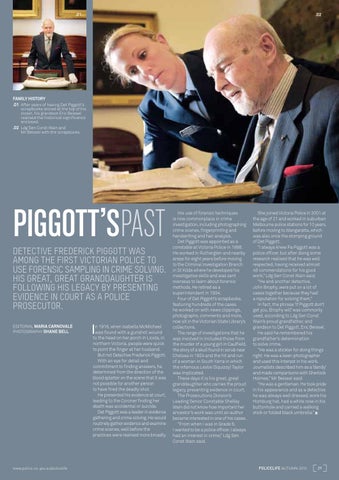
FAMILY HISTORY .01 After years of having Det Piggott’s scrapbooks stored at the top of his closet, his grandson Eric Beissel realised the historical significance enclosed. .02 Ldg Sen Const Wain and Mr Beissel with the scrapbooks.
PIGGOTT’SPAST Detective Frederick Piggott was among the first Victorian police to use forensic sampling in crime solving. His great, great granddaughter is following his legacy by presenting evidence in court as a police prosecutor. EDITORIAL MARIA CARNOVALE PHOTOGRAPHY SHANE BELL
www.police.vic.gov.au/policelife
I
n 1916, when Isabella McMichael was found with a gunshot wound to the head on her porch in Licola, in northern Victoria, people were quick to point the finger at her husband. But not Detective Frederick Piggott. With an eye for detail and commitment to finding answers, he determined from the direction of the blood splatter on the scene that it was not possible for another person to have fired the deadly shot. He presented his evidence at court, leading to the Coroner finding her death was accidental or suicide. Det Piggott was a leader in evidence gathering and crime solving. He would routinely gather evidence and examine crime scenes, well before the practices were realised more broadly.
His use of forensic techniques is now commonplace in crime investigation, including photographing crime scenes, fingerprinting and handwriting and hair analysis. Det Piggott was appointed as a constable at Victoria Police in 1898. He worked in Rutherglen and nearby areas for eight years before moving to the Criminal Investigation Branch in St Kilda where he developed his investigative skills and was sent overseas to learn about forensic methods. He retired as a superintendent in 1934. Four of Det Piggott’s scrapbooks, featuring hundreds of the cases he worked on with news clippings, photographs, comments and more, now sit in the Victorian State Library’s collections. The range of investigations that he was involved in included those from the murder of a young girl in Caulfield, the story of a skull found in scrub near Chelsea in 1924 and the hit and run of a woman in South Yarra in which the infamous Leslie (Squizzy) Taylor was implicated. These days it is his great, great granddaughter who carries the proud legacy, presenting evidence in court. The Prosecutions Division’s Leading Senior Constable Shelley Wain did not know how important her ancestor’s work was until an author became interested in one of his cases. “From when I was in Grade 6, I wanted to be a police officer. I always had an interest in crime,” Ldg Sen Const Wain said.
She joined Victoria Police in 2001 at the age of 21 and worked in suburban Melbourne police stations for 10 years, before moving to Wangaratta, which was also once the stomping ground of Det Piggott. “I always knew Pa Piggott was a police officer, but after doing some research realised that he was well respected, having received almost 48 commendations for his good work,” Ldg Sen Const Wain said. “He and another detective, John Brophy, were put on a lot of cases together because they had a reputation for solving them.” In fact, the phrase ‘If Piggott don’t get you, Brophy will’ was commonly used, according to Ldg Sen Const Wain’s proud grandfather, and grandson to Det Piggott, Eric Beissel. He said he remembered his grandfather’s determination to solve crime. “He was a stickler for doing things right. He was a keen photographer and used this interest in his work. Journalists described him as a ‘dandy’ and made comparisons with Sherlock Holmes,” Mr Beissel said. “He was a gentleman. He took pride in his appearance and as a detective he was always well dressed, wore his Homburg hat, had a white rose in his buttonhole and carried a walking stick or folded black umbrella.”
POLICELIFE AUTUMN 2013
29