Q&A
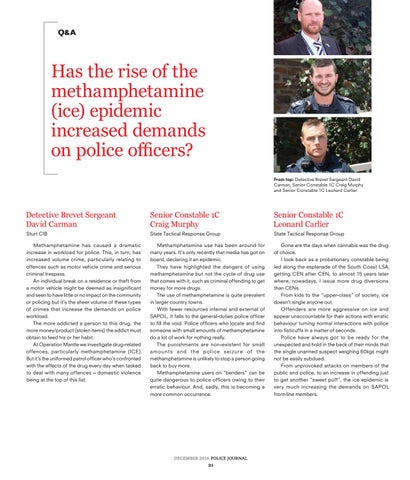
Has the rise of the methamphetamine (ice) epidemic increased demands on police officers? From top: Detective Brevet Sergeant David Carman, Senior Constable 1C Craig Murphy and Senior Constable 1C Leonard Carlier.
Detective Brevet Sergeant David Carman
Senior Constable 1C Craig Murphy
Senior Constable 1C Leonard Carlier
Sturt CIB
State Tactical Response Group
State Tactical Response Group
Methamphetamine has caused a dramatic increase in workload for police. This, in turn, has increased volume crime, particularly relating to offences such as motor vehicle crime and serious criminal trespass. An individual break on a residence or theft from a motor vehicle might be deemed as insignificant and seen to have little or no impact on the community or policing but it’s the sheer volume of these types of crimes that increase the demands on police workload. The more addicted a person to this drug, the more money/product (stolen items) the addict must obtain to feed his or her habit. At Operation Mantle we investigate drug-related offences, particularly methamphetamine (ICE). But it’s the uniformed patrol officer who’s confronted with the effects of the drug every day when tasked to deal with many offences – domestic violence being at the top of this list.
Methamphetamine use has been around for many years. It’s only recently that media has got on board, declaring it an epidemic. They have highlighted the dangers of using methamphetamine but not the cycle of drug use that comes with it, such as criminal offending to get money for more drugs. The use of methamphetamine is quite prevalent in larger country towns. With fewer resources internal and external of SAPOL, it falls to the general-duties police officer to fill the void. Police officers who locate and find someone with small amounts of methamphetamine do a lot of work for nothing really. The punishments are non-existent for small amounts and the polic e se izure of the methamphetamine is unlikely to stop a person going back to buy more. Methamphetamine users on “benders” can be quite dangerous to police officers owing to their erratic behaviour. And, sadly, this is becoming a more common occurrence.
Gone are the days when cannabis was the drug of choice. I look back as a probationary constable being led along the esplanade of the South Coast LSA, getting CEN after CEN, to almost 15 years later where, nowadays, I issue more drug diversions than CENs. From kids to the “upper-class” of society, ice doesn’t single anyone out. Offenders are more aggressive on ice and appear unaccountable for their actions with erratic behaviour turning normal interactions with police into fisticuffs in a matter of seconds. Police have always got to be ready for the unexpected and hold in the back of their minds that the single unarmed suspect weighing 60kgs might not be easily subdued. From unprovoked attacks on members of the public and police, to an increase in offending just to get another “sweet puff”, the ice epidemic is very much increasing the demands on SAPOL front-line members.
DECEMBER 2016 POLICE JOURNAL
21