Herald Business Journal A10
|
THE DAILY HERALD
|
WWW.HERALDNET.COM
|
FRIDAY, 01.02.2015
Wealth gap affects sibling ties Some brothers and sisters watch with envy as the other rises to riches By Bernard Condon Associated Press
NEW YORK — When Jayson Seaver thinks about why he makes so much money while some Americans can’t catch a break, he thinks of the sacrifices he’s made, the jobs he worked to pay for college, the 12-hour days he spends at the office now. And he thinks of his youngest sister, Jackie, whom he practically begged to go to college and how she refused and is “paying for it” now, watching with envy while he flies around on vacation and enjoys his wealth. At least that’s how he sees it. She has a different view. But they don’t talk much. “I’m disappointed in her,” says Jayson, 37. “I think it’s distanced us.” It’s a story as old as humankind: People raised in the same home, at the same time, by the same parents, who as adults land in vastly different financial circumstances. In 35 years practicing psychotherapy, Janna Malamud Smith says she’s never had so many clients troubled by sibling wealth. The complaints have grown so familiar to her she can riff on them without pause: “‘My sibling can afford to join this country club, and I can’t.’ ‘My brother has houses in four countries, and why can’t he help me out?”’ There’s more than one reason Stuart Schneider and his brother and sister don’t speak anymore. But he thinks the problem began when he struck it rich in the late ‘90s selling high-end textiles and began driving a Land Rover and sporting a Rolex watch. “I thought they would be proud of me,” says Schneider, 53. “But it really wasn’t that way.” Likewise, VP Young Chang, co-owner of a Los Angeles clothes company, thought his cousins would be pleased he could afford a Ferrari and BMW 7 Series — until he showed up to a family party a few years ago in one of the cars. “It didn’t play well. It wasn’t, ‘Congrats, Buddy,”’ says Chang,
Tesla cars will go faster By Charles Fleming Los Angeles Times
MARK LENNIHAN / ASSOCIATED PRESS
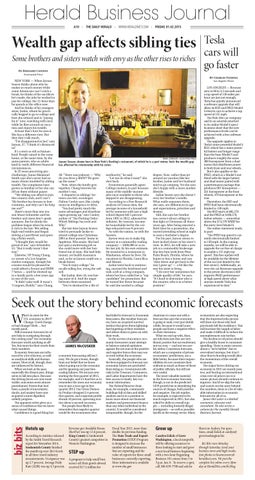
Jayson Seaver, shown here in New York’s Harding’s restaurant, of which he is a part owner, feels the wealth gap has affected his relationship with his sister.
38. “There was jealousy — ‘Why do you drive a BMW? We grew up the same.”’ Now, when the family gets together, Chang borrows his mother’s van. A disparity in siblings’ fortunes can feel, sociologist Dalton Conley says, like a judgment on intelligence or drive. “You had pretty much the same advantages and disadvantages growing up,” says Conley, author of “The Pecking Order: Which Siblings Succeed and Why.” The last time Jayson Seaver tried to persuade Jackie to attend college was Christmas 2004 at their parents’ home in Appleton, Wisconsin. She had just quit a waitressing job so she could move with her boyfriend out of state. She had little money, no health insurance and, as far as Jayson could see, a bleak future. “You’d enjoy college,” he recalls telling her, trying the soft sell. But Jackie, then 18, was having none of it. And the anger between them mounted. “You’re destined for a life of
mediocrity,” he said. “Let me do what I want!” she shot back. Economists generally agree: College matters, in part because many of the middle-income jobs once available to those who skipped it are disappearing. According to a Pew Research analysis of Census data, the average income of a household led by someone with just a high school degree fell 5 percent from 1991 to 2012, adjusted for inflation. By contrast, income for households led by the college educated rose 9 percent. As with the nation, so with the Seavers. Jayson went on to make big money at a commodity trading company — $300,000 or so in his last job, by his own estimate. He invested in a restaurant in Manhattan, where he lives. He vacations in Florida, Costa Rica and Hawaii. Jackie went back to waitressing, married the boyfriend and took a job at a drug company, where her boss called her a “top candidate” for promotion. But he turned her down because he said she needed a college
degree. Now, rather than jet around on vacation like her brother, Jackie and her husband tend to go camping. Yet she says she’s happy with a more modest lifestyle. Jackie Seaver says she doesn’t envy her brother’s wealth. What really separates them, she says, are differences in age and expectations, priorities and desires. Still, she says her brother was correct about college in that fight at Christmas all those years ago. After being rejected a third time for a promotion, she started attending school at night to earn a bachelor’s degree. For his part, Jayson seems to have inched closer to his sister’s view. In 2015, he will take a new job at a commodity brokerage that lets him work from West Palm Beach, Florida, where he hopes to buy a home and can “slow down and get back to the way I grew up” — a bit like the way his sister is living. “I do envy her sometimes her simple quality of life,” he says. “It’s hard to determine who is the smarter, who is in a better position.”
LOS ANGELES — Because zero to 60 in 3.2 seconds and a top speed of 130 miles per hour are just not enough, Tesla has quietly announced a software upgrade that will allow its 85D and P85D Model S electric cars to achieve a top speed of 155 mph. The Palo Alto car company said in an asterisk attached to its online Model S specifications sheet that the new performance levels can be achieved with a free software upgrade. The upgrade applies to Tesla’s more powerful Model S 85D, which has a more powerful battery and longer range than the base Model S and produces roughly the same 380 horsepower from a dual motor that distributes power to both front and rear wheels. But it also applies to the P85D, which is a Model S outfitted with the larger battery and dual motor paired with a performance package that produces 691 horsepower — 221 horsepower at the front wheels, 470 horsepower at the rear. Heretofore, the 85D and P85D had been electronically limited to 130 mph. The 85D starts at $85,570 and the P85D at $106,570, before rebates — somewhat above the $74,570 MSRP for the entry-level Model S. The online statement reads, in part: “The P85D top speed is currently electronically limited to 130 mph. In the coming months, we will be able to upgrade the car free of charge to enable a 155 mph top speed. This free update will be available for the lifetime of the car (not limited to the first owner). Additionally, an over-the-air firmware upgrade to the power electronics will improve P85D performance at high speed above what anyone outside Tesla has experienced to date.”
Seek out the story behind economic forecasts W
biz bits
hat’s in store for the U.S. economy in 2015? Change. Good change or bad change? Both … but mostly good. Will economic forecasts be of any help in navigating through the coming year? Are economic forecasts worth anything at all? Yes, but more for their words than their numbers. Economic forecasts are influenced by a lot of factors, as well as analytical skills and human nature. Most of all, though, they are influenced by history. When we look at the past, especially the distant past, things seem to fall into place. Because the driving forces are now more visible, outcomes seem almost preordained. Events that had been a puzzle of uncertainty, doubt, and anxiety have now acquired a more dignified, orderly progress. The apparent order gives us a sense of confidence that we know what caused things. Confidence is a good thing but
JAMES McCUSKER economic forecasting still isn’t easy. We do get a boost, though from our belief that we know what is going on in the economy and by ignoring our past forecasting failures. We are just now starting the first quarter of 2015, for example, and it’s hard for us to remember the mess our economy was in just a year ago in first quarter 2014. Our Gross Domestic Product dropped 2.4 percent that quarter, and corporate profits shrank 10 percent, spawning worries about a second recession. The people least likely to remember that negative quarter would be the economists who
Hotels up According to statistics released by the Smith Travel Research report for November 2014, Snohomish County finished the month up over 2013 levels in all three travel industry measurements. Occupancy was up 2.7 percent. Average Daily Rate (ADR) was up 4.5 percent.
had failed to forecast it. Economic forecasters, like weather forecasters, have an acquired survival instinct that gives them lightningfast forgetting of their mistakes and allows them to press on with their work. In the service of accuracy, economic forecasters must attempt to balance natural optimism against the net sum of the positive and negative forces they may see at work within the economy. Ironically, the people who are the best equipped to forecast our economic future are precluded from doing so. Government officials in the Treasury, Commerce, and Labor departments have the best access to timely, key economic information. The Federal Reserve chairman, for example, commands buildings full of data and skilled analysts and is in a position to know more about our financial markets and government finance than any other individual in the country. It would be considered irresponsible, though, for the
Revenue per Available Room (RevPar) was up 13.6 percent. King County is Snohomish County’s greatest competitor in Western Washington.
STEP up A program to help small businesses sell their goods abroad received $17.4 million for
Fiscal Year 2015, more than double its previous funding. The State Trade and Export Promotion (STEP) Program is designed to increase the number of small businesses that are exporting and the value of exports for those small businesses currently exporting. More information is available at www.sba.gov
chairman to come out with a forecast that says the economy is going to tank, even just shrink a little, because it would scare people and have a negative effect on their decisions. What we end up with, then, are tofu forecasts that are very bland; positive but not exuberant, not too rosy — and not too useful, either. Consensus forecasts, which are a composite of private economists’ predictions, are a little better, because their responsibilities do not constrain their outlook as much as those of those of public officials, but still not very useful. The most valuable material in the best economic forecasts, though, is not in the predicted GDP growth but in identifying the sources of change, both positive and negative. The job market, for example, is expected to be much improved in 2015, but also roiled by shifts in overall supply — including formerly illegal immigrants —as well as possible layoffs in the energy sector. Many
Grow up Carolyn Eslick of Grow Washington, a local nonprofit, will be offering resources to those looking to start and grow a new local business beginning with a two-hour Beginning Business 101 course from 3 to 5 p.m. Jan. 6. To reserve a spot, call 360-659-7700 and ask for
economists are also expecting that the improved jobs picture will draw out those who had previously left the workforce. This will increase the supply of labor and make it difficult to reduce the unemployment rate further. The decline in oil prices should give a healthy boost to consumer spending. There is some concern about a “tech bubble” due to overvalued startups, but it isn’t clear that its bursting would alter the momentum of the overall economy. The major forces driving our economy in 2015 are mostly positive, and barring an international crisis over oil prices our economic picture should continue to improve. And if we skip the tofu and search out the story behind the numbers, there is a lot of valuable information in economic forecasts for all of us. James McCusker is a Bothell economist, educator and consultant. He also writes a column for the monthly Herald Business Journal.
Sherri or Audrey. For questions, email Eslick at carolyn@ growwashington.biz Biz Bits runs Monday through Saturday. Send your business news and high-resolution photos to businessnews@ heraldnet.com. We post the complete list online every Monday at HeraldNet.com/bizblog.