BIG
The Foreign Office spokesman at the time said the remarks “provide no justifiable basis” to bring further charges against Nazanin Zaghari-Ratcliffe. Whilst undoubtedly true, given Iran’s behaviour in this matter up to this point, it was completely the wrong thing to say at the wrong time. Naturally, he has never apologised for this remark. For years, Richard Ratcliffe believed that there were elements, indeed a whole government department, who wanted to block payment to Iran at any cost. The fact the Zaghari-Ratcliffe spent six years in prison points at an ambivalence of the UK’s diplomatic and foreign players towards its own citizens. In truth, Zaghari-Ratcliffe’s incarceration was, of course, a farce - devoid of legal, humanistic or intelligent merit. The United Nations, US Congress, the Canadian Parliament and the European Parliament were among those calling for her immediate release.
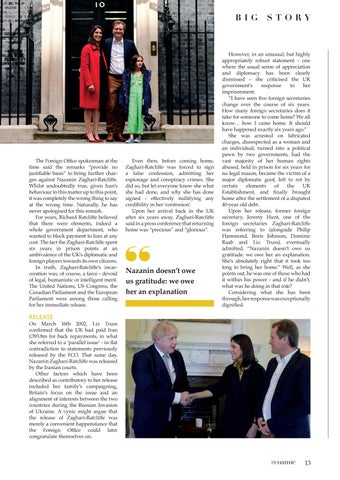
Even then, before coming home, Zaghari-Ratcliffe was forced to sign a false confession, admitting her espionage and conspiracy crimes. She did so, but let everyone know she what she had done, and why she has done signed - effectively nullifying any credibility in her ‘confession’. Upon her arrival back in the UK after six years away, Zaghari-Ratcliffe said in a press conference that returning home was “precious” and “glorious”.
Nazanin doesn’t owe us gratitude: we owe her an explanation
STORY
However, in an unusual, but highly appropriately robust statement – one where the usual sense of appreciation and diplomacy has been clearly dismissed – she criticised the UK government’s response to her imprisonment. “I have seen five foreign secretaries change over the course of six years. How many foreign secretaries does it take for someone to come home? We all know… how I came home. It should have happened exactly six years ago.” She was arrested on fabricated charges, disrespected as a woman and an individual, turned into a political pawn by two governments, had the vast majority of her human rights abused, held in prison for six years for no legal reason, became the victim of a major diplomatic goof, left to rot by certain elements of the UK Establishment, and finally brought home after the settlement of a disputed 40-year old debt. Upon her release, former foreign secretary, Jeremy Hunt, one of the foreign secretaries Zaghari-Ratcliffe was referring to (alongside Philip Hammond, Boris Johnson, Dominic Raab and Liz Truss), eventually admitted, ”Nazanin doesn’t owe us gratitude: we owe her an explanation. She’s absolutely right that it took too long to bring her home.” Well, as she points out, he was one of those who had it within his power - and if he didn’t, what was he doing in that role? Considering what she has been through, her response was exceptionally dignified.
RELEASE
On March 16th 2002, Liz Truss confirmed that the UK had paid Iran £393.8m for back repayments, in what she referred to a ‘parallel issue’ - in flat contradiction to statements previously released by the FCO. That same day, Nazanin Zaghari-Ratcliffe was released by the Iranian courts. Other factors which have been described as contributory to her release included her family’s campaigning, Britain’s focus on the issue and an alignment of interests between the two countries during the Russian Invasion of Ukraine. A cynic might argue that the release of Zaghari-Ratcliffe was merely a convenient happenstance that the Foreign Office could later congratulate themselves on.
13