Which road for urban mobility?
Enduring desire to own cars Rationally, the numbers stack up against owning a car in the city. Yet many urbanites continue to covet a car of their own - including Gen Y, who some (see ‘Millennials don’t want cars’: Debunked, page 14) claim have fallen out of love with cars. On the contrary: a recent survey showed that 75 percent of Gen Y drivers in developed markets (79 percent in developing markets) believe that they are likely to be using their own, personal car in five years’ time.5 Despite the demonisation of cars by policy wonks and pressure groups, for most the automobile remains a powerful symbol of personal freedom and individuality. In other words, buying a car is not an entirely rational act. Translating intention into action While plenty of people are aware of car sharing and think it sounds relevant to them, getting them to try car clubs out – let alone engrain them into their lives – is an uphill battle. For example,
8 percent of Londoners who signed up for car clubs in 2014, for one reason or another, never actually rented a car.6 This presents operators with a classic marketing challenge: how to convert interest into action? The challenge of keeping busy Car sharing enthusiasts love to quote statistics about how most private cars spend the vast majority of the time unused – typically they are only used 5 percent. However, they tend to gloss over the fact that car club vehicles also spend a sizeable chunk of time unused (and not earning) during the troughs in demand for mobility. Zipcar quotes utilisation rates of 30-40 percent7. Sweating these assets effectively is critical to the commercial viability8 of car clubs, and it’s a real challenge. One car, many motivations for use In the popular imagination a car club user is a young, environmentally-aware hipster who spontaneously decides to nip down to the new artisanal coffee shop. In reality, driver profiles and use cases vary widely over time and location within a city – for example, few customers are explicitly driven by sustainability concerns. This diverse set of customers and motivations makes targeted service development and marketing challenging.
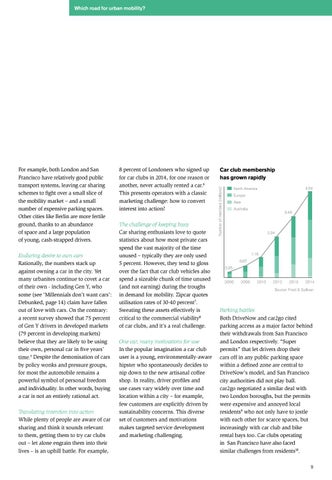
Car club membership has grown rapidly 4.94
North America
Number of members (millions)
For example, both London and San Francisco have relatively good public transport systems, leaving car sharing schemes to fight over a small slice of the mobility market – and a small number of expensive parking spaces. Other cities like Berlin are more fertile ground, thanks to an abundance of space and a large population of young, cash-strapped drivers.
Europe Asia Australia
3.48
2.34
1.16 0.67 0.35
2006
2008
2010
2012
2013
2014
Source: Frost & Sullivan
Parking battles Both DriveNow and car2go cited parking access as a major factor behind their withdrawals from San Francisco and London respectively. “Super permits” that let drivers drop their cars off in any public parking space within a defined zone are central to DriveNow’s model, and San Francisco city authorities did not play ball. car2go negotiated a similar deal with two London boroughs, but the permits were expensive and annoyed local residents9 who not only have to jostle with each other for scarce spaces, but increasingly with car club and bike rental bays too. Car clubs operating in San Francisco have also faced similar challenges from residents10. 9