‘ Despite the zeitgeisty goodwill, there are signs that the prospects of turning a profit in car sharing are not so rosy.’
Remember how the “sharing economy” was going to revolutionise urban car ownership? Car clubs like Daimler’s car2go are still enjoying the tail end of that hype, but converting the buzz into bucks is proving far from straightforward. It’s clear that there are real opportunities out there for car clubs, but it’s up to each operator to find their niche.
of mobility services that complement public transport, such as bike hire, ride hailing and ride sharing (see map on page 12). These alternatives to private car ownership shine a light on its cost and hassle – especially in urban areas, where cars are used less. It seems car sharing is an idea whose time has come.
As Uber continues its march, the urban mobility marketplace is evolving fast. The car sharing schemes that succeed will be the ones that adapt to very specific local needs, hone their operations to suit niches within increasingly diverse mobility ecosystems, and then market their service in creative, compelling and nimble ways.
Yet despite the zeitgeisty goodwill, there are signs that the prospects of turning a profit in car sharing are not so rosy. A recent survey suggests that membership of car clubs is now falling in the USA.1 Zipcar, the market leader, managed to turn a 3 percent profit in 2013/14.2 In 2014, car2go’s “free floating” service pulled out of the UK3 and the joint venture between BMW Group and Sixt recently announced that it was withdrawing its DriveNow service from San Francisco.4 So why are two of the most sophisticated car sharing providers finding it impossible to get established in two of the world’s most progressive and tech-savvy cities? The reality of car sharing is a bumpier road than first appearances seem to suggest.
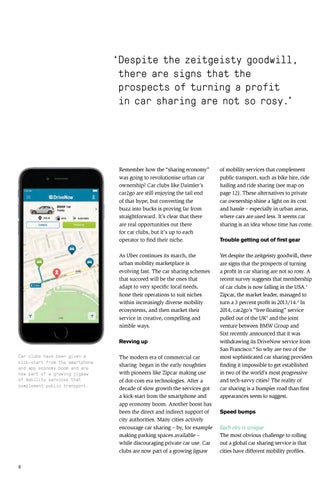
Revving up Car clubs have been given a kick-start from the smartphone and app economy boom and are now part of a growing jigsaw of mobility services that complement public transport.
8
The modern era of commercial car sharing began in the early noughties with pioneers like Zipcar making use of dot-com era technologies. After a decade of slow growth the services got a kick-start from the smartphone and app economy boom. Another boost has been the direct and indirect support of city authorities. Many cities actively encourage car sharing – by, for example making parking spaces available – while discouraging private car use. Car clubs are now part of a growing jigsaw
Trouble getting out of first gear
Speed bumps Each city is unique The most obvious challenge to rolling out a global car sharing service is that cities have different mobility profiles.