Cross-silo communication
Experience awareness
Foresight and vision
Visualisation and prototyping
Resolving and completing
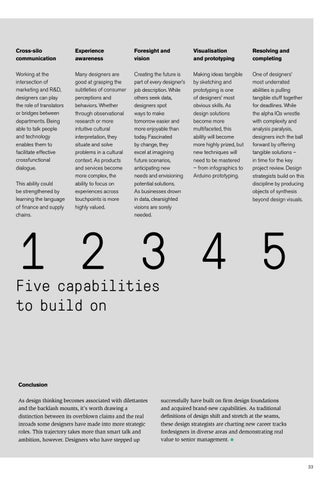
Working at the intersection of marketing and R&D, designers can play the role of translators or bridges between departments. Being able to talk people and technology enables them to facilitate effective crossfunctional dialogue.
Many designers are good at grasping the subtleties of consumer perceptions and behaviors. Whether through observational research or more intuitive cultural interpretation, they situate and solve problems in a cultural context. As products and services become more complex, the ability to focus on experiences across touchpoints is more highly valued.
Creating the future is part of every designer’s job description. While others seek data, designers spot ways to make tomorrow easier and more enjoyable than today. Fascinated by change, they excel at imagining future scenarios, anticipating new needs and envisioning potential solutions. As businesses drown in data, clearsighted visions are sorely needed.
Making ideas tangible by sketching and prototyping is one of designers’ most obvious skills. As design solutions become more multifaceted, this ability will become more highly prized, but new techniques will need to be mastered – from infographics to Arduino prototyping.
One of designers’ most underrated abilities is pulling tangible stuff together for deadlines. While the alpha IQs wrestle with complexity and analysis paralysis, designers inch the ball forward by offering tangible solutions – in time for the key project review. Design strategists build on this discipline by producing objects of synthesis beyond design visuals.
This ability could be strengthened by learning the language of finance and supply chains.
1 2 3 4 5
Five capabilities to build on
Conclusion As design thinking becomes associated with dilettantes and the backlash mounts, it’s worth drawing a distinction between its overblown claims and the real inroads some designers have made into more strategic roles. This trajectory takes more than smart talk and ambition, however. Designers who have stepped up
successfully have built on firm design foundations and acquired brand-new capabilities. As traditional definitions of design shift and stretch at the seams, these design strategists are charting new career tracks fordesigners in diverse areas and demonstrating real value to senior management.
33