From the archive
Five capabilities to brush up on
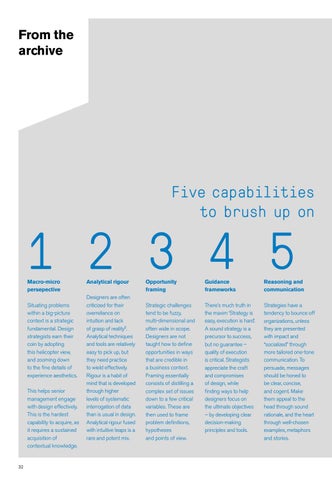
1 2 3 4 5 Macro-micro persepective
Situating problems within a big-picture context is a strategic fundamental. Design strategists earn their coin by adopting this helicopter view, and zooming down to the fine details of experience aesthetics. This helps senior management engage with design effectively. This is the hardest capability to acquire, as it requires a sustained acquisition of contextual knowledge.
32
Analytical rigour
Designers are often criticized for their overreliance on intuition and lack of grasp of reality5. Analytical techniques and tools are relatively easy to pick up, but they need practice to wield effectively. Rigour is a habit of mind that is developed through higher levels of systematic interrogation of data than is usual in design. Analytical rigour fused with intuitive leaps is a rare and potent mix.
Opportunity framing
Guidance frameworks
Reasoning and communication
Strategic challenges tend to be fuzzy, multi-dimensional and often wide in scope. Designers are not taught how to define opportunities in ways that are credible in a business context. Framing essentially consists of distilling a complex set of issues down to a few critical variables. These are then used to frame problem definitions, hypotheses and points of view.
There’s much truth in the maxim ‘Strategy is easy, execution is hard’. A sound strategy is a precursor to success, but no guarantee – quality of execution is critical. Strategists appreciate the craft and compromises of design, while finding ways to help designers focus on the ultimate objectives – by developing clear decision-making principles and tools.
Strategies have a tendency to bounce off organizations, unless they are presented with impact and “socialized” through more tailored one-tone communication. To persuade, messages should be honed to be clear, concise, and cogent. Make them appeal to the head through sound rationale, and the heart through well-chosen examples, metaphors and stories.