Beyond Design Thinking PROCESS
CONTEXT
: Kevin McCullagh Design Management Review, Summer 2013
TALENT
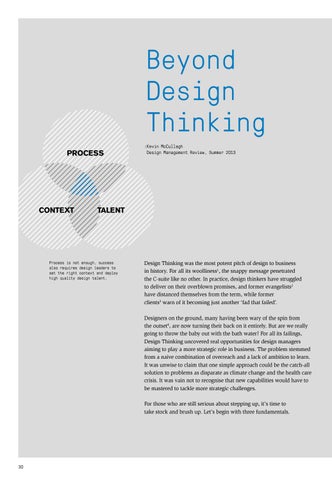
Process is not enough, success also requires design leaders to set the right context and deploy high quality design talent.
Design Thinking was the most potent pitch of design to business in history. For all its woolliness1, the snappy message penetrated the C-suite like no other. In practice, design thinkers have struggled to deliver on their overblown promises, and former evangelists2 have distanced themselves from the term, while former clients3 warn of it becoming just another ‘fad that failed’. Designers on the ground, many having been wary of the spin from the outset4, are now turning their back on it entirely. But are we really going to throw the baby out with the bath water? For all its failings, Design Thinking uncovered real opportunities for design managers aiming to play a more strategic role in business. The problem stemmed from a naive combination of overreach and a lack of ambition to learn. It was unwise to claim that one simple approach could be the catch-all solution to problems as disparate as climate change and the health care crisis. It was vain not to recognise that new capabilities would have to be mastered to tackle more strategic challenges. For those who are still serious about stepping up, it’s time to take stock and brush up. Let’s begin with three fundamentals.
30