Gig economy
Peak car
Redefined town centres
Work done by a rapidly growing workforce of independent and insecure freelancers
The theory that miles-travelledby-car per capita has plateaued in the West, needs revisiting
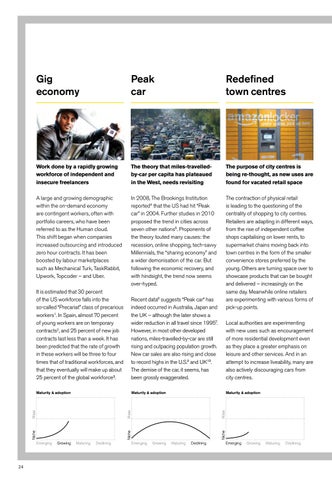
The purpose of city centres is being re-thought, as new uses are found for vacated retail space
A large and growing demographic within the on-demand economy are contingent workers, often with portfolio careers, who have been referred to as the Human cloud. This shift began when companies increased outsourcing and introduced zero hour contracts. It has been boosted by labour marketplaces such as Mechanical Turk, TaskRabbit, Upwork, Topcoder – and Uber.
In 2008, The Brookings Institution reported4 that the US had hit “Peak car” in 2004. Further studies in 2010 proposed the trend in cities across seven other nations5. Proponents of the theory touted many causes: the recession, online shopping, tech-savvy Millennials, the “sharing economy” and a wider demonisation of the car. But following the economic recovery, and with hindsight, the trend now seems over-hyped.
The contraction of physical retail is leading to the questioning of the centrality of shopping to city centres. Retailers are adapting in different ways, from the rise of independent coffee shops capitalising on lower rents, to supermarket chains moving back into town centres in the form of the smaller convenience stores preferred by the young. Others are turning space over to showcase products that can be bought and delivered – increasingly on the same day. Meanwhile online retailers are experimenting with various forms of pick-up points.
Recent data6 suggests “Peak car“ has indeed occurred in Australia, Japan and the UK – although the later shows a wider reduction in all travel since 19957. However, in most other developed nations, miles-travelled-by-car are still rising and outpacing population growth. New car sales are also rising and close to record highs in the U.S.9 and UK10. The demise of the car, it seems, has been grossly exaggerated.
Maturity & adoption
Maturity & adoption
24
Growing
Maturing
Declining
Mass Niche
Mass Emerging
Local authorities are experimenting with new uses such as encouragement of more residential development even as they place a greater emphasis on leisure and other services. And in an attempt to increase liveability, many are also actively discouraging cars from city centres. Maturity & adoption
Niche
Niche
Mass
It is estimated that 30 percent of the US workforce falls into the so-called “Precariat” class of precarious workers1. In Spain, almost 70 percent of young workers are on temporary contracts2, and 25 percent of new job contracts last less than a week. It has been predicted that the rate of growth in these workers will be three to four times that of traditional workforces, and that they eventually will make up about 25 percent of the global workforce3.
Emerging
Growing
Maturing
Declining
Emerging
Growing
Maturing
Declining