essential and contextually relevant information. They’ll need to work from an assumption set that doesn’t include engagement with an app. This is going to require them to leverage context, user behaviour and “big data” in ever more sophisticated ways. What are the timely, meaningful “micro-moments” in which brands need to be present? Secondly, mobile advertising is set for another jump in its precision, something that might help cushion the decline in revenue caused by mobile-ad blocking software. Brands will need to be ever smarter at locating themselves inside deep-linked apps. It will be a job not just for analytics teams, but also for marketing teams, as smart association with other apps will help discoverability: think of an accommodation brand working in association with a train-travel brand. Thirdly, as mobile operating systems place more and more emphasis on intelligent assistants, brands need to
work out how to be front and centre in these experiences. For big players, integration within mainstay apps makes this less of an issue. (For example, Uber, who are integrated into Google Maps.) But for smaller players, the key will be ensuring that they offer distinctive services that mark them out uniquely for the assistants to discover and prioritise. It suggests that the future for service providers lies in either being incredibly distinctive, narrow and specialist, or being part of a large constellation of natural brand allies that support each other. Placing more emphasis on horizontal integration – learning how to work embedded deep inside an ecosystem – rather than going toe-to-toe with a competitor at an app level, may be a better investment.
Glance-able notifications Alerts from apps pushed to a device screen. Increasingly, these allow users to accomplish apprelated tasks within the notification “pane”.
Looking ahead to 2016, brands need a deep, precise understanding of where they add most value. They must also be utterly rigorous in shedding services that are just ‘nice to have’, and better leverage partnerships – otherwise the consumer quite literally won’t give you a second glance.
With most smartphone forecasts showing a levelling off of growth in mature markets for the foreseeable future, and smartwatch forecasts coming down all the time, it’s unlikely that there is a new wave of hardware
‘ Brands will have to learn how to exist in a world where they compete to have their content highlighted by an OS they don’t control.’
Glossary
around the corner to drive service engagement. Meanwhile, Apple, Google and Microsoft are ever more forcefully shaping the interaction rules.
Intelligent Personal Assistants Software that performs tasks for the user based on elements such as location, weather or schedule. These tasks can be done without explicit intervention by the user. Deep linking Using a hyperlink to go to a specific piece of information contained in a website or, increasingly, “inside” an app.
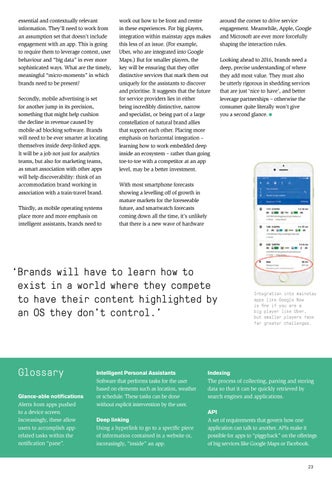
Integration into mainstay apps like Google Now is fine if you are a big player like Uber, but smaller players face far greater challenges.
Indexing The process of collecting, parsing and storing data so that it can be quickly retrieved by search engines and applications. API A set of requirements that govern how one application can talk to another. APIs make it possible for apps to “piggyback” on the offerings of big services like Google Maps or Facebook.
23