‘ With deep linking, app users are guided straight to the content they’re seeking.’
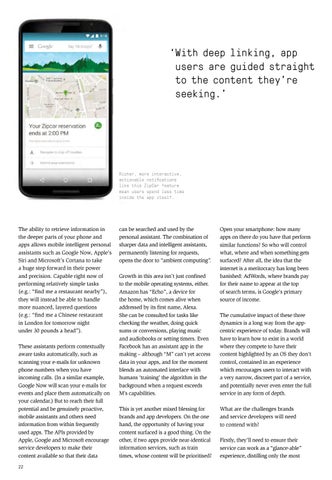
Richer, more interactive, actionable notifications like this ZipCar feature mean users spend less time inside the app itself.
The ability to retrieve information in the deeper parts of your phone and apps allows mobile intelligent personal assistants such as Google Now, Apple’s Siri and Microsoft’s Cortana to take a huge step forward in their power and precision. Capable right now of performing relatively simple tasks (e.g.: “find me a restaurant nearby”), they will instead be able to handle more nuanced, layered questions (e.g.: “find me a Chinese restaurant in London for tomorrow night under 30 pounds a head”). These assistants perform contextually aware tasks automatically, such as scanning your e-mails for unknown phone numbers when you have incoming calls. (In a similar example, Google Now will scan your e-mails for events and place them automatically on your calendar.) But to reach their full potential and be genuinely proactive, mobile assistants and others need information from within frequently used apps. The APIs provided by Apple, Google and Microsoft encourage service developers to make their content available so that their data 22
can be searched and used by the personal assistant. The combination of sharper data and intelligent assistants, permanently listening for requests, opens the door to “ambient computing”. Growth in this area isn’t just confined to the mobile operating systems, either. Amazon has “Echo”, a device for the home, which comes alive when addressed by its first name, Alexa. She can be consulted for tasks like checking the weather, doing quick sums or conversions, playing music and audiobooks or setting timers. Even Facebook has an assistant app in the making – although “M” can’t yet access data in your apps, and for the moment blends an automated interface with humans ‘training’ the algorithm in the background when a request exceeds M’s capabilities. This is yet another mixed blessing for brands and app developers. On the one hand, the opportunity of having your content surfaced is a good thing. On the other, if two apps provide near-identical information services, such as train times, whose content will be prioritised?
Open your smartphone: how many apps on there do you have that perform similar functions? So who will control what, where and when something gets surfaced? After all, the idea that the internet is a meritocracy has long been banished: AdWords, where brands pay for their name to appear at the top of search terms, is Google’s primary source of income. The cumulative impact of these three dynamics is a long way from the appcentric experience of today. Brands will have to learn how to exist in a world where they compete to have their content highlighted by an OS they don’t control, contained in an experience which encourages users to interact with a very narrow, discreet part of a service, and potentially never even enter the full service in any form of depth. What are the challenges brands and service developers will need to contend with? Firstly, they’ll need to ensure their service can work as a “glance-able” experience, distilling only the most