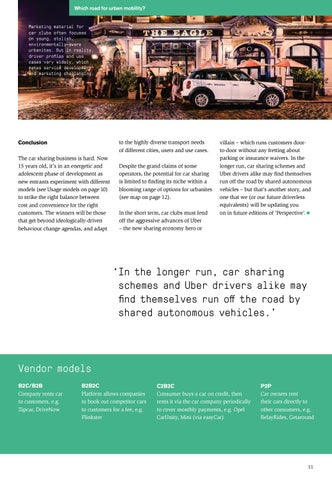
Which road for urban mobility? Marketing material for car clubs often focuses on young, stylish, environmentally-aware urbanites. But in reality, driver profiles and use cases vary widely, which makes service development and marketing challenging.
to the highly diverse transport needs of different cities, users and use cases.
Conclusion The car sharing business is hard. Now 15 years old, it’s in an energetic and adolescent phase of development as new entrants experiment with different models (see Usage models on page 10) to strike the right balance between cost and convenience for the right customers. The winners will be those that get beyond ideologically-driven behaviour change agendas, and adapt
Despite the grand claims of some operators, the potential for car sharing is limited to finding its niche within a blooming range of options for urbanites (see map on page 12). In the short term, car clubs must fend off the aggressive advances of Uber – the new sharing economy hero or
villain – which runs customers doorto-door without any fretting about parking or insurance waivers. In the longer run, car sharing schemes and Uber drivers alike may find themselves run off the road by shared autonomous vehicles – but that’s another story, and one that we (or our future driverless equivalents) will be updating you on in future editions of ‘Perspective’.
‘ In the longer run, car sharing schemes and Uber drivers alike may find themselves run off the road by shared autonomous vehicles.’
Vendor models B2C/B2B Company rents car to customers, e.g. Zipcar, DriveNow
B2B2C Platform allows companies to book out competitor cars to customers for a fee, e.g. Flinkster
C2B2C Consumer buys a car on credit, then rents it via the car company periodically to cover monthly payments, e.g. Opel CarUnity, Mini (via easyCar)
P2P Car owners rent their cars directly to other consumers, e.g. RelayRides, Getaround
11