Just Breathe is the first legal cannabis dispensary to open outside of New York City.
Binghamton is now home to New York state’s first legal cannabis dispensary outside of New York City.
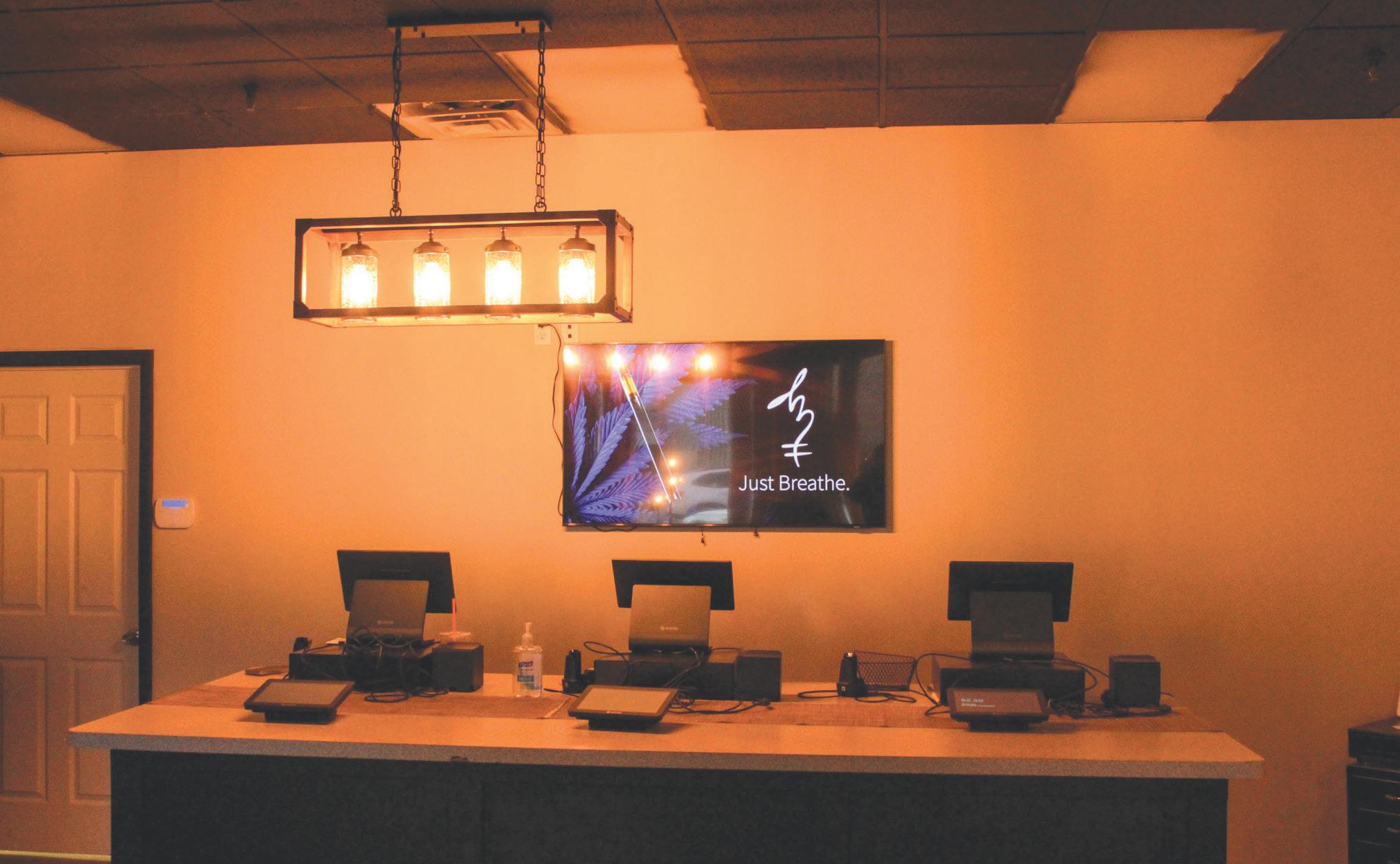
On Friday, many traveled to Binghamton to be the first to purchase from Just Breathe — a new local business that sells marijuana flowers, edibles and other cannabis products grown in New York state, according to Spectrum News. Damien Cornwell, one of the owners, has previously owned a CBD store and has now partnered with the Broome County Urban League to open the full cannabis dispensary.
Cornwell explained that cities like Binghamton have been in an economic decline, and that business opportunities such as the dispensary are the “shot in the arm” that these communities need to grow.
“We are seeing hundreds of people come into the store, and it’s only logical that these people are shopping at other shops or going to eat at other places,” Cornwell said. “I get calls all day long from people out of town that are on route to visit the dispensary, and I think that’s really good for the community. I think it makes for a great impact and is really needed. I’m delighted, not only because I’m the owner but because I live in Binghamton.”
Men’s and women’s teams place third, nine Bearcats earn individual titles at championship meet.
Jared Kraham, the Mayor of Binghamton, spoke about the steps that led to the final approval of the cannabis dispensary downtown over the past few months. He explained that when he took office in January of 2022, the City of Binghamton was working quickly to update their zoning code to allow for cannabis-related businesses.
Track and field teams compete at AE meet
— five on the men’s side and four on the women’s — both Bearcat teams earned third-place finishes.
“This might be the best overall performance we’ve had at this meet,” said Binghamton head coach Mike Thompson. “We’ve had more talented teams, but I don’t think we’ve ever had two teams overachieve like this group did this weekend.”
Over the weekend, the Binghamton track teams traveled to Boston, Massachusetts to participate in the America East (AE) Championships. After winning nine individual titles

Among the winners on day one was sophomore Jaston Ormsby, who took the gold in the weight throw. Ormsby registered a throw of 58-10.00 feet, a
Last June, they were one of the first municipalities to release a zoning map and get it approved through city council, which allowed for Just Breathe to jumpstart the process of applying and receiving approval for opening. Kraham outlined the potential economic impacts that the dispensary
personal best, and is the first Bearcat to win the event since 2008. Junior Brandon Love and graduate student Casey Gribben swept first and second place in the pole vault, respectively. Love earned first with a 15-07.00 foot leap, while Gribben followed him up with a 15-01.00 foot jump. At the end of the meet, Love was named Most Outstanding Men’s Field Athlete. Graduate student Jake Restivo had a silver finish in the long jump, with a leap of 23-10.75 feet.
will have on the community in Binghamton.
“I think when major social changes happen, you always want to be on the cutting edge because you want to be known for innovation,” Kraham said. “I’m interested in seeing the tax revenue. I stopped by the store yesterday, and they are getting people
from across New York state. They are getting people from out of state. And they are choosing to spend their money in Binghamton. They are spending money at our restaurants, our taverns, our small businesses — they are filling up their tank of gas which leads to sales tax revenue.”
Legal cannabis now available in Binghamton Mac & Cheese Fest is a muenster-ous success
The food festival showcased a wide variety of mac and cheese samples for attendees.
Sam Lillianthal arts & culture editor
There was no question that Binghamton and mac and cheese brie-long together last Thursday, at one of the town’s biggest food festivals of the year.
Returning for their eighth year, Binghamton Philharmonic Orchestra’s biggest fundraiser was sold out on the ground floor of the Holiday Inn in Downtown Binghamton. After returning to a full in-person experience last year, the Mac & Cheese Fest has not let up in its output, with 21 participating restaurants showcasing their most creative and tasty dishes.
Like usual, restaurants set up tables all over the room with small cups of mac and cheese that patrons could take to eat — or grab seconds if they wanted. Tables with chips and water dispensers were periodically refilled. The event also featured raffle baskets, with prizes that included free tickets to a Binghamton Philharmonic show and a cannabis gift from Just Breathe.
As the festival progressed and macaroni dishes were consumed, patrons could scan a QR code to pick their choices for three of the five awards of the show. The three
awards people could vote for were Most Classic Mac, which went to Park Diner and Restaurant, Most Original Mac and Best of the Fest, which were both awarded to Kampai Japanese Steakhouse. Park Diner and Restaurant’s mac and cheese was creamy in texture, with a burnt top that gave it a homey and comforting feeling. Kampai Japanese Steakhouse’s sweet and spicy chicken teriyaki mac and cheese was an extremely original sensation to the taste buds — especially with its addition of pickled ginger and scallions. Their experimental approach brought a refreshing fusion of flavors deserving of its two awards.
There was even more praise given out at the festival, however, with awards for New To the Fest and Judge’s Choice — both voted on by the judging panel. One judge at the event was Brenden Capria, president of the Binghamton Cheese Club and a senior majoring in computer science. According to Capria, members of Cheese Club have always come to help volunteer for the event, but this is the second year in a row that the president of the club has been asked to be a celebrity judge.
Capria felt the turnout was fantastic, with the a positive overall vibe.
OPINIONS ARTS & CULTURE SPORTS SEE PAGE 9 SEE PAGE 10 SEE PAGE 9 Paramore lives up to the hype in their recent album, SHADES brings fun games and raffles in this year’s Sex Carnival, The Editorial Board discusses the concerning rise in deepfake technology, Softball posts winning record at Furman Tournament, Women’s basketball loses to River Hawks on Senior Day, SEE PAGE 10 SEE PAGE 4 Tuesday, February 21, 2023 | Vol. CI, Issues 36 & 37 | Binghamton University | bupipedream.com The Free Word on Campus Since 1946
Alongside Just Breathe, three
Ella Connors news intern william walsh contributing photographer
other
dispensaries are in the process of opening in the Capital Region, specifically in Schenectady and Albany.
provided by brian foley
see breathe page 3 see track page 10
mac
Senior Nick Malfitano won gold for BU in the heptathlon at the America East Championships over the weekend.
see
page 9
Jack Oh sports editor
Tuesday, February 21, 2023
Word on the Street
Robert Smith
a junior majoring in electrical engineering
Q: What did you think of the halftime show?
A: “I thought it was pretty mid, but she gave it her all because she was pregnant and all that, so it wasn’t too bad.”
Q: What did you do during Valentine’s Day?
A: “I didn’t do anything for Valentine’s Day. I do have a girlfriend so this weekend we’re gonna go see the new Ant-Man that just came out, and then go get some dinner and hang out.”
Jared Childs
a junior majoring in English
Q: What did you think of the halftime show?
A: “I didn’t think Rihanna’s halftime show was too amazing. I was expecting a costume change, maybe a little more pizzazz. I thought she would bring someone out and make it a little more interesting. She didn’t move that much, so I don’t know — wasn’t really a fan.”
Q: What did you do during Valentine’s Day?
A: “I think Valentine’s Day is a marketing plot for companies to make money.”
Valentina Soto
a freshman majoring in nursing
a freshman majoring in biology
Q: What did you think of the halftime show?
A: “It was pretty good. It was better than the rest of the game because I’m not really that into football. So yeah, that’s pretty much the only part I watched.”
Q: What did you do during Valentine’s Day?
A: “I split a cookie cake from the dining hall with my roommate and just mostly studied for the tests that I had that week.”
Q: What did you think of the halftime show?
A: “Rihanna is amazing as always. Loved the throwback songs, that was really fun. It was a good way to get back into performing. She’s pregnant, so that’s cool.”
Q: What did you do during Valentine’s Day?
A: “I just really hung out with my friends, just enjoyed the day. My mom got me chocolate covered strawberries, so that was a nice surprise.”
a sophomore majoring in integrative neuroscience


Q: What did you think of the halftime show?
A: “I thought it was really nice. I liked seeing the people dance around in their marshmallow suits. And I feel like it was nice to see Rihanna back performing after such a long time without putting out music. But it felt slightly sad and melancholic because it felt like it was the closing of a chapter.”
Q: What did you do during Valentine’s Day?
A: “I didn’t do much. I had an organic chemistry test, so I spent the whole day studying. And I saw some of my own friends, so that was nice.”
Ben Oppedisiano a junior majoring in geological sciences


Q: What did you think of the halftime show?
A: “It could have been a lot better than it was. I was expecting ‘Disturbia’ [or] ‘Upon the Replay,’ to open up with, but we got “Bitch Better Have my Money.” And I was shocked because like, there are kids — there are kids guys. And on top of that, I get that she’s pregnant but I would have preferred less clubby, more poppy.”
Q: What did you do during Valentine’s Day?
A: “It was pretty quiet. I hosted an RA event that was pretty popular, got like 35 people. So that kind of made me forget about my loneliness — but aside from that, no. I had a lot of sugar, which was great, and then I crashed — so all in all, 6.5.”
Courtney Dellarocca

a senior majoring in math
Q: What did you think of the halftime show?
A: “I loved the Super Bowl halftime show. I thought she looked amazing. It was such a great [entrance] back into performing — loved it.”
Q: What did you do during Valentine’s Day?
A: “I just came home and me and my roommates got Taco Bell, and we ate together — because we’re all single.”
John Vincelette
a junior majoring in environmental science
Q: What did you think of the halftime show?
A: “Honestly, I didn’t really watch it but I saw the memes afterward. I kind of tuned into the Super Bowl right after it happened, so I kind of like — I don’t know — I saw Rihanna was pregnant. That’s cool I guess.”
Q: What did you do during Valentine’s Day?
A: “The day before Valentine’s Day I hung out with my girlfriend, and we exchanged gifts and stuff — I got her flowers. And then the day of Valentine’s Day we both had exams, I didn’t see her at all. The day after Valentine’s Day we went out to a nice dinner. We went to Maxi’s Bar and Grill. I’d give it like a 4.5 out of 5. It was pretty good. It was expensive though.”
Ryan Rodriguez
a sophomore majoring in business administration
Q: What did you think of the halftime show?
A: “I really enjoyed the Super Bowl halftime show. I really liked how she started out with ‘Bitch Better Have my Money.’ The one thing I would have liked more is costume changes. I feel like in the past they’ve done that — cool costume changes — and changed the scenery throughout the show. But overall I really liked it, I thought Rihanna did really good. I thought the background dancers were really cool too.”
Q: What did you do during Valentine’s Day?
A: “I’m single so I just hung out with my friends. I also had two tests yesterday — like two days after Valentine’s Day — so I spent a lot of time studying for those, super fun.”
Alex Eskenazi
a freshman majoring in computer science

Q: What did you think of the halftime show?
A: “I liked the Super Bowl halftime show. I thought it was good, but not as good as last year’s.”
Q: What did you do during Valentine’s Day?
A: “I didn’t do anything special for Valentine’s Day. Hung out with the boys, had a good time.”
Brandon Zhou

a freshman majoring in applied math
Q: What did you think of the halftime show?
A: “I thought the Super Bowl halftime show was really good. I really liked the entire performance, cause the floating stages really made it exciting.”
Q: What did you do during Valentine’s Day?
A: “I mostly just hung out with friends.”
Monday, April 3, 2017 Monday, October 2, 2017 Thursday, October 5, 2017
Spring 2023 Business Manager Lukas Ladekarl business@bupipedream.com Managing editor* Harry Karpen manager@bupipedream.com Editor-in-Chief* Hamza Khan editor@bupipedream.com news editor Jacob Knipes news@bupipedream.com asst news editors Melissa Cosovic Hallie Milligan asst arts & Culture editors Jamie Nguyen Eli Engler sports editor Jack Oh sports@bupipedream.com Fun editor* Peter Proscia fun@bupipedream.com design Manager Bella Daidone design@bupipedream.com design assistants Brianna Crowther Sonia Leyvi Alexa Valadez photography editor Michael Golann photo@bupipedream.com Copy desk ChieF* Lia Richter copy@bupipedream.com teChnology Manager* Steven Yeung tech@bupipedream.com asst teChnology Manager Leora Dallas asst. Copy desk ChieF Allison Peteka asst sports editors Michael Carbone Ian Mills arts & Culture editor Sam Lillianthal arts@bupipedream.com opinions editor Doris Turkel opinions@bupipedream.com asst photography editor Mason Brody-Lewis asst opinions editor Desmond Keuper asst. Business Manager Adam Perez businessassistant@bupipedream.com a University Union WB03 4400 Vestal Parkway E. Binghamton, N.Y. 13902 phone 607-777-2515 weB bupipedream.com stabilizing:pinochole schedule:destabilizing Pipe Dream is published by the Pipe Dream Executive Board, which has sole and final discretion over the newspaper’s content and personnel. Positions seated on the executive board are denoted by an asterisk. Pipe Dream is published online Mondays and Thursdays while classes are in session during the fall and spring semesters, except during finals weeks and academic breaks. The content on the Opinions page with bylines represent the views of those authors and do not necessarily represent the views of the Pipe Dream Executive Board. The content of advertisements do not necessarily reflect the views of the Pipe Dream Executive Board. We reserve the right to reject ads for any reason. All letters submitted for publication must include the author's name, year and major. Please limit letters to the editor to 400 words and guest columns to 750 words. Pipe Dream reserves the right to edit submissions, and does not guarantee publication. All submissions become property of Pipe Dream. Guest column submissions may be emailed to the opinions editor at opinions@bupipedream.com, and all letters to the editor may be sent to editor@ bupipedream.com.
PAGE II
Hadja Aw
Anna Churchill
breathe from page 1
Kraham said cannabis legalization is important because before becoming regulated, the buying and selling of it was a distrustful process. The products that people use will now be examined and tested, and consumers will have more awareness of the inner workings of the businesses
The GSEU staged a petition drop and protest this past Wednesday.

Jacob Knipes
that are distributing them. At illegal stores, people have less of an awareness of what they are buying which, as Kraham emphasized, can be dangerous.
Cornwell added that the dispensary offers an opportunity for college students to remain in Binghamton after graduation by increasing the city’s appeal.
Emily Blakley, president of GSEU and a sixth-year graduate student pursuing a Ph.D. in cognitive and brain studies, described the crowd Wednesday as “engaging.”
“I think the Just Breathe dispensary is a step in the right direction to make this a more attractive place to retain the talent that the college has,” Cornwell said. “That’s really what we should be aiming to do. That’s how the town will reignite itself in the future.”
According to Spectrum News, three dispensaries are in the process of opening in the
coming months in the Capital Region, with one meant to be located in Schenectady and two others in Albany.
Malcolm Clemmer, a senior majoring in computer engineering, expressed concern about the success of the business.
“Gray market shops are going to be important in determining [Just Breathe’s]
success — students are always going to go with the cheaper options,” Clemmer said.
Michael Esquivel, a senior majoring in computer engineering, shared his support for the opening of the cannabis dispensary.
“With a legal dispensary, I would assume the prices they are charging would match the quality of cannabis they are
Legal cannabis dispensary opens downtown Graduate students petition for ‘living wage’
selling,” Esquivel said. “I know of a few friends that are already excited that it has opened up. Now that it’s an actual legal dispensary, more people will be comfortable with the use of it downtown and it will gain a lot more business. There are a lot of students I have met looking for better places to purchase these products.”
The Graduate Student Employees Union (GSEU) made their presence known in the Couper Administration Building yesterday, taping their “Petition For a Living Wage” to the stairwell.
This latest protest comes after the completion of GSEU’s petition, which saw over 1,500 people from across the campus and beyond sign in support of the “GSEU Binghamton Living Wage Campaign.” Beginning last November, the GSEU has organized various initiatives in an attempt to raise the wages of Binghamton University Graduate Assistants (GA), Teaching Assistants (TA) and other positions, including a protest earlier last month. Members have claimed that most graduate student workers earn a median salary of $19,428 per year, compared to the minimum living wage of over $34,000 according to the Massachusetts Institute of Technology’s Living Wage Calculator.
Beginning in the late afternoon, members of GSEU alongside other supporters first gathered on the green outside of the administration building. Once there, protest signs and slogan sheets were passed out to protesters, and many wore shirts with phrases advocating for the campaign.
“They cheered at all the right moments, and I think it means that anybody who came who may have never really engaged in this before, I’m hoping came away with thinking this is an important thing, but also that they had a bit of a good time being in a group like that so they come back,” Blakley said. “But every time you stand up there and you look at a crowd of people who show up for each other, because that’s the only way you get things done and see that people power, that force, it means so much to us after the month of planning just to see people come out and be like ‘yeah we care.’”
After the group had fully come together, multiple members of GSEU spoke about the campaign and its goals. Intermixed with the speeches were various chants and verbal answers from the crowd to questions posed by the speakers. After the speeches concluded, the group embarked on a march around the Spine.
Jonathan Hagofsky, a fourth-year graduate student pursuing a Ph.D. in philosophy, described his motivations for supporting the campaign as being able to afford necessities that come easy in other jobs.
“It would mean for me to become something other than a graduate student slaving
away at their job, at their research and at their other obligations,” Hagofsky said. “I would have the flexibility to do basic things that other people do, like own a car, even a used car.”
After the march concluded, the protesters then entered the administration building to drop off a printed version of the petition. Once inside a few members of the group took turns reading selected statements writing by anonymous graduate students, before another member read the text of the petition. When no one from administration came out to address the group, they proceeded to tap the petition to the stairwell.
Blakley described the action of taping the petition as
preplanned and akin to Martin Luther’s “96 theses”.
“It’s this, like, powerful movement of ‘here are our demands’, and it is a sign that we were here and they weren’t,” Blakley said. “It’s nice to leave a piece of evidence behind. So it was a really big symbolic movement of, ‘we were here, here’s our demands, you didn’t listen.’ And I’m going to follow up with them. I am going to email [BU President Harvey Stenger] the petition with all 1500 signatures as well. I know that he knows that it’s there, but just to make sure.”
Lucas Williams, a campus organizer for GSEU and a third-year graduate student pursuing a Ph.D. in mathematics, expressed his appreciation for the turnout to
the petition drop.
“So many people care about this issue,” Williams said. “I mean, this is an issue that affects all of us. The range that TAs and GAs at [BU] are paid is from $11,000 all the way up to $27,000 while a living wage is $34,000. So this is an issue for everyone here, some more than others, but this affects us all. So it was amazing to see so many people here.”
Moving forward, Blakley said other initiatives and potentially monthly events are in the works to further support the campaign. Representatives from the Union have also met with Kathryn Madigan, the chair of the BU Council, and Donald E. Hall, provost and executive vice president for academic affairs, according to
BU places high on ‘Campus Pride Index’
The University was rated a 4.5 out of 5 on the survey, which rates inclusiveness.
Vassili Gonzales news contributor
news editor Binghamton University has received a 4.5 out of five stars on the Campus Pride Index (CPI).
The CPI was created in 2007 by the nonprofit organization Campus Pride. According to their website, Campus Pride works with student leaders and campus groups to create safer, more LGBTQ-friendly
environments at colleges and universities. The index measures LGBTQ+ inclusive policies, practices and programs that are implemented by a university or college. The index score measures eight factors, including LGBTQ+ academic life, housing, campus safety, and counseling and health services, according to the Campus Pride website.
To participate in the index, a campus official creates an account to take a self-assessment with over 50 questions corresponding to the eight factors being measured. Once
the assessment is complete, the official receives a confidential report of their responses, results and recommendations.
According to the Campus Pride website, BU has received four out of five stars in terms of policy inclusion, support and institutional commitment, and recruitment and retention efforts. BU has also received five stars for both LGBTQ+ student life and residential and housing life. The index gave BU a 4.5 for campus safety, with the lowestrated factor being counseling and health, with a score of 3.5.
Nicholas Martin, assistant
director of the Q Center, an organization providing resources and hosting educational events for LGBTQ+ students at BU, discussed the contributions the organization has made to the University’s score.
“Since my arrival at [BU] in the fall 2021, the Q Center team has worked tirelessly to increase LGBTQ+ visibility on campus through events, educational workshops, our Gender Bender Clothing Closet and meaningful collaborations with campus partners and the LGBTQ+ student organizations,” Martin wrote in an email. “This work is never finished and improvement is always necessary.”
Part of the CPI score measures two inclusion factors — sexual orientation and gender identity/expression score. BU has been rated 4.5 stars for both factors.
Rachel Del Fierro, an intern at the Q Center and a sophomore majoring in psychology, said BU can improve inclusion for gender non-conforming students.
“We recently celebrated the implementation of the SUNY-wide ‘chosen name and pronoun’ policy, which is great, but not the end-all, beall when it comes to combating discrimination against gender non-conforming folk,” Del Fierro said. “I believe having
more widespread, highly enforced education and training on the topic would help solve these issues on an individual level. On top of that, putting more gender-neutral bathrooms in popular, accessible locations would be appreciated.”
The Q-Center provides resources for LGBTQ students, such as the Gender-Bender Clothing Closet, offering clothes affirming students’ gender identities and expressions in exchange for donated clothes, along with holding events such as Transgender Awareness Week, the National Day of Silence and the “OUTober”
Pride Month.
Luis Hernandez, the political activism chair for SHADES — an organization for LGBTQIAP+ students on campus — and a sophomore majoring in biology, said BU can improve their effort toward people-of-color (POC) LGBTQ+ students.
“I think that [BU] can promote intersectionality between LGBTQ and POC identities, rather than solely focusing on the white LGBTQ experience,” Hernandez wrote in an email. “They can do this by simply hosting queer events and having resources that actively strive for more inclusion of different ethnic backgrounds.
I think BU can also hire more POC LGBTQ figures for
Blakley.
With the petition having come to a close and being dropped, Blakley said she was thankful for the support from the campus community.
“I am 100 percent grateful for the people who showed up and signed the petition,” Blakley said. “The fact that upon making that petition scroll and seeing the people who signed, the fact is that over 600 undergraduates filled out our petition. The fact that that group is our biggest group of petition signers, and those are our students. Our students are the one who really stepped forward, and undergraduates are starting to realize that their education is because of us.”
students to go to for support and assistance, as well as giving appropriate budgets to each organization that correlates with their impact on campus.”
According to the CPI website, some of the services that BU does not offer currently are an LGBTQ+ social fraternity, a standing advisory committee focused on LGBTQ+ issues and the option for students to selfidentify their sexual orientation on an admission application or post-enrollment form.

Hernandez discussed the impact that events from SHADES have made for LGBTQ+ students at BU, such their Vogue Ball and Sex Carnival.
“Voguing, originating from gay and trans-Latinx and Black culture, celebrates and magnifies a culture that is underrepresented on campus,” Hernandez said. “Thus, our event allows students of multiple identities to feel comfortable in a space where they can embrace themselves, their history and their roots. Conducting events that both [embrace] culture and addresses critical issues of being a POC queer student at a [predominantly white institution] allows the [BU] queer student body as a whole to benefit by embracing the diversity that exists within the queer community on and outside of campus.”
bupipedream.com | February 21, 2023 NEWS 3
joanna fishman & ryan harvey video contributors
The protesters marched along the Spine before entering the Couper Administration Building to drop off their “Petition For a Higher Wage.”
brianna crowther design assistant Binghamton University received a perfect score in two of the eight categories measured by the Campus Pride Index.












Students fundraise for earthquake victims
Turkish students aim to raise at least $10,000 for Turkey and Syria.
Tresa Karnati news intern
Turkish students at Binghamton University have organized a fundraiser for those affected by the recent earthquake in Turkey and Syria.

On Feb. 6, two earthquakes of magnitudes 7.8 and 7.5 hit the border between Turkey and northern Syria, resulting in a death toll of more than 41,000 people, according to independent news source Al Jazeera. Turkish graduate students and the Turkish Culture Association (TURCA) at BU have since worked together to lead the relief effort in Binghamton by collecting donations for Turkish Philanthropy Funds (TPF). TURCA held an event on Monday, Feb. 13, during which they packed supplies donated by the Binghamton community into boxes to be sent to those displaced by the earthquake.
According to Reuters, nearly 25,000 buildings collapsed or were badly damaged due to improper construction, trapping many civilians under rubble and forcing others to endure freezing temperatures without shelter. The search effort for survivors is still ongoing more than a week after the earthquakes, according to the Associated Press.
Mert Can Bayar, a sixthyear graduate student pursuing a Ph.D. in political science — one of the students who began the
relief initiative — explained how they chose to raise money for TBF through GoFundMe and tabling donations.
“We started the item donation campaign and searched for organizations to raise funds for and did a lot of research on the credibility of the existing organizations based in the [United States],” Bayar wrote in an email. “After our efforts of research and discussion, we decided to raise funds for the Turkish Philanthropy Funds (TBF), a 501(c)(3) taxexempt organization. TBF is currently raising funds for its ‘Türkiye Earthquake Relief Fund’ to support local agencies and organizations that deliver food, water, shelter, medicine and other urgent needs to the region affected by this disaster.”
So far, the group has raised over $1,500 in four days, according to Emre Demir, a sophomore majoring in computer science. Demir said the campaign will continue until its goal of $10,000 is reached.
Our colleagues, professors, students and University executives have been extremely supportive and started donating and circulating our fundraising and relief efforts to their departments, colleagues and friends,” Demir wrote. “Local news agencies have interviewed our team about our efforts and agreed to advertise our campaign.
We are grateful for every donation. It is great to see that our community here has our back in this difficult time.”
Turkish food — including borek, baklava and bulgur
— was served prior to the packing of supplies by the volunteers.
During the relief event, Oktay Sekercisoy, senior director of global partnerships and adjunct professor of international business at BU’s School of Management, gave a speech describing how BU students and the Binghamton community at large contributed to the donations. Those gathered also observed a moment of silence for the lives lost due to the earthquake.
“Since 1978, around
2,000 Turkish students have graduated from [BU],” Sekercisoy said. “Not just students and faculty, but the Binghamton community has come together to provide supplies that will be packaged into boxes tonight.”
Items donated included essentials such as diapers, hygiene products, canned goods and medical supplies. Blankets, hand warmers and jackets were also donated to help survivors who lost their homes face the freezing weather as they stay in emergency shelters.
According to Sekercisoy, the supplies will be packed into boxes and driven to New Jersey, where they will then be shipped to Turkey. Items will be collected until Feb. 26, and any item donations can be dropped off at the Dual Diploma Program (DDP) Office in Academic A, Room 136. TURCA will also be tabling for donations in the University Union lobby from noon to 4 p.m. until Thursday, Feb. 16.
Bayar emphasized the impact the earthquake has had on the region and the “crucial” items these
donations will provide for survivors, with millions already facing displacement.
“We are trying to expand our campaign to as many people as possible on campus and in the greater Binghamton area,” Bayar wrote. “A $5-$10 donation can buy food and basic items that are crucial, and a $20-50 donation can buy urgent winter items such as coats, boots and blankets. $100–200 donation can help us raise money quicker for more expensive items such as disaster tents, generators and portable toilets.”
New funding aims to boost SNAP benefactors
Hallie Milligan assistant news editor
New York state will provide extended aid to those relying on food benefits, Governor Kathy Hochul announced.
The extended federal budget for the Supplemental Nutrition Assistance Program (SNAP) — a governmentfunded food benefit agency that aids low-income families and individuals — was recently reduced due to the decline of COVID-19.
According to the Department of Agriculture’s Food and
Nutrition Service (FNS) website, the extra benefits were a “temporary strategy authorized by Congress,” meaning they were set to end in unison with the shutdown. This February is the last month extended benefits will be provided by the federal government. Hochul’s extended aid would benefit all SNAP recipients through the month of February as a way of “protecting New Yorkers who are struggling to feed themselves and their families,” according to a statement released by Hochul. Each household supported by SNAP will receive a supplement of at least $95 — including households that are
regularly given under $95 per month and those receiving the maximum monthly amount.
Daniel Tietz is the commissioner of the New York State Office of Temporary and Disability Assistance (OTDA) — the office in charge of regulating SNAP benefits in New York state. Tietz said the extended benefits throughout the COVID-19 pandemic have helped, and suggested SNAP receivers seek alternate forms of aid in the coming months.
“The additional food benefits provided throughout the public health crisis have helped alleviate much uncertainty among New Yorkers who were unsure about being able to put food

on the table,” Tietz said. “It’s important that affected households seek out other available assistance that may help with offsetting other household costs.” Local emergency food service programs have been impacted by the decrease in SNAP benefits, and expect to be further affected by Hochul’s plan for February.
Les Aylesworth, director of the Community Hunger Outreach Warehouse (CHOW) at the Broome County Council of Churches, said the warehouse saw “an uptick in need” once benefits — including extended SNAP assistance — were discontinued. Aylesworth advised individuals in need
of food assistance to utilize CHOW’s services.
“The proposed benefits will certainly help people through February, but that’s obviously only temporary,” Aylesworth wrote in an email. “One of the things people can do is shop at the store we opened in Binghamton called the Greater Good Grocery, where folks who use SNAP can double up on their purchases to help stretch those benefits.”
According to Aylesworth, one in seven individuals and one in four children in Broome County are “food insecure.” He further claimed this number of individuals could fill the University’s Events Center over five times.
Lori Accardi, the executive director of Catholic Charities in Broome County, described a similar experience, with the organization currently helping over 3,500 people each month, half of which are children and seniors.
Accardi described a decrease in the amount of individuals relying on Catholic Charities during the pandemic, with an increase in deliveries. Since the decline of the pandemic, the organization has been helping more people from Broome County — which has seen an increased homeless population.
“We have an affordable housing crisis in our community, as well as an issue with shelter beds being filled, leading to many people living in local hotels where it is difficult to prepare food,” Accardi wrote in an email.
“That means that serving them requires additional
expense to provide single servings, microwaveable food, items that don’t need to be heated, etc.”
Lucy Mandel, a junior double-majoring in history and philosophy, politics and law, expressed worry toward Hochul’s solution being temporary.
“I think its good that [Hochul’s plan] is being extended, but clearly it’s not a long-term solution to the problem,” Mandel said. “I don’t know how they would fix that, but clearly something else needs to be implemented to help people that can’t afford food anymore. Especially, being in college, there are plenty of kids who can’t afford food and there’s not enough resources to help [students].”
Hochul said households outside of NYC can expect to receive the extra stateprovided benefits by Feb. 24, and households within New York City by Feb. 28.
Silas Wieland, a junior double-majoring in mathematics and physics, had similar concerns for Hochul’s plan and a possible shortage of benefits in the coming months.
“My initial thought is, because of inflation and the lingering effects of COVID-19, one month isn’t really enough grace period to fully help people on SNAP and who need SNAP benefits.” Wieland said. “I think that it should be extended over a much longer period, maybe six months to a year. That would make it a lot more equal, and maybe we could look for more longterm improvements for SNAP to help raise people up past where inflation is.”
bupipedream.com | January 31, 2023 NEWS 5
michael golann photography editor
The fundraising campaign has included tabling for the cause in the University Union.
caspar carson photo
One objective of the plan is to grow connections
response time faster.
funding will give each SNAP household an extra $95 a month.
intern
between the sheriff’s office and the Broome County community in order to make conflict
The
Deepfakes are problematic in general, as they offer dangerous opportunities to spread disinformation. Many deepfake videos have been created that manipulate politicians or public figures to say different things.
Deepfake porn is an especially invasive and evil form of disinformation. Advanced software, like the Windows program “FakeApp,” allows any user to upload a photo set of a face onto a pornographic video. As of 2021, it was estimated that between 90 and 95 percent of all deepfake videos are nonconsensual porn, and 90 percent feature women. While deepfake videos can vastly vary in quality, the psychological effect on its victims is the same. In addition to stealing and manipulating people’s identities, deepfake porn can affect employment,
harm interpersonal and romantic relationships, cause body dysmorphia in victims, and subject people to stalking or harassment.
The porn industry has already immensely profited from the exploitation and abuse of women. For example, in June of 2021, 34 women sued PornHub for having profited from “nonconsensual content involving rape, child sexual abuse, and human trafficking.”

Deepfakes continue to be uploaded to porn sites each month. Deepfakes inherently ignore consent, allowing for people to create and distribute manipulated and compromising images of people anonymously. Some defenders of deepfake imaging argue that it is part of the “natural progression of technology” and that people can do what they’d like with pictures of others.
Werewolf
Since the dawn of the term “monstrosity,” queerness has been interwoven with the concept of disruptive, hybrid identities — identities par for the course in paranormal stories. There is a tight connection visible through the portrayal of the werewolf, a vilified creature in a futile fight with their own physical reality, which will often ostracize them from “normal” society. Although it may not be as blatant to those outside the LGBTQ+ community, werewolves have served as inspiration for adaptive and radical fanworks within queer representation due to the similarities in experience. In essence, queerness and lycanthropy mirror one another on three main fronts — the struggle with physical reality, the repudiation from greater society and the shame associated with the “monstrosity” ascribed by societal norms.
In recent years, we have seen more of an assimilation culture occur in queer media whereby queer stories are injected into traditionally heteronormative plots. Rules like the Hays Code, which prohibited the portrayal of queerness in films and shows between the 1930s and 1950s, made clearly queer stories almost impossible to produce
DEEPFAKES POSE A REAL THREAT
However, if made realistic enough, deepfakes threaten to influence others’ perceptions of their subjects. Regardless of the quality of the deepfake, they strip individuals of the agency to determine how they are presented. Additionally, deepfakes jeopardize movements to empower sex workers and protect their sexual agency and consent.
Another harmful dimension of deepfakes is their ability to sexualize anyone. Deepfake technology has been used as a tool to sexually abuse children by imposing their faces on explicit imagery and video, a disgusting and illegal act that endangers children.
Fortunately, there have been efforts to create software to detect deepfakes. Unfortunately, the very method a program uses to detect a deepfake can be
used to “train” new deepfake creation algorithms. Recently, researchers from Watson College here at Binghamton University worked with Intel Corp. to develop an online tool called “FakeCatcher,” which can detect if videos have used deepfake editing by analyzing differences in skin color caused by heartbeats — the technology is 90 percent accurate. Hopefully, these technologies can be used by pornography websites to ensure that they are not posting deepfake videos.
So, what protections do people have against being taken advantage of by deepfake technology? In the United States, the Stop Hacks and Improve Electronic Data Security Act (“SHIELD Act”) amendment to the Violence Against Women Reauthorization Act of 2021
provides privacy protections against deepfake pornography and its pernicious effects on employment and educational opportunity, ad well as the harassment it often causes.
Additionally, New York State Senate Bill S5959D provides a private right of action for those victim to “unlawful dissemination or publication of a sexually explicit depiction of an individual.” Forty-six U.S. states also ban revenge porn, though only Virginia and California’s bans specifically enumerate deepfaked media.
While some may argue that regulating deepfakes violates First Amendment free speech rights, the amendment states that the free speech guarantee is not extended to “the lewd and obscene, the profane, the libelous and insulting words or ‘fighting’ words.” Other legal claims that victims of
deepfake pornography may be able to pursue are defamation, violation of privacy, appropriation of personality or copyright infringement. Additionally, child pornography is criminalized on a federal level. However, the difficulty of bringing a deepfake case to court is that the perpetrator is usually anonymous. While awareness and legal protections surrounding deepfake pornography are increasing, it is important that research continues to target those perpetrating these heinous crimes. Additionally, we should begin to break down the broad stigma surrounding pornography, so that support can be given to those who are victims of deepfake technology. Technology is only going to advance, so it is up to the law to advance with it.
coded
not a fag. I’m … a werewolf.”
at all. But, that didn’t mean none existed, as people began turning to queer-coding, the use of queer call signs, like flamboyancy or crossdressing, to subtextually depict a character as part the LGBTQ+ community.
Queer-coding stemmed from Hollywoods’ selfimposed guidelines and led to certain archetypes becoming synonymous with queer people. Thus, the rise of allegorical queerness began to define generations of queer media, in which the werewolf began symbolizing homosexuality in queer circles.
The physical aspect of the werewolf is akin to several queer identities. Most explicitly homosexual people have an identity that, like the werewolf, allows them to assimilate into general culture most of the time, but once the “transformation” happens, they are unveiled and no longer able to hide this core aspect of their personality. Further, the physicality of the werewolf’s transformation has deeply troubling yet painfully accurate parallels to queer puberty, where one’s own body becomes an “other” that the self must reckon with. Plus, much like the unassuming queer person, werewolves are forcibly sent on a journey of religious morality due to their inherent “monsterhood.” Obviously, the connection between
queerness and monstrosity stems from the homophobic perspective of queerness being negative and unnatural, but this does not erase the fact that homophobia is a very tangible part of being queer, both externally and internally. Both identities exemplify alienation — the terrifying occurrence of looking up at the shepherd and around at the flock, yet looking down and realizing that you are wearing sheep’s clothes. Understanding one’s unique yet inextricable identity and coming to terms with the queerness — that is to say oddness — of one’s self-expression, despite potential negative retaliation from dominant culture, is the unifying battle. Thus, humanizing the paranormal creatures that mirror queer identity is essential to the healing and support of queer audiences. As Jaquelin Elliott describes it, “Ever the outcast, werewolves destabilize gender and eschew sexual binaries. Lycanthropic monstrosity is rooted in their disruption of the moral and social fabric of a normative society.”
Thus, being a werewolf doesn’t bode well for a seamless assimilation into non-monster society, similar to the difficulties of being queer in a heteronormative society. For ages, there have been parallels drawn between the secrets kept as a werewolf and the secrets kept as a queer person, where
both groups must only reveal their identities in trusted circles for fear of capture and retribution. Both identities present a very real threat of excommunication and to personal safety. Revealing this secret to the wrong person may lead to the loss of social circles, public safety or job positions, as was the case with Remus Lupin, Harry Potter’s lycanthropic professor. Lupin needed to keep his identity a secret because “other parents weren’t likely to want their children exposed to [him],” and, once the wrong person found out about his condition, he was removed from his teaching position as a result of werewolf prejudice. Sound familiar? This exact scenario — a systematic and bias-led attempt by the majority class to eliminate all influences of queerness within society — has happened to queer people across the world for decades.
Additionally, a more explicit parallel lies in the “coming out” trope within werewolf media, which is clearly akin to the coming out of a queer person. An example of this is in the 1986 movie “Teen Wolf,” in which the main character, Scott, reveals his lycanthropy to his best friend, Stiles: “Scott: Stiles, I got something to tell you. It’s kind of hard, but … // Stiles: Look, are you gonna tell me you’re a fag because if you’re gonna tell me that you’re a fag, I don’t think I can handle it. // Scott: I’m
Although this rendition obviously approaches the queer parallels of lycanthropy with far less tact than is preferred, it is still a great example of how similar these experiences can be and why so many werewolf characters are called queer-coded by audiences who are yearning for blatant representation.
Although not the goal of the original tale, werewolves are clearly emblematic of queerness in a way that demands a certain type of care and thoughtfulness when crafting their stories. For example, “Lupin’s condition of lycanthropy was a metaphor for those illnesses that carry a stigma, like HIV and AIDS,” as confirmed by J.K. Rowling. However, the fans’ demands for a queer love story between him and his friend, Sirius Black, were snuffed out in favor of a late-stage romance with a woman — whose queerness has also been extensively argued in the fandom — shortly before both of their deaths. Acknowledgment of the inherent queerness of werewolves is necessary when exploiting their stories for the queer-synonymous drama of alienation, internalized hatred, community and rebirth.
However, just the acknowledgement of this parallel does little good for the healing of queer traumas as it relates to the issues
mentioned previously. As Michael Elias put it, “[Queer people] have long been saying ‘we belong.’ We are not like ‘others.’ We are not the slurs that are thrown at us. We are not monsters,” as a way to reconcile feelings of ostracism. The desire to reassure oneself after being called a monster is natural, especially in a paradoxical system where the world that has rejected minorities also remains the only world that they can be a part of. However, the move to reject the “monstrous” parts of oneself is more detrimental than helpful in the long run. “As long as monsters exist, the system that has created them and their oppressors will exist,” and thus the answer is not to renounce one’s monstrosity but to embrace it as a strength. In an ideal world, the distinction between “monsters” and “normal people” would not exist. However, in the world we live in, the role of the queer monster can provide a sense of identity and understanding, as well as a way for queer communities to break free from heteronormative expectations of “good guys” and instead redefine one’s own unique and queer goodness.
Emily Vega is a junior majoring in English.

Monday, April 3, 2017 Monday, October 2, 2017 Thursday, October 5, 2017 OPINIONS Tuesday, February 21 2023
allegorical
characters are queer
Werewolf story plots are
to queer identity journeys. bella daidone design manager
Views expressed in the opinion pages represent the opinions of the columnists. The only piece which represents the views of the Pipe Dream Editorial Board is the Staff Editorial, above. The Editorial Board is composed of the Editor-in-Chief, News Editor, Opinions Editor, Sports Editor and Arts & Culture Editor.
Over the past few years, there has been a massive increase in deepfake pornography, a new form of sexual harassment where the perpetrator is anonymous.
Emily Vega Opinions Columnist
The U.S.’ capitalist biopower must be combatted
U.S.
Sean Reichbach Opinions Columnist

The United States’ narratives are weapons aimed at those who are the most marginalized by capitalist institutions. The state seeks perpetual control through puppeteering — to tether itself to the stories of those who live on the gray border between freedom and oppression that is every square inch of this land. The state almost never releases its grip on those who, if some semblance of real individual power were possible, could be a threat to the state’s corporate mission. A simple analysis can conclude that the state’s mission to control minority populations and impose cultural subjugation upon the land’s original caretakers has been mostly or entirely successful. The capitalist class and the government have created a narrative that they must have the authority to command the right to life or death, and the right to limit life in order to increase the utility of the state. In this sense, we could say the concept of policing stems from the rule-utilitarian belief that less criminal activity brings the state more happiness, and thus we should promote a strong policing force to maximize our productivity to the state.
But the state doesn’t
stop at using narratives of patriotism to justify its military-industrial complex or imperialist tendencies.
It also takes the stories and dreams of every oppressed citizen and twists them in order to promote its own goals and, indeed, impose more suffering. This is the idea of biopower, which confers the status of “living dead” upon every non-white citizen of this country.
Before I discuss biopower, I will first introduce the apparatus that births it.
Let us conceive the United States as an ideological state apparatus, one similar to the theoretical conception of the capitalist state by Marxist philosopher, Louis Althusser. We might say there are important institutions that the state uses to maintain its power, such as religion, education, the family, law, communication and the military. Importantly, the ideology that is realized in these institutions is that of the ruling class. The ruling class uses narrative-control of these institutions in order to hold power and continue subjugation of the individuals who blindly follow these institutions in order to remain good citizens. The individual citizen participates in regular day-to-day tasks that are directed by the ideological apparatus of the state. You may go to a tax-
exempt church and be told how to perform immaterial practices, such as devotion to a deity, through material practices, such as donating to the military or church.
If we are ideologically nurtured by the state, we can see that, from our start within the capitalist system, our narratives are manipulated in order to accomplish an objective of producing workers — who
The
features
Theodore Brita Opinions Columnist
For a good amount of time, the animated comedy television series “The Simpsons” was known as the prognosticator-in-chief in the wide world of TV shows. A quick Google search of “Simpsons predictions” provides a long and varied list of bits from the show that eventually occurred in real life, including predicting the Trump presidency 16 years before it happened. But another, perhaps less well-known comedy, has emerged as something close to or equal to “The Simpsons’” in its predictions about the future. “30 Rock,” the Tina Fey creation that was ostensibly about working on a fictional sketch comedy show but evolved into the definitive pop culture satire of its time, has an everincreasing list of jokes that accurately resemble today’s reality. Only recently, a new reality show called “Milf Manor” aired on TLC of all networks, and many “30 Rock” fans and the
show’s Twitter account — which is still active for some reason — pointed out that Fey and company had already predicted the existence of such a reality show. Incredibly, the very same episode also predicted the existence of an AI. Jerry Seinfeld, which made its debut streaming on Twitch last week before it was banned for transphobia. While there is no doubt that the incredibly niche accuracy of these predictions is very funny, it also proves that the American pop culture ecosystem does not necessarily reward quality. One of the central conceits of “30 Rock” was to mock the absurdity of many aspects of popular entertainment, and the more culture resembles the world of “30 Rock,” the stranger it appears to get.
“30 Rock,” being a show about the entertainment industry, featured a litany of fictional shows and movies that were typically minor parts of any given episode but contained hilarious premises. Shows such as “God Cop” and movies like “Rural Juror”
remain subjects rather than equals within the system.
If one group of citizens becomes more “equal” to the ideological state apparatus by telling their own narratives and raising their own cultural concerns, the delicate system that the state has created to maintain control over its subjects is threatened.
oppression in their home country and brings with them a new cultural norm within our borders. Or, imagine a group of people who are oppressed by the ideological state apparatus and open their eyes in an attempt to control their own narrative. It is when the subjugated people seek freedom from subjugation that the state uses its strongest form of power. Now, we are ready to discuss biopower and its control over citizens as the “living dead.” There are two important components of biopower that relate to controlling the narratives of oppressed citizens — posthumous citizenship and rightless life.
It is true, of course, that there are many groups that come into the United States or develop in the United States that do not adhere to the ideological state apparatus. Imagine an immigrant who flees
According to biopolitical theory, victims of oppression and non-citizens may be more valuable to the state in death than in life. Let’s say that an American soldier is a member of a group that is oppressed within the United States. When they die, the state
can claim the right to their story as a patriotic one, one of success and glory for the state. Essentially, the state can take the narrative of this oppressed citizen and refurbish it as one of glory and heroism in death. Controlling the identity of soldiers who fought in World War II and then came home to a segregated America is an example of this. So is the example of Muslim Americans who might have joined the military in the aftermath of the Patriot Act. Many were separated into a distinct form of American hero only because the United States wanted to patriotize their life stories to avoid the shrieks of terror from those marginalized citizens facing hate crimes and immigration bans based on the color of their skin or their religion. The Patriot Act, of course, was another tool of biopower, isolating many innocent Americans as suspected terrorists and constraining their freedom to unprecedented degrees. By stealing away the living stories of these oppressed citizens, the state can bulk up the ideological state apparatus and maintain control over the body politic. This is a form of “living dead” citizenship, in which the dead are kept alive only in ways that serve the interests of the state. There is also a border that is drawn between white
citizens, who are given de facto and de jure living status due to their integral ties with the ideological state apparatus, and all others, who are granted parole from social death at best and often conjured into living-dead puppets for the state at worst. The latter group is restricted from ever obtaining true political power by the state’s institutions, and is subjected to oppressive policing by the state. Essentially, they are made to be puppets whose only task is to fulfill the goals of the state, and they are restricted from expressing their own goals and ambitions in ways that threaten capitalist power. Is there any way to fight back against this superstructure? Well, we can infer that the stories and individual narratives of oppressed citizens must be told by activist groups and activist politicians. These stories cannot be manipulated or forgotten, for they are the last line of defense against the superstructure that I’ve described. If they are lost, then total cultural destruction will prevail, and all but the white capitalist class will be in a state of living death. Sean Reichbach is a sophomore doublemajoring in economics and philosophy, politics and law.
‘30 Rock’ offers accurate satire on pop culture
were such hilarious plot points precisely because they were absurdly dumb. Of course, this is also the point the show was trying to make. Networks and studios felt and continue to feel confident enough to market such products because they assume their audiences are as vapid as the entertainment pushed
could easily be perfectly suited for midweek primetime programming. One could also argue that massive blockbuster movie franchises, such as Marvel Studios, do not even have to make an effort to make truly quality movies anymore. Even if Marvel movies are panned critically, there is no doubt they will succeed
A simple analysis can conclude that the state’s mission to control minority populations and impose cultural subjugation upon the land’s original caretakers has been mostly or entirely successful. Rather bleakly, “30 Rock” depicted a world of foolishness at every turn. Nobody in entertainment, politics or business seemed especially intelligent or highly capable.
on them. One only needs to take a broader look around the entertainment industry today to see how well this central aspect of the show has aged. At one point, network executive Jack Donaghy — played by Alec Baldwin — decides to tank NBC by implementing a bizarre fall slate of television shows. Today, some of Donaghy’s shows
at the box office, which does not do much to encourage greater artistry in the industry’s most popular films.
The show was also withering and accurate in its criticisms of the stars of the entertainment industry. Tracy Jordan and Jenna Maroney, played by Tracy Morgan and Jane Krakowski, respectively, are
the two stars of the sketch comedy “30 Rock.” They are frequently portrayed as being out of touch with everyday life and the concerns of their coworkers. One only needs to think of the infamous “Imagine” video, filmed at the onset of lockdowns and social distancing, which featured numerous celebrities singing a cover of John Lennon’s song, to realize how well the show has held up. Everyday people were worried about a new deadly pandemic that no one seemed to know much about and Gal Gadot and Co. seemed to think that video would be incredibly beneficial. In retrospect, it is the exact sort of thing Jordan or Maroney would have done on “30 Rock,” all while feeling great about themselves. That particular video was also eerily reminiscent of “Operation Cowboy Lightning,” which was Donaghy’s plan to record a celebrity benefit for a natural disaster before the disaster happened in order to increase his network’s profits. It is hard to watch the “Imagine” video and avoid the feeling that it
could have been rolled out for any large-scale tragedy with the same pervasive sense of false sympathy.
Rather bleakly, “30 Rock” depicted a world of foolishness at every turn. Nobody in entertainment, politics or business seemed especially intelligent or highly capable. But in depicting such a world with such accuracy and comedy, the show also proved that a truly quality product can still have tremendous value. The show was never a ratings hit, but its reemergence on streaming services has given it something of a new life among those who were too young to watch it when it aired. Especially for those of us who are growing up in a world that seems to be growing more bizarre by the day, “30 Rock” provides both a true comedic outlet and the hope that there will always be space available for entertainment that pushes its viewers to engage with it critically.
Theodore Brita is a junior majoring in political science.

bupipedream.com | February 21, 2023 OPINIONS 7
uses false narratives to control those marginalized by capitalism.
show
comedic criticism of the entertainment industry and stars.



Monday, April 3, 2017 Monday, October 2, 2017 Thursday, October 5, 2017 Tuesday, February 21, 2023 F UN @dundadre @bingstan452 @laney_bonora @viva.la.erin @laney_bonora
Festival features over 20 mac and cheeses
mac from page 1
“I think the biggest thing is not only is our studentrun organization able to stay in the on-campus community and promote cheese,” Capria said. “But we’re also bringing it off campus and supporting the cheese-loving community. That’s what we’re all about”

Capria and his fellow judges selected The Fat Cowboys Fireside BBQ as the New to the Fest winner — an award that acknowledges the most impressive restaurant to have been at the festival within the past two years. Having won Best of the Fest the previous year as well, the restaurant did not disappoint with its briskettopped crackeroni. Using a farfalle pasta covered in a salivating, rich sauce accompanied by brisket and topped with a white cheddar Cheez-It, the sheer variety gave the dish a unique and unpredictable tasting experience.
The biggest award of the night, Judge’s Choice, went to Big Zues Barbecue, which offered a six-cheese macaroni and brisket — with a bacon ranch sauce mixed in as well. The bacon ranch was the essential ingredient that boosted the dish’s flavor without
overpowering all of the other ingredients.
Another stand-out dish was McCoy’s Chophouse’s lobster mac and cheese, which included fresh Maine lobster, cajun seasoned cavatappi pasta, multiple different kinds of cheese such as smoked gruyere and gouda, and a variety of cheddar cheeses topped with a parmesan Ritz cracker. The creator of this satisfying and luscious dish was Joshua Crane, 32, an executive chef at McCoy’s Chophouse. Crane said he couldn’t pick just one cheese, so he went with 11 of his favorites.
Crane’s main motivation for being at the festival wasn’t for any awards, surprisingly, but to spend time with family.
“For the first time in my life I got to bring my kids to the competition, and they were dishing out their plates like they were cooks themselves,” Crane said. “I already feel like a winner. I don’t care if I win or not.”
People don’t only come to the festival for cheesy offerings — they also come to see the mayor of macaroni, Chelsea Cheddar. This is the third year that Erika Dentinger, the director of operations at the Binghamton Philharmonic Orchestra,
is playing the character. Cheddar walks around, talks to patrons and makes important announcements — including the award winners.
Dentinger was pleased with how Mac & Cheese Fest turned out this year.
“I think it’s been a hoot and a half,” Dentinger said. “It’s been a great time. We
got a lot of restaurants here, and a lot of happy people — formally hungry people — so pretty solid.”
Another year of Mac & Cheese Fest has passed,
reminding people that if they’re feeling bleu, a warm bowl of cheese-filled goodness is always the best remedy.
Paramore find their best sound on “This is Why”
Paramore tackles a more grown up angst in their lyrics.

From apocalyptic headlines to horrible men shielded from accountability, Paramore covers the full spectrum of modern despair in their stunning new album, “This Is Why.” After years of championing the emo genre, the group made the controversial choice to shed their punk rock roots in favor of 80s synths and glitzy pop in 2017’s “After Laughter.”
Now, after a lengthy break from the spotlight and nearly two decades into their career, Paramore uncovered their best sound yet, and with it released their best produced, most ambitious and experimental record yet. “This Is Why” consists of a concise ten tracks, and while this makes for a nearly flawless record, one can’t help but long for more of this wonderful new sound now that they have unearthed it — especially after such a long hiatus. Well, here is hoping for a deluxe edition soon.
“This Is Why”:
Starting off on a high note
Paramore began this new era with the fantastic lead single “This is Why” back in September. As the opening and title track, it remains the album’s funky yet cynical thesis. The song “This Is Why,” like the album, is a homage to a much more grown-up type of angst than the kind Paramore sported in their youth. It is also one of the few great post-quarantine tracks with its themes, which include existential dread and agoraphobia. These are tackled in a way that feels
specific to the times without being tacky or dated.
“Running Out of Time”: The SpongeBob soundtrack, but make it Paramore
Unlike the previous track, “Running Out of Time” takes on an incredibly relatable struggle of adulthood that for some reason no one has thought to write a catchy hook about — poor time management. Thankfully, Hayley Williams is wise enough to realize that the mundane isn’t always unnoteworthy, and that’s what makes
“Running Out of Time” so great. The song has some delightful creative elements, like in the second verse where Williams shouts out excuses — “there was a fire!” — while soft vocals are layered underneath admitting how false those claims really are — “metaphorically.”
Another great element is the instrumentation — which many fans have pointed out
shares an amusing similarity with the ukulele soundtrack featured in “SpongeBob.” It’s funky, catchy and oh-so relatable.
“C’est Comme Ca”: The album’s weakest moment “C’est Comme Ca” starts off strong. Williams opens the track with a gloomy spoken narration chronicling what feels to her like her life’s gradual, painful decay. “In a single year,” she drawls, “I’ve aged one hundred.” As the song goes on, she admits that she craves the disorder and selfdestruction of her youth, and finds the stability and healing she’s worked so hard to cultivate in her adulthood to be boring. It’s a bleak but achingly relatable premise that fits perfectly with the album’s overall theme. The problem is the track’s chorus. Sing-talky hooks are great when done right, but when not they’re downright annoying. The first time
Williams sings the hook “c’est comme ca,” it’s fun and poppy, but by the fifth time in the same chorus, it’s already tedious — and tagging a series of highpitched “na na na’s” onto the end doesn’t help. Still, the track has its gut-punch moments, particularly in the bridge, which contains some lyrical gems like “I hate to admit getting better is boring / but the high cost of chaos, who can afford it?”
“You First”: A welcome blast from the past “You First” is a fan favorite, and for good reason. There are many moments on this album where old Paramore and new Paramore come together, but never have they illustrated a mastery of their old sound as perfectly as in “You First.” It’s not just the sonic familiarity that makes this track feel like teenage Paramore, with York and Farro fully rocking out on the instrumentation as loudly and defiantly as
ever. It is also the lyricism too — calling “everyone a bad guy” is a very emo, black-and-white take — heavy on the black — that screams “Riot!” and “All We Know is Falling.” But God, if the world does not feel that way sometimes.
“Figure 8”: A heartpumping but melancholic rock-out moment
Don’t let this track’s loudness distract you from the fact that it’s one of the album’s darkest moments. The production is phenomenal, with an eerie, electric motif and a sweeping, heavy chorus that crashes into you in the best way. Farro’s drumming is nothing short of breathtaking.
Paired with Williams’ belting vocals, it results in an especially emotionally cathartic moment in the final verse, where the two feel completely in synergy as they give it their all. By the end of the recording they were probably out of
breath, and you can’t help but feel like you’ve had the air knocked out of you too.
“Liar”: Proof that Paramore does quiet moments as adeptly as their loud ones
Every Paramore album features a stunning, emotionally devastating ballad, from “Misguided Ghosts” in “Brand New Eyes” to “26” in “After Laughter.” “This is Why” maintains this tradition with the gorgeous, dreamy “Liar.”
“Crave”: A breathtaking career achievement
Here is not only an album highlight, but a career highlight the members of Paramore can contently rest their hats on. “Crave” is a gorgeous meditation on yearning, an ode to the present moment that eludes us as quickly as it greets us. If you listen to nothing else from “This is Why,” let it be this one.
jacob knipes news editor
The Binghamton Philharmonic Orchestra’s eighth-annual Mac & Cheese Fest continues to be a success.
Samra Ashe Arts & Culture Intern
sourced by wikipedia
After a lengthy hiatus, Paramore has finally returned with “This is Why,” an album that revisits past elements and experiments with new ones.
SHADES hosts seventh annual sex carnival
tabling organizations also gave out prizes such as pronoun buttons, fidget toys and stickers.
Margaret Giordano arts & culture contributor

Over 100 students flocked to Old Union Hall last Saturday to take part in the final event of the “Love, SHADES” series — the seventh-annual Sex Carnival.
SHADES has been hosting “Love, SHADES” throughout the last month. The Carnival, which was in collaboration with 16 other campus organizations, promised a night of fun with games, a photo wall, a raffle, a student competition and a drag performance — all while attendees learned about safe-sex practices. On every single one of these promises, the SHADES Sex Carnival delivered.
Upon entering, every attendee received a glow stick wristband, a raffle ticket and a punch card that participants could fill by visiting the club tables to get more raffle tickets. Every organization had a different sex-themed game, including relationship truth-or-dare, toss the ring on the cock, pin the clitoris on the vagina, pop the boob, sex and sexuality jeopardy, match the name to the sex position and a race to put a condom on a cucumber.
Besides raffle tickets,
A big goal for SHADES was to create a fun and inclusive environment for everyone, and they succeeded by all accounts.
Chelssy Taveras, a junior majoring in sociology, attended the Sex Carnival has her first-ever SHADES event.
“It’s so nice, and it feels very inclusive,” Taveras said. “I’m happy we have spaces like this at [Binghamton University].”
Attendees of the Carnival milled about from table to table, laughing and chatting among each other seeming entirely at ease. At 8:45 p.m., everyone took their seats as one of the main events began — the drag performance by The Dancing Diva of Binghamton, Paris LuRux.
A familiar guest performer for on-campus events, LuRux stunned in her gold metallic outfit. She captivated the crowd with her performance of Ava Max’s “Maybe You’re the Problem.” People were uproariously cheering and clapping as she got everyone riled up with her dancing, with the loudest cheer coming as she took a running slide into a split.
After her performance, LuRux took up the mantle as the MC for the student
competition, where it was revealed that the category was “best dressed” and that the winner would receive 20 raffle tickets. Students flocked to the stage area to use it as a runway to show off their outfits to the rest of the onlookers. Contestant number 13 ended up being crowned the winner by the audience.
By 10 p.m., the raffle was officially closed and the winners were ready to be announced. Prizes ranged from self-care items such as lotion and face masks to sex toys such as vibrators and

butt plugs. Cheers echoed through Old Union Hall as the lucky winners were called up to receive their prizes.
Katherine Chen, a junior majoring in economics, had a great time at the Sex Carnival.
“The drag show was really nice,” Chen said. “I’ve never been to this event [before], so it was nice to experience it.”
Taveras felt similarly, saying her favorite parts were the drag show and the student competition.
SHADES President
Sheyla Santana Escoto, a senior majoring in history, considered the event a major success and a testament to her E-Board’s work.
“I’m just really excited because we’ve had an amazing turnout,” Escoto said. “It makes my heart happy that it turned out this way. They’ve worked so hard. It was extremely difficult since we’ve been working on this event for months, since the summer, and they’re extremely proud of themselves and I’m proud of them, too.”
The seventh-annual SHADES Sex Carnival was truly a labor of love, and the amount of effort put in by organizers shined. SHADES and its collaborating organizations not only succeeded in creating a safe and inclusive environment for everyone in attendance, but they also managed to do so in a way that was still fun and electric, as well as educational.
bupipedream.com | February 21, 2023 ARTS & CULTURE 10
The sex carnival was the finale to the “Love, SHADES” series.
kai depalma photography intern
SHADES’ seventh-annual Sex Carnival was a beautiful balance between fun, sexy and informative.
Softball wins four of five at Furman Invitational
Pappas strikes out career-high 13 batters against Sacred Heart.
Over the weekend, the Binghamton softball team continued its start to the season on the road at the Furman Invitational in South Carolina. BU
recovered from its 1-4 result in the season-opening tournament last weekend, turning it around by going 4-1 after beating Bellarmine, Furman and sweeping Towson.
“It was good to come out of the weekend 4-1,” said Binghamton head coach Jess Bump. “I think we got a lot better in a lot of areas from last week to this
weekend. The loss against Sacred Heart was a tough one as [graduate student pitcher Sophia Pappas] had a career day on the mound with I think 13 strikeouts. And we just didn’t really put a great offensive effort into that game, but I was happy with how the team came back against a really good Furman team last night.”
BU’s (5-5) tournament
got off to a positive start on Friday, as it swept the day for the first time this season against Bellarmine (1-8) and Towson (3-2). The weekend’s opening game against Bellarmine displayed solid offensive and defensive performances from the Bearcats. A firstinning single and an RBI double later had BU up 2-0, courtesy of sophomore
outfielder Sarah Rende.

After that, junior catcher Hailey Ehlers added a third in the top of the sixth.
The win marked freshman pitcher Brianna Roberts’ first career shutout, limiting the Knights to two hits and striking out eight batters.
Binghamton defeated Towson later that day despite taking an immediate deficit. By the end of the top of the first inning, the Tigers had a two-run lead, scoring the first runs against BU of the tournament. In the third inning, however, the Bearcats mounted their comeback through an RBI single by sophomore outfielder Alayna Harbaugh. A two-run single from redshirt sophomore outfielder Brianna Santos took the lead at 3-2.
“[Redshirt sophomore Lindsey Walter] really had a great weekend for us,” Bump said. “She’s in a designated player role right now and getting on base a lot and stealing bases, and when we need to call upon her to be our pitcher in the relief role and she’s been dominant on both sides of the ball. This weekend, I think she really showed us that she can do a lot for our team.”
The sole defeat of Binghamton’s weekend came against Sacred Heart (2-3) on Saturday morning. The Pioneers held BU to a scoreless game while scoring two themselves, overshadowing Pappas’ career-high 13 strikeouts, the most by a Binghamton student since 2009. Later that day, however, the Bearcats got back to their winning ways after facing Furman (3-4). By the fifth inning, a 4-2 deficit called for another comeback from the visitors. Two RBI singles from Rende and junior third baseman Shelby Carvalho

leveled it up, shortly followed by a two-run single hit by freshman pinch hitter Emma Lawson to give Binghamton the lead. BU rounded out its split day with a 9-5 win in the end.
“For the last few years [Pappas] has been a reliever for us, and I decided to put her in a starting role this weekend because she’s really had some great outings and [is] showing some great confidence on the mound,” Bump said. “But when she’s on the mound it kind of makes our whole team confident because she shows that presence for us.”
The tournament concluded on Sunday, with Binghamton facing Towson once again. Graduate student infielder Alli Richmond made the difference, hitting a two-run homer in the top of the fourth, guiding the Bearcats to a 2-0 victory and a 4-1 record at the Furman Invitational in the end. BU’s second shutout of the weekend was pitched by freshman Kendal Leitner, with five hits allowed and three strikeouts, before the game was finished by Walter, who allowed only a single hit in 2.1 innings.
“All five of our pitchers did really great things for us this weekend, either giving us good starts or coming in and relieving and shutting down offenses,” Bump said. “I think we just can’t rely on our pitchers to always throw shutouts, and we just got to get going a little bit better offensively. Obviously, it’s nice knowing that whoever’s on the mound can keep us in most games.”
BU continues on the road to face George Washington on Friday, March 3 at the Hampton & Norfolk State Tournament. First pitch is scheduled for 12:30 p.m. in Hampton, Virginia.
mason brody-lewis assistant photo editor
bupipedream.com | February 21, 2023 SPORTS 11
Sophomore outfielder Alayna Harbaugh had a hit and scored three runs in BU’s 9-5 victory over Furman at the Furman Invitational over the weekend.
Aidan Jennings
assistant sports editor
Tuesday, February 21, 2023
Men’s basketball drops matchup at UMass Lowell
BU falls to third in conference standings.
Peter Schortemeyer sports contributor
On Saturday, the Binghamton men’s basketball team entered its second meeting with UMass Lowell this year — as the teams closed out their regular season battles in Massachusetts. Before the game, the Bearcats held sole possession of second place in the America East (AE) standings, with the River Hawks right behind them at the third seed. A win for the hosts would allow them to leapfrog past BU in the standings, as both teams fight for the top seed along with Vermont. UMass Lowell controlled the score for most of the game and pulled away late as Binghamton fell to its conference foes 84-70.
“[UMass Lowell] capitalized on our mistakes,” said Binghamton head coach Levell Sanders. “I didn’t think they played any type of super aggressive defense. We had a lot of unforced turnovers, and we gotta value the ball more.”
The game started with the Bearcats (12-14, 8-5 AE) and the River Hawks (22-7, 9-5 AE) trading baskets and keeping a steady offensive pace. BU put itself on the board first and held control early on in the half. The visitors did not allow UMass Lowell to grab a lead for over six minutes of the opening game time. Although the hosts tied the contest at 11 during the fifth minute, a layup from senior guard Jacob Falko kept Binghamton at the helm.
Eventually, the River Hawks held a 26-25 lead at the eightminute mark, but staged a 10-0 run that gave them an 11-point lead with nearly five minutes left in the half. Nevertheless, BU was able to cut the deficit to just six by halftime, as it entered the break trailing 40-34. Coming out of the half, UMass Lowell would get on the board first. However, junior guard Armon Harried responded and got the second half scoring started for Binghamton by making a jump shot. Despite going back-andforth for the first few minutes of the frame, the River Hawks began to slowly pull away. The
hosts held a 12 point lead with 13 minutes left to play as the Bearcats began to attempt a comeback. The visitors staged a 10-4 run, capped off by a senior guard Dan Petcash 3-pointer, and cut their deficit to just six. This was as close as they would get, however, as the hosts controlled the rest of the game. Although BU did see itself within eight points with just under two minutes remaining, UMass Lowell went on a 10-4 run and secured the win at 84-70.
Despite leading early, Binghamton never regained the advantage after the first half. A common theme with the Bearcats, however, was the turnovers and loss of possessions — as they had a season-high 23 turnovers and allowed the River Hawks to score 32 points off these turnovers. BU was outgunned and — despite forcing 12 turnovers — it could only accumulate two points off of those opportunities.
“I think the really big thing for us was the turnovers,” Sanders said. “I liked how we started the game, but we
had 23 turnovers and [UMass Lowell] scored points off those turnovers … We gave them too much easy baskets.”
Petcash led the team in scoring, putting up 21 points, shooting 7-for-13 from the field. Harried scored 14 points on 100 percent shooting splits. Falko filled up the stat sheet as well, leading the team with six
assists and six rebounds, while also scoring 13 points of his own.
“[Petcash] had been playing really well and he got some really good shots off, in the first half especially,” Sanders said.
“He had some really nice drives to the basket in the second half as well. We’re gonna take it one game at a time, we
gotta be ourselves as much as possible. We need to play the best basketball this time of year and really prepare ourselves for Vermont.”
BU continues conference play when it faces the No. 1 seeded Vermont on Wednesday, Feb. 22. Tipoff is scheduled for 7 p.m. at the Patrick Gymnasium in Burlington, Vermont.
Track and field teams place third at AE meet
track from page 1
Furthermore, junior Josh Stone placed second in the 5000 meter, clocking in at 14:28.97.
On the women’s side, freshman Alyssa Armitage won the pole vault, her first career title — with a leap of 12-04.00 feet — besting last year’s championship score. The quartet of sophomores, Jennifer Mui, Jessica Prentice, Zoe Rose and redshirt senior Aziza Chigatayeva, earned a secondplace finish in the 4000-distance medley relay. They crossed the line at 11:57.44. In addition,
junior Jenna Chan won the 60 hurdles prelim with a time of 8.49, breaking her own personal record.
At the end of day one of competition, the men’s team found itself in first place while the women held third.
“I think on the men’s side we outperformed our projected score by 10 or 15 points, which was super awesome,” said senior Matthew Cavaliere. “I think the main thing that helped us was the energy our team brought to the meet. We have a super small roster compared to other teams,
but you could hear BU chants from across the track while competing. It was awesome because I think we had like 10 podium finishes in the throws, jumps [and] sprints and distance as a team of [about] 30.”
On Sunday, Cavaliere took gold in the one mile, clocking in at 4:08.46, and senior Marcrene Jeannot came out on top in the triple jump, with a 49-00.75 foot leap. Jeannot is the first Bearcat in program history to win the event. Highlighting day two, senior Nick Malfitano came out with first place in the
heptathlon, winning the long jump, 60 hurdles, pole vault and 1000-meter in the process.
“Individually, it was a great race,” Cavaliere said. “I was confident that if I put myself in the right position, I had a good shot at the win! I haven’t had the best season leading up to today, so grabbing the win was very rewarding!”
Following up on her personal record-breaking performance the day before, Chan secured the title in the 60 hurdles for the second straight year with a time of 8.56. Senior Sophia Morone
followed her performance up with a first-place victory of her own in the 400 meter, crossing the finish line in 55.31. Additionally, graduate student Stephanie Cassens registered a runner-up finish in the 500 meter at 1:13.43.
Sophomore Lucciana Robertson won the high jump event with a winning height of 5-08.00 feet. Chigatayeva competed again on day two, this time defending her title in the 3000 meter. Despite winning the event a season ago, Chigatayeva came in second place this time
around, with a time of 9:40.58.
“Overall, I think that both the men and women’s team left everything we had on the track and deserved the success many had this weekend,” Robertson said. “Our team puts a tremendous amount of hard work on and off the track, and it clearly shows when conferences comes around.”
Binghamton will compete again at the ECAC/IC4A Championships starting on Friday, March 3. First event is scheduled to begin at 10 a.m. in Boston, Massachusetts.
Women’s basketball loses to River Hawks
Traeger tallies 12 points and eight rebounds.
Kyle Beame sports contributor
Following its annual senior day celebrations, the Binghamton women’s basketball team faced bottom of the America East (AE) UMass Lowell on Saturday
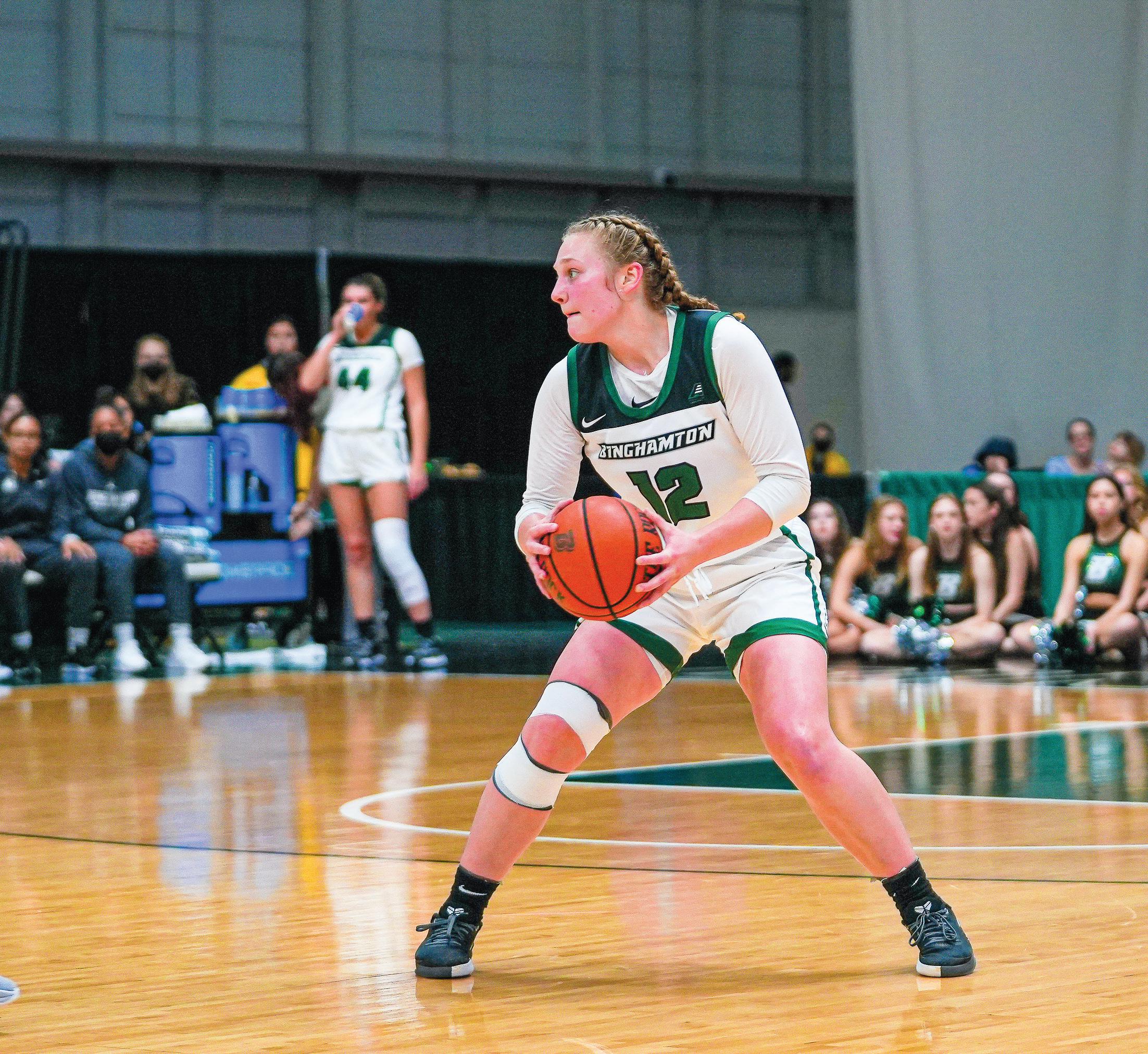
afternoon. Despite a strong first quarter defensively — and a 6-0 run in the final minute — the Bearcats fell short against the River Hawks 62-55.
“I think UMass Lowell came in and they just were swinging,” said Binghamton head coach Bethann Shapiro Ord. “That’s a really good team right there. Their record
does not show what it is, and they came out punching and swinging.”
BU (13-14, 6-8 AE) got off to a strong start on defense, not allowing a single basket in the first five minutes of the game. Senior guard Denai Bowman had two blocks in the first two minutes, as Binghamton’s defense forced eight turnovers in
the opening quarter. This defensive effort allowed the Bearcats to gather a 6-0 lead early on. However, UMass Lowell (3-21, 2-12 AE) made three 3-pointers in the second half of the period, keeping the game close. The Bearcats would finish the frame with a narrow 11-9 lead.
BU opened the second quarter with back-to-back threes from sophomore forward Genevieve Coleman and redshirt freshman guard Ella Wanzer, respectively. Both teams traded baskets after that, until the middle of the period when the River Hawks went on a 9-0 run to tie the game with just under three minutes left in the half.
UMass Lowell continued to pull away in the final minutes of the half, as it finished with a 28-23 lead at the break.
“[UMass Lowell] were doing a good job of attacking the rim, and we stopped attacking the rim,” Shapiro Ord said. “We gotta keep up the intensity.” The second half started with both teams trading baskets, until the River Hawks went on another run at 9-2, giving them a comfortable 11-point lead with 2:50 left in the third. This time, BU responded with free throws from senior guard Clare Traeger and baskets
from Bowman and redshirt freshman guard Jadyn Weltz, cutting the deficit to just five. In the final minute of the frame, UMass Lowell looked to expand its lead with a fast break opportunity. However, Bowman came from behind and blocked it, keeping the game at 43-36 going into the final period.
After a basket from Binghamton to begin the fourth quarter, the River Hawks continued to pull away and extend their lead. With under a minute and a half remaining in the game, the Bearcats trailed by 10 points and looked to make a comeback. After a Weltz basket cut the deficit to eight, steals on back-to-back defensive possessions led to two more scores for BU, cutting the UMass Lowell lead to just four with 30 seconds left. However, the River Hawks were able to sink clutch free throws, pulling away and defeating the Bearcats 62-55.
“We never stopped playing hard,” Shapiro Ord said. “And that’s what we always do and you gotta learn from these [losses].”
Traeger led Binghamton in scoring and rebounding, with 12 points and eight rebounds. She had support from Coleman and Bowman, who tallied 11 and nine
points, respectively. In the loss, the Bearcats had more bench points than the River Hawks, with 20 points off the bench compared to UMass Lowell’s three. Weltz led the bench with 11 points, while Wanzer added five of her own.
“We had [points] off the bench because obviously [we were] starting the seniors,” Shapiro Ord said. “[Weltz] and Ella Wanzer came off the bench. [Wanzer] wasn’t getting a lot of opportunities to score so that was tough, but we’ll just continue to work on moving off the ball and getting her more opportunities.”
Before the game, a pregame ceremony was held in which Binghamton honored its five seniors. This included Traeger, Bowman, guard Zahra Barnes, guard Khoryn Bannis and guard Cassidy Roberts.
“They are amazing young women,” Shapiro Ord said. “The minute they stepped on this campus they changed this community in a great way.”
BU will play its final home game of the season against Vermont on Wednesday, Feb. 22. Tipoff is scheduled for 7 p.m. at the Dr. Bai Lee Court at the Events Center in Vestal, New York.
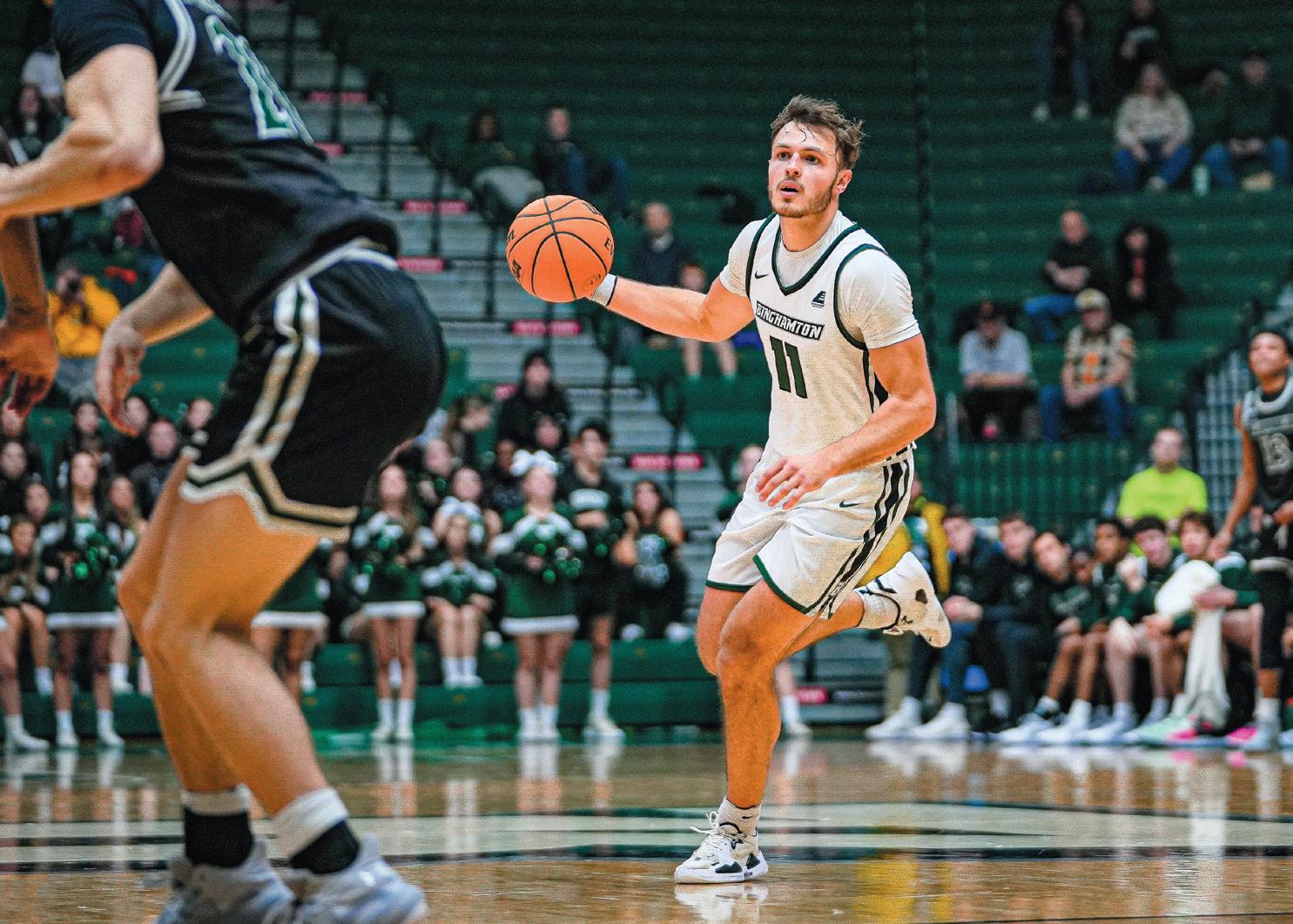 mason brody-lewis assistant photo editor Senior guard Clare Traeger tallied 12 points and eight rebounds in Binghamton’s senior day matchup against UMass Lowell, falling 62-55.
mason brody-lewis assistant photo editor
Senior guard Dan Petcash dropped 21 points in BU’s 84-70 loss against UMass Lowell on Saturday.
mason brody-lewis assistant photo editor Senior guard Clare Traeger tallied 12 points and eight rebounds in Binghamton’s senior day matchup against UMass Lowell, falling 62-55.
mason brody-lewis assistant photo editor
Senior guard Dan Petcash dropped 21 points in BU’s 84-70 loss against UMass Lowell on Saturday.
STREAM ON SPOTIFY Pipe Dream Bearcast
