SWEET TEA CHRONICLES
Second Chance Champs BY JIM DODSON
Photograph By Hannah Sharpe
Four years
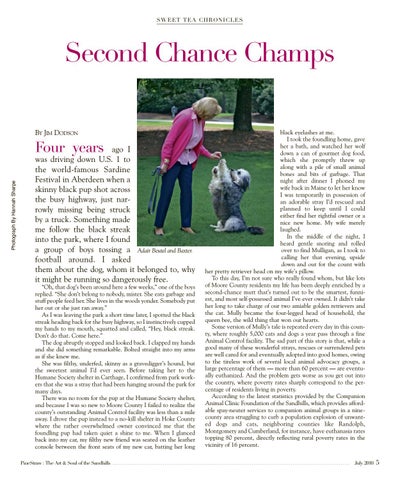
ago I was driving down U.S. 1 to the world-famous Sardine Festival in Aberdeen when a skinny black pup shot across the busy highway, just narrowly missing being struck by a truck. Something made me follow the black streak into the park, where I found a group of boys tossing a Adair Beutel and Baxter. football around. I asked them about the dog, whom it belonged to, why it might be running so dangerously free. “Oh, that dog’s been around here a few weeks,” one of the boys replied. “She don’t belong to nobody, mister. She eats garbage and stuff people feed her. She lives in the woods yonder. Somebody put her out or she just ran away.” As I was leaving the park a short time later, I spotted the black streak heading back for the busy highway, so I instinctively cupped my hands to my mouth, squatted and called, “Hey, black streak. Don’t do that. Come here.” The dog abruptly stopped and looked back. I clapped my hands and she did something remarkable. Bolted straight into my arms as if she knew me. She was filthy, underfed, skinny as a gravedigger’s hound, but the sweetest animal I’d ever seen. Before taking her to the Humane Society shelter in Carthage, I confirmed from park workers that she was a stray that had been hanging around the park for many days. There was no room for the pup at the Humane Society shelter, and because I was so new to Moore County I failed to realize the county’s outstanding Animal Control facility was less than a mile away. I drove the pup instead to a no-kill shelter in Hoke County where the rather overwhelmed owner convinced me that the foundling pup had taken quiet a shine to me. When I glanced back into my car, my filthy new friend was seated on the leather console between the front seats of my new car, batting her long PineStraw : The Art & Soul of the Sandhills
black eyelashes at me. I took the foundling home, gave her a bath, and watched her wolf down a can of gourmet dog food, which she promptly threw up along with a pile of small animal bones and bits of garbage. That night after dinner I phoned my wife back in Maine to let her know I was temporarily in possession of an adorable stray I’d rescued and planned to keep until I could either find her rightful owner or a nice new home. My wife merely laughed. In the middle of the night, I heard gentle snoring and rolled over to find Mulligan, as I took to calling her that evening, upside down and out for the count with her pretty retriever head on my wife’s pillow. To this day, I’m not sure who really found whom, but like lots of Moore County residents my life has been deeply enriched by a second-chance mutt that’s turned out to be the smartest, funniest, and most self-possessed animal I’ve ever owned. It didn’t take her long to take charge of our two amiable golden retrievers and the cat. Mully became the four-legged head of household, the queen bee, the wild thing that won our hearts. Some version of Mully’s tale is repeated every day in this county, where roughly 5,000 cats and dogs a year pass through a fine Animal Control facility. The sad part of this story is that, while a good many of these wonderful strays, rescues or surrendered pets are well cared for and eventually adopted into good homes, owing to the tireless work of several local animal advocacy groups, a large percentage of them — more than 60 percent — are eventually euthanized. And the problem gets worse as you get out into the country, where poverty rates sharply correspond to the percentage of residents living in poverty. According to the latest statistics provided by the Companion Animal Clinic Foundation of the Sandhills, which provides affordable spay-neuter services to companion animal groups in a ninecounty area struggling to curb a population explosion of unwanted dogs and cats, neighboring counties like Randolph, Montgomery and Cumberland, for instance, have euthanasia rates topping 80 percent, directly reflecting rural poverty rates in the vicinity of 16 percent.
................................................................................................................................
July 2010
5