3 Mechanics 3.3 Motion in two and three Dimensions
P2131100
Projectile motion
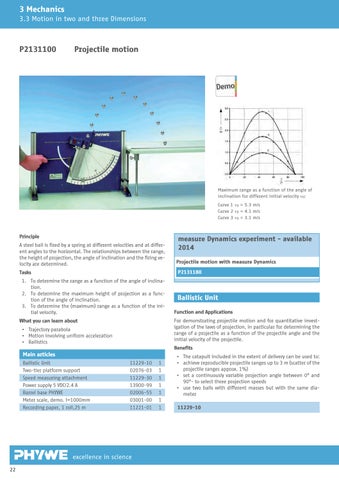
Maximum range as a function of the angle of inclination for different initial velocity v0: Curve 1 v0 = 5.3 m/s Curve 2 v0 = 4.1 m/s Curve 3 v0 = 3.1 m/s
Principle
measure Dynamics experiment - available 2014
A steel ball is fired by a spring at different velocities and at different angles to the horizontal. The relationships between the range, the height of projection, the angle of inclination and the firing velocity are determined.
Projectile motion with measure Dynamics
Tasks
P2131180
1. To determine the range as a function of the angle of inclination. 2. To determine the maximum height of projection as a function of the angle of inclination. 3. To determine the (maximum) range as a function of the initial velocity.
Ballistic Unit Function and Applications For demonstrating projectile motion and for quantitative investigation of the laws of projection, in particular for determining the range of a projectile as a function of the projectile angle and the initial velocity of the projectile.
What you can learn about ▪ Trajectory parabola ▪ Motion involving uniform acceleration ▪ Ballistics
Benefits
Main articles Ballistic Unit Two-tier platform support Speed measuring attachment Power supply 5 VDC/2.4 A Barrel base PHYWE Meter scale, demo. l=1000mm Recording paper, 1 roll,25 m
11229-10 02076-03 11229-30 13900-99 02006-55 03001-00 11221-01
excellence in science 22
1 1 1 1 1 1 1
▪ The catapult included in the extent of delivery can be used to: ▪ achieve reproducible projectile ranges up to 3 m (scatter of the projectile ranges approx. 1%) ▪ set a continuously variable projection angle between 0° and 90°- to select three projection speeds ▪ use two balls with different masses but with the same diameter 11229-10