Electrochemistry
LEC 06
06.22 Electrogravimetric determination of copper What you can learn about Quantitative analysis Electrolysis Gravimetry Overpotential and electrode polarisation
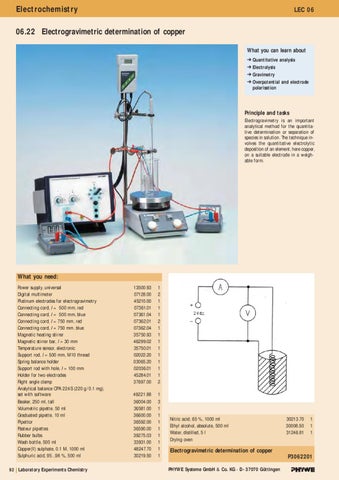
Principle and tasks Electrogravimetry is an important analytical method for the quantitative determination or separation of species in solution. The technique involves the quantitative electrolytic deposition of an element, here copper, on a suitable electrode in a weighable form.
What you need: Power supply, universal Digital multimeter Platinum electrodes for electrogravimetry Connecting cord, l = 500 mm, red Connecting cord, l = 500 mm, blue Connecting cord, l = 750 mm, red Connecting cord, l = 750 mm, blue Magnetic heating stirrer Magnetic stirrer bar, l = 30 mm Temperature sensor, electronic Support rod, l = 500 mm, M10 thread Spring balance holder Support rod with hole, l = 100 mm Holder for two electrodes Right angle clamp Analytical balance CPA 224S (220 g/0.1 mg), set with software
13500.93 07128.00 45210.00 07361.01 07361.04 07362.01 07362.04 35750.93 46299.02 35750.01 02022.20 03065.20 02036.01 45284.01 37697.00
1 2 1 1 1 2 1 1 1 1 1 1 1 1 2
49221.88
1
Beaker, 250 ml, tall Volumetric pipette, 50 ml Graduated pipette, 10 ml Pipettor Pasteur pipettes Rubber bulbs Wash bottle, 500 ml Copper(II) sulphate, 0.1 M, 1000 ml Sulphuric acid, 95…98 %, 500 ml
36004.00 36581.00 36600.00 36592.00 36590.00 39275.03 33931.00 48247.70 30219.50
3 1 1 1 1 1 1 1 1
92 Laboratory Experiments Chemistry
Nitric acid, 65 %, 1000 ml Ethyl alcohol, absolute, 500 ml Water, distilled, 5 l Drying oven
30213.70 30008.50 31246.81
1 1 1
Electrogravimetric determination of copper P3062201 PHYWE Systeme GmbH & Co. KG · D - 37070 Göttingen