2.3 Thermodynamics 2.3.2 Heat, Work, and the First Law of Thermodynamics
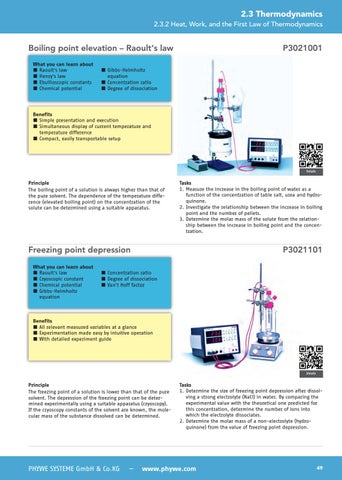
Boiling point elevation – Raoult‘s law What you can learn about ■■ Raoult‘s law ■■ Henry‘s law ■■ Ebullioscopic constants ■■ Chemical potential
P3021001
■■ Gibbs-Helmholtz equation ■■ Concentration ratio ■■ Degree of dissociation
Benefits ■■ Simple presentation and execution ■■ Simultaneous display of current temperature and temperature difference ■■ Compact, easily transportable setup
Details
Principle The boiling point of a solution is always higher than that of the pure solvent. The dependence of the temperature difference (elevated boiling point) on the concentration of the solute can be determined using a suitable apparatus.
Tasks 1. Measure the increase in the boiling point of water as a function of the concentration of table salt, urea and hydroquinone. 2. Investigate the relationship between the increase in boiling point and the number of pellets. 3. Determine the molar mass of the solute from the relationship between the increase in boiling point and the concentration.
Freezing point depression What you can learn about ■■ Raoult‘s law ■■ Cryoscopic constant ■■ Chemical potential ■■ Gibbs-Helmholtz equation
P3021101
■■ Concentration ratio ■■ Degree of dissociation ■■ Van‘t Hoff factor
Benefits ■■ All relevant measured variables at a glance ■■ Experimentation made easy by intuitive operation ■■ With detailed experiment guide
Details
Principle The freezing point of a solution is lower than that of the pure solvent. The depression of the freezing point can be determined experimentally using a suitable apparatus (cryoscopy). If the cryoscopy constants of the solvent are known, the molecular mass of the substance dissolved can be determined.
PHYWE SYSTEME GmbH & Co.KG —
Tasks 1. Determine the size of freezing point depression after dissolving a strong electrolyte (NaCl) in water. By comparing the experimental value with the theoretical one predicted for this concentration, determine the number of ions into which the electrolyte dissociates. 2. Determine the molar mass of a non-electrolyte (hydroquinone) from the value of freezing point depression.
www.phywe.com
49