2.3 Thermodynamics 2.3.2 Heat, Work, and the First Law of Thermodynamics
Joule-Thomson effect What you can learn about ■■ Real gas ■■ Intrinsic energy ■■ Gay-Lussac theory ■■ Throttling ■■ Van der Waals equation ■■ Van der Waals force
P2320600
■■ Inverse Joule-Thomson effect ■■ Inversion temperature
Benefits ■■ For both demonstration and student experiments ■■ With detailed experiment guide ■■ Affordable set-up
Details
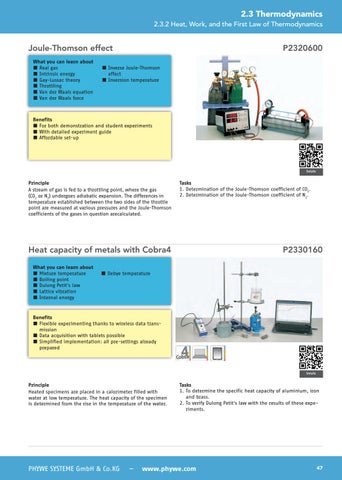
Principle A stream of gas is fed to a throttling point, where the gas (CO2 or N2) undergoes adiabatic expansion. The differences in temperature established between the two sides of the throttle point are measured at various pressures and the Joule-Thomson coefficients of the gases in question arecalculated.
Tasks 1. Determination of the Joule-Thomson coefficient of CO2. 2. Determination of the Joule-Thomson coefficient of N2.
Heat capacity of metals with Cobra4 What you can learn about ■■ Mixture temperature ■■ Boiling point ■■ Dulong Petit‘s law ■■ Lattice vibration ■■ Internal energy
P2330160
■■ Debye temperature
Benefits ■■ Flexible experimenting thanks to wireless data transmission ■■ Data acquisition with tablets possible ■■ Simplified implementation: all pre-settings already prepared
Details
Principle Heated specimens are placed in a calorimeter filled with water at low temperature. The heat capacity of the specimen is determined from the rise in the temperature of the water.
PHYWE SYSTEME GmbH & Co.KG —
Tasks 1. To determine the specific heat capacity of aluminium, iron and brass. 2. To verify Dulong Petit‘s law with the results of these experiments.
www.phywe.com
47