2.1 Mechanics 2.1.4 Rotational Motion
Mechanical conservation of energy / Maxwell‘s wheel
What you can learn about ■■ Maxwell disc ■■ Energy of translation and rotation ■■ Potential energy ■■ Moment of inertia
P2131800
■■ Angular velocity and acceleration ■■ Instantaneous velocity Gyroscope
Benefits ■■ High and sturdy set-up ■■ Expressive demonstration of energy conversion ■■ Convert potential energy in energy of rotation, energy of translation, and vice versa
Details
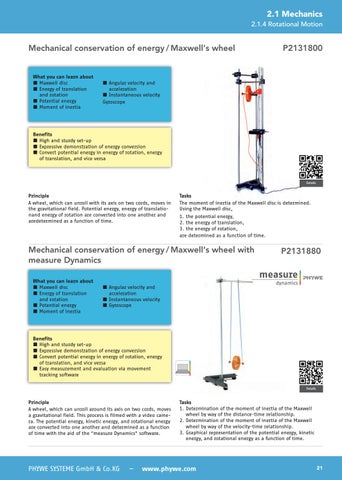
Principle A wheel, which can unroll with its axis on two cords, moves in the gravitational field. Potential energy, energy of translationand energy of rotation are converted into one another and aredetermined as a function of time.
Tasks The moment of inertia of the Maxwell disc is determined. Using the Maxwell disc, 1. the potential energy, 2. the energy of translation, 3. the energy of rotation, are determined as a function of time.
Mechanical conservation of energy / Maxwell‘s wheel with measure Dynamics What you can learn about ■■ Maxwell disc ■■ Energy of translation and rotation ■■ Potential energy ■■ Moment of inertia
P2131880
measure dynamics
■■ Angular velocity and acceleration ■■ Instantaneous velocity ■■ Gyroscope
Benefits ■■ High and sturdy set-up ■■ Expressive demonstration of energy conversion ■■ Convert potential energy in energy of rotation, energy of translation, and vice versa ■■ Easy measurement and evaluation via movement tracking software Details
Principle A wheel, which can unroll around its axis on two cords, moves a gravitational field. This process is filmed with a video camera. The potential energy, kinetic energy, and rotational energy are converted into one another and determined as a function of time with the aid of the “measure Dynamics“ software.
PHYWE SYSTEME GmbH & Co.KG —
Tasks 1. Determination of the moment of inertia of the Maxwell wheel by way of the distance-time relationship. 2. Determination of the moment of inertia of the Maxwell wheel by way of the velocity-time relationship. 3. Graphical representation of the potential energy, kinetic energy, and rotational energy as a function of time.
www.phywe.com
21