Gastroenterology Practice Consolidation: Q&A with Drs. James Weber and Michael Weinstein
By Scott Fraser, President, PE Gastro
As president of PE Gastro, a new division of Physicians Endoscopy, I have the opportunity to work with a team of healthcare management professionals focused on the administrative side of private practice gastroenterology. My 20-plus years in the GI space has provided a unique opportunity to partner with many leading gastroenterologists and witness firsthand about what has made their respective groups thrive in this ever-changing healthcare environment. Although there are many top private gastroenterology groups around the country, two physicians who stand out for their leadership and vision for the future of gastroenterology are Drs. James Weber and Michael Weinstein. Dr. Weber is the president and chief executive officer of Texas Digestive Disease Consultants (TDDC). He formed TDDC in 1995 by bringing together a dozen doctors from several different groups in the Dallas area. Over the next 15 years, the super group grew close to 40 doctors. It was in 2010 when
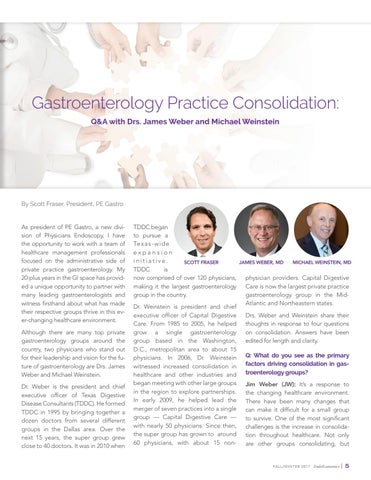
TDDC began to pursue a Te x a s - w i d e expansion initiative. SCOTT FRASER TDDC is now comprised of over 120 physicians, making it the largest gastroenterology group in the country. Dr. Weinstein is president and chief executive officer of Capital Digestive Care. From 1985 to 2005, he helped grow a single gastroenterology group based in the Washington, D.C., metropolitan area to about 15 physicians. In 2006, Dr. Weinstein witnessed increased consolidation in healthcare and other industries and began meeting with other large groups in the region to explore partnerships. In early 2009, he helped lead the merger of seven practices into a single group — Capital Digestive Care — with nearly 50 physicians. Since then, the super group has grown to around 60 physicians, with about 15 non-
JAMES WEBER, MD
MICHAEL WEINSTEIN, MD
physician providers. Capital Digestive Care is now the largest private practice gastroenterology group in the MidAtlantic and Northeastern states. Drs. Weber and Weinstein share their thoughts in response to four questions on consolidation. Answers have been edited for length and clarity. Q: What do you see as the primary factors driving consolidation in gastroenterology groups? Jim Weber (JW): It’s a response to the changing healthcare environment. There have been many changes that can make it difficult for a small group to survive. One of the most significant challenges is the increase in consolidation throughout healthcare. Not only are other groups consolidating, but
FAL L /WI NTE R 2 0 1 7 EndoEconomics
| 5