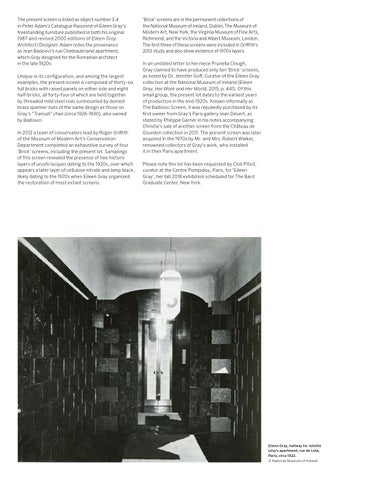
The present screen is listed as object number 3.4 in Peter Adam’s Catalogue Raisonné of Eileen Gray’s freestanding furniture published in both his original 1987 and revised 2000 editions of Eileen Gray: Architect/Designer. Adam notes the provenance as Jean Badovici’s rue Chateaubriand apartment, which Gray designed for the Romanian architect in the late 1920s. Unique in its confguration, and among the largest examples, the present screen is composed of thirty-six full bricks with raised panels on either side and eight half-bricks, all forty-four of which are held together by threaded mild steel rods surmounted by domed brass spanner nuts of the same design as those on Gray’s “Transat” chair (circa 1926-1930), also owned by Badovici. In 2012 a team of conservators lead by Roger Grifth of the Museum of Modern Art’s Conservation Department completed an exhaustive survey of four ‘Brick’ screens, including the present lot. Samplings of this screen revealed the presence of two historic layers of urushi lacquer dating to the 1920s, over which appears a later layer of cellulose nitrate and lamp black, likely dating to the 1970s when Eileen Gray organized the restoration of most extant screens.
‘Brick’ screens are in the permanent collections of the National Museum of Ireland, Dublin; The Museum of Modern Art, New York; the Virginia Museum of Fine Arts, Richmond; and the Victoria and Albert Museum, London. The frst three of these screens were included in Grifth’s 2012 study and also show evidence of 1970s layers. In an undated letter to her niece Prunella Clough, Gray claimed to have produced only ten ‘Brick’ screens, as noted by Dr. Jennifer Gof, Curator of the Eileen Gray collection at the National Museum of Ireland (Eileen Gray, Her Work and Her World, 2015, p. 441). Of this small group, the present lot dates to the earliest years of production in the mid-1920s. Known informally as The Badovici Screen, it was reputedly purchased by its frst owner from Gray’s Paris gallery Jean Désert, as stated by Philippe Garner in his notes accompanying Christie’s sale of another screen from the Château de Gourdon collection in 2011. The present screen was later acquired in the 1970s by Mr. and Mrs. Robert Walker, renowned collectors of Gray’s work, who installed it in their Paris apartment. Please note this lot has been requested by Cloé Pitiot, curator at the Centre Pompidou, Paris, for ‘Eileen Gray’, her fall 2018 exhibition scheduled for The Bard Graduate Center, New York.
Eileen Gray, hallway for Juliette Lévy’s apartment, rue de Lota, Paris, circa 1922. © National Museum of Ireland.
UK DESIGN EVENING_APR16_2-83.indd 38
31/03/16 23:52