and commercial surroundings through the medium of collage. Kruger’s artwork features strong similarities to Höch’s collages, constructed by images taken from popular publications, magazines and journals, and critiquing the social and political landscape to which she was subjugated, using satire to challenge the social status of women, and ultimately setting the course for post-modern conceptual artists. Both artist’s use photomontage to expose, critique and mock the ideological purposes of consumer publications. Kruger, assumes both visual and conceptual resemblances to Höch, addressing the cultural construct of power, whilst also using pop culture images appropriated from the public sphere, and redefning their context.
‘I’m interested in pictures and words because they have specific powers to define who we are and who we aren’t.’ Barbara Kruger
Kruger’s remarkable corpus, spanning four decades, is decidedly political. The artist’s command of media techniques, combined with poetic and linguistic fair, facilitates her ability to produce artwork which transcends the impenetrable boundaries of patriarchal culture. ‘The quotational qualities of these words and pictures remove them and their ‘originals’ from the seemingly natural position within the fow of dominant social directives, into the realm of commentary’. (Barbara Kruger quoted in Kate Linker, ‘Early Work’, in Charles Miers, ed., Love for Sale: The Words and Pictures of Barbara Kruger, New York, 1990, p. 17).
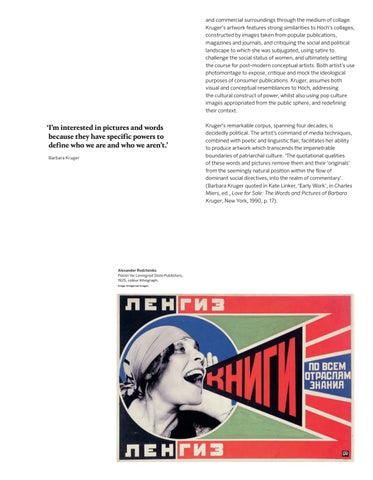
Alexander Rodchenko Poster for Leningrad State Publishers, 1925, colour lithograph. Image: Bridgeman Images.
UK_TCA Eve Sale_OCT18_116-175.indd 153
17/09/18 11:38