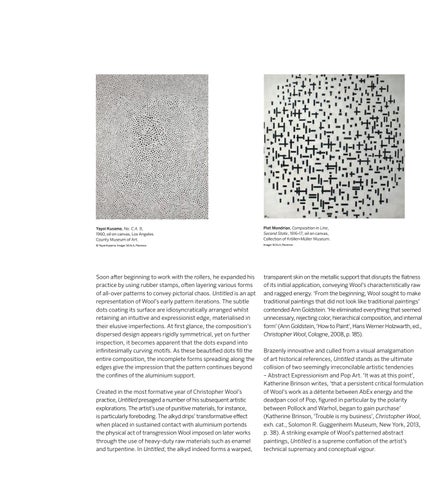
Yayoi Kusama, No. C.A. 9, 1960, oil on canvas, Los Angeles County Museum of Art.
Piet Mondrian, Composition in Line, Second State, 1916-17, oil on canvas, Collection of Kröller-Müller Museum.
© Yayoi Kusama. Image: SCALA, Florence.
Image: SCALA, Florence.
Soon afer beginning to work with the rollers, he expanded his practice by using rubber stamps, ofen layering various forms of all-over patterns to convey pictorial chaos. Untitled is an apt representation of Wool’s early pattern iterations. The subtle dots coating its surface are idiosyncratically arranged whilst retaining an intuitive and expressionist edge, materialised in their elusive imperfections. At frst glance, the composition’s dispersed design appears rigidly symmetrical, yet on further inspection, it becomes apparent that the dots expand into infnitesimally curving motifs. As these beautifed dots fll the entire composition, the incomplete forms spreading along the edges give the impression that the pattern continues beyond the confnes of the aluminium support.
transparent skin on the metallic support that disrupts the fatness of its initial application, conveying Wool’s characteristically raw and ragged energy. ‘From the beginning, Wool sought to make traditional paintings that did not look like traditional paintings’ contended Ann Goldstein. ‘He eliminated everything that seemed unnecessary, rejecting color, hierarchical composition, and internal form’ (Ann Goldstein, ‘How to Paint’, Hans Werner Holzwarth, ed., Christopher Wool, Cologne, 2008, p. 185).
Created in the most formative year of Christopher Wool’s practice, Untitled presaged a number of his subsequent artistic explorations. The artist’s use of punitive materials, for instance, is particularly foreboding. The alkyd drips’ transformative efect when placed in sustained contact with aluminium portends the physical act of transgression Wool imposed on later works through the use of heavy-duty raw materials such as enamel and turpentine. In Untitled, the alkyd indeed forms a warped,
Brazenly innovative and culled from a visual amalgamation of art historical references, Untitled stands as the ultimate collision of two seemingly irreconcilable artistic tendencies – Abstract Expressionism and Pop Art. ‘It was at this point’, Katherine Brinson writes, ‘that a persistent critical formulation of Wool’s work as a détente between AbEx energy and the deadpan cool of Pop, fgured in particular by the polarity between Pollock and Warhol, began to gain purchase’ (Katherine Brinson, ‘Trouble is my business’, Christopher Wool, exh. cat., Solomon R. Guggenheim Museum, New York, 2013, p. 38). A striking example of Wool’s patterned abstract paintings, Untitled is a supreme confation of the artist’s technical supremacy and conceptual vigour.